The Trump administration just laundered its bogus energy affordability talking points through Politico’s White House team
Despite extensive evidence to the contrary, the White House wants us to think it cares about energy affordability. Based on the Trump administration's actions over the past year, don’t believe the spin.

Quitting Carbon is a 100% subscriber-funded publication. To support my work, please consider becoming a paid subscriber or making a one-time donation.
The credulous headline is the tell.
Given an “exclusive” by the White House, Politico returned the favor by giving the administration the gift of its perfect, preferred headline.
“Inside the White House obsession with reducing energy prices,” reads a story published last week.
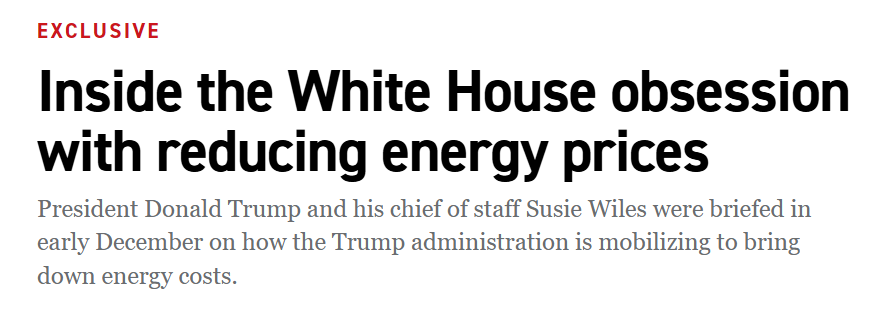
“Obsession” is Politico’s choice of word. No Trump administration official is quoted using the word in the story.
So, what is the basis for the declaration that the White House is newly laser-focused on energy affordability?
“The White House has zeroed in on energy prices as a political and economic pressure point heading into this year’s midterms, ordering an all-of-government accounting of how the administration can make electricity cheaper for American households,” write Sophia Cai and Cheyenne Haslett.
“In early December, officials across the government were asked to assemble a comprehensive briefing on the administration’s actions on energy affordability – a sign that lowering electricity and fuel costs has become a top priority for President Donald Trump with control of the House on the line as midterm elections approach,” they add.
Had Politico assigned the story to its laudable E&E News team, the energy policy reporters there would have challenged the administration’s spin. Instead, we are delivered White House talking points from two political reporters – Cai is a White House reporter and co-author of West Wing Playbook and Haslett recently joined Politico’s White House team to help lead its health care and technology policy coverage.
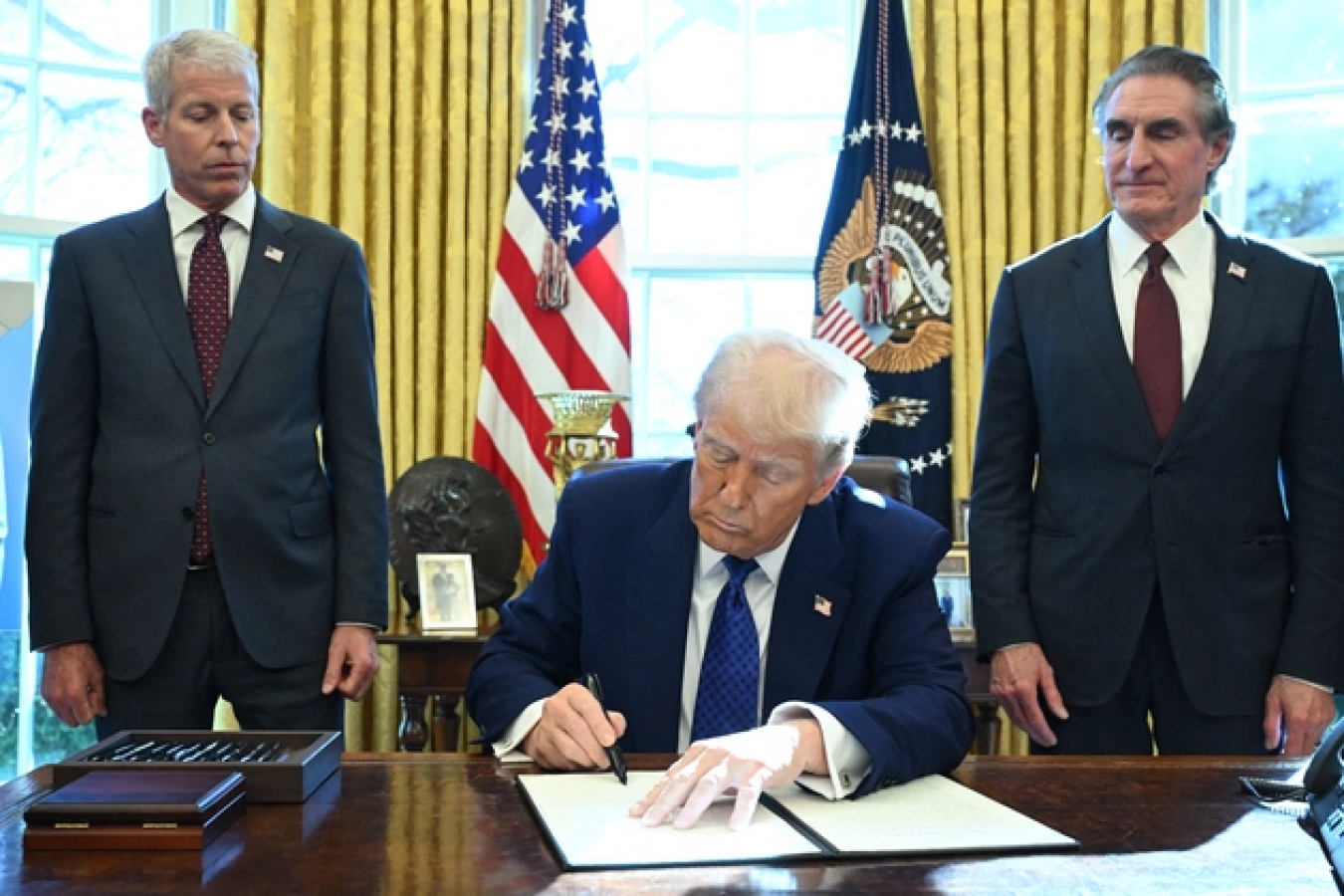
From the pair, we learn that Energy Secretary Chris Wright, Interior Secretary Doug Burgum, and White House’s National Energy Dominance Council Executive Director Jarrod Agen recently briefed President Trump and Chief of Staff Susie Wiles on “the administration’s strategy and upcoming actions.”
“Those steps include small bore items like rolling back appliance efficiency standards – a nod to Trump’s obsession with criticizing things like low-flow toilets – to major efforts aimed at boosting power generation, easing grid constraints and cutting regulatory compliance costs, according to notes on the briefing obtained by POLITICO,” write Cai and Haslett.
Hmmm. At this point you, my knowledgeable readers, might be thinking to yourself, Wait a minute, I thought the goal was to lower energy prices.
Let’s take those steps one at a time.
“Rolling back appliance efficiency standards”
You mean the standards that are saving U.S. households more than $500 annually on energy and water bills? And future standards that could have saved households an average of $150 annually on their utility bills from 2030 to 2050?
“Boosting power generation”
Really? When the Trump administration is doing everything it can to thwart the rollout of the cheapest new electricity available with its war on wind and solar power?
The administration is trying to kill all the offshore wind projects under construction on the East Coast, even though, as I’ve cited before, the deployment of offshore wind will save households money by displacing volatile fossil gas.
A July 2025 memo signed by Burgum requiring “elevated” review for each step of renewable project development has resulted in a near de facto moratorium on approvals for wind and solar projects on federal land.
Nevertheless, the words “solar,” “wind,” and “renewables” do not appear once in Cai and Haslett’s story.
“Easing grid constraints”
The grid constraints that would have been alleviated by projects like the Grain Belt Express transmission line that aims to unlock new wind and solar power capacity in Kansas and Missouri?
I guess not because the Trump administration’s Loan Programs Office (since renamed the Office of Energy Dominance Financing) terminated a loan guarantee for the $5 billion project last July.
Three months later, the Energy Department terminated hundreds of grants, including for projects supported by the Grid Deployment Office. On Monday, a federal judge in Washington, D.C., ruled the administration’s decision to cancel the grants unlawful.
“Cutting regulatory compliance costs”
Just not for renewables projects. The Interior Department saw to this when it moved last May to rescind Biden administration-era rules that slashed fees by as much as 80% for renewable energy projects on federal lands.
“Beyond appliances,” write Cai and Haslett, “steps the administration is taking include invoking emergency authorities to prevent the retirement of power plants deemed critical to grid reliability, and reversing Biden-era policies that administration officials say drove up costs without clear consumer benefits.”
Again, let’s address these steps in turn.
“Invoking emergency authorities to prevent the retirement of power plants”
I thought the purpose of these steps was to lower costs.
The Department of Energy’s orders to force coal plants to stay open beyond their scheduled closures are already costing consumers hundreds of millions of dollars.
“The DOE already extended its order to keep Michigan’s JH Campbell coal plant running even though it cost consumers $164 million to keep it running over just four months,” writes Greg Alvarez at The Power Line, the newsletter of the think tank Energy Innovation.
“Additional DOE orders to force coal plants to stay online could increase consumer costs $3 to $5 billion annually,” he adds.
“Reversing Biden-era policies that administration officials say drove up costs without clear consumer benefits”
How about $5 trillion in benefits? That’s what a Princeton University study found in an assessment of fuel cost savings since the launch of the federal government’s CAFE fuel economy standards in 1975.
And what about the more stringent CAFE standards adopted by the Biden administration that Trump 2.0 is working to roll back?
“Those standards would have delivered more than $23 billion in fuel savings, reduced national gasoline consumption by nearly 70 billion gallons, and saved the average driver hundreds of dollars over the lifetime of a vehicle,” according to the Southwest Energy Efficiency Project.
Even so, Cai and Haslett write, with no supporting evidence, that “while regulatory rollbacks can help lower long-term costs [emphasis added], they rarely produce immediate, visible savings on monthly bills.”
“The White House is betting that a visible, aggressive focus on energy will resonate with voters uneasy about costs, and that incremental savings, combined with a broader affordability message, will help Republicans’ chances heading into November,” they write.
The White House is also betting it can continue to bait credulous editors eager for a scoop into turning its talking points into favorable coverage.
Journalists are supposed to separate the signal from the noise.
In this case, that means an obligation to tell readers that the Trump administration’s “broader affordability message” is a sham.