What I’m reading: China's e-truck boom, UK to require solar and heat pumps in new homes, state building energy codes threatened, and more
Quitting Carbon's biweekly roundup of energy transition developments you might have missed.


Quitting Carbon is a 100% reader-supported publication. Support independent energy journalism by becoming a paid subscriber or making a one-time donation.
Welcome back to another roundup of highlights from what I’ve been reading.
I’ll be in San Diego next week for ARPA-E's Energy Innovation Summit. If you'll be there, too, find me to say hello or grab coffee. Thanks, as always, for reading.
China’s e-truck boom
In a recent roundup, I wrote about the “tectonic shift underway” because of China’s EV initiative.
Most coverage of China’s electric vehicles boom focuses on passenger cars. For good reason, EVs now comprise half the new vehicle market in China and exports to Southeast Asia, Latin America, Australia, Africa, and Europe are surging.
But equally remarkable is the J-shaped rollout of electric heavy-duty trucks in the country.
“Almost 30% of new heavy trucks sold in China last year were new-energy models, compared to Europe’s 4%, while sales in California – the leading US e-truck market – remains in the hundreds, according to Rystad Energy,” writes Semafor’s Xiaoying You.
China’s rapid adoption of e-trucks “leaves the rest of the world in the dust,” Pei Zhao, a postdoctoral fellow at the Massachusetts Institute of Technology, told You.
“Truck makers, benefiting from a huge domestic market and tight-knit supply chains, are expanding as far afield as South Africa and Europe. This shift has far-reaching consequences for China, the world’s biggest fossil fuel importer: By 2030, the rollout of e-trucks is projected to lead to a 20% drop in Chinese diesel demand,” she writes.
Renewable energy is a competitive advantage – part II
In a roundup published last summer, I wrote about how the availability of cheap, plentiful renewable electricity was sparking a rebirth of industry in South Australia, one of the world’s leading clean energy economies, as large energy users flocked to the state.
Wind and solar projects supply about 75% of the annual electricity demand in South Australia, which is on pace to meet its target of 100% net renewables by the end of next year.
A new report from the state transmission company ElectraNet documents how this clean energy boom is building momentum for more renewables deployment and economic growth.
“Peak demand in South Australia is expected to double over the next 15 years as industry flocks to the state, attracted by its high level of renewables and its unique status as the world’s first gigawatt-scale grid to reach 100 per cent net renewables,” writes Giles Parkinson at Renew Economy.
ElectraNet says the state “is on the verge of a ‘once-in-a-generation’ economic growth opportunity, underpinned by low cost, reliable and green grid,” he adds.
“South Australia is facing a jobs boom as industries seek to access the state’s unique combination of valuable minerals and world-class wind and solar renewable energy. As industries such as mining, steelmaking, defence and AI expand, the demand for electricity in the state is set to grow significantly,” ElectraNet CEO Simon Emms said in a statement.
UK to require solar, heat pumps in most new homes
In my last roundup, I mentioned that the UK's Labour government would soon unveil its long-awaited plan to decarbonize new homes. That plan, the Future Homes and Buildings Standard, was released last Tuesday.
Under the regulations, “most newly built homes will come equipped with solar panels and heat pumps from March 2028,” reports the Guardian’s Fiona Harvey. “Homes built from 2028 will produce 75% less greenhouse gas emissions than those built according to existing 2013 standards.”
Harvey notes, however, that the new rules were expected to take effect next year.
University of Oxford energy expert Jan Rosenow blasted the delay.
“It is outrageous that people will be buying homes that are expensively heated with gas when we have perfectly good technology – heat pumps – that can be installed instead,” he told Harvey.
“Another two years of this really should not be happening. We are in a war, and a most severe energy crisis, and it would be perfectly easy to ensure all new homes have heat pumps now.”
Data from electricity supplier Octopus Energy backs Rosenow's position.
“Octopus Energy has launched a new website displaying both the current and year-long data from every one of its Cosy heat pumps, in what the UK's largest energy provider by customer numbers has touted as a direct challenge to those who are sceptical about the efficacy of green heating technologies,” BusinessGreen's Stuart Stone reported last month.
The most recent data at the Cosy Heat Pump Fleet Performance Dashboard, “shows that at April 2026 tariff rates, 92% of Cosy heat pump customers can heat their home cheaper than with a gas boiler,” according to Octopus Energy.
The company says that heat pump customers “on our Cosy Octopus tariff saved on average £213 [$282] per year vs a gas boiler.”
State building energy codes threatened
Many U.S. states peg their building energy codes to versions of the model codes developed by the American Society of Heating, Refrigerating and Air-Conditioning Engineers (for commercial and large multi-family residential buildings) and the International Energy Conservation Code (for small residential buildings).
The codes establish minimum standards, which are generally strengthened every three years.
I say generally because the American Council for an Energy-Efficient Economy (ACEEE), a nonprofit research organization, warns that a new proposal from International Codes Council, the body that develops the IECC, threatens to weaken state and local building energy codes going forward.
“The organization’s draft scope and intent (S&I) document for the 2030 IECC would allow efficiency requirements to stagnate – or even weaken – raising long-term energy costs for families and businesses, increasing vulnerability to future energy price volatility, and setting a precedent for future cycles,” writes Skye Gruen, ACEEE’s senior manager, buildings program and director of the National Energy Codes Collaborative.
“Buildings built under these codes will be occupied for decades,” she adds, “so decisions made in this cycle will shape energy costs for the people who live and work in them for years to come.”
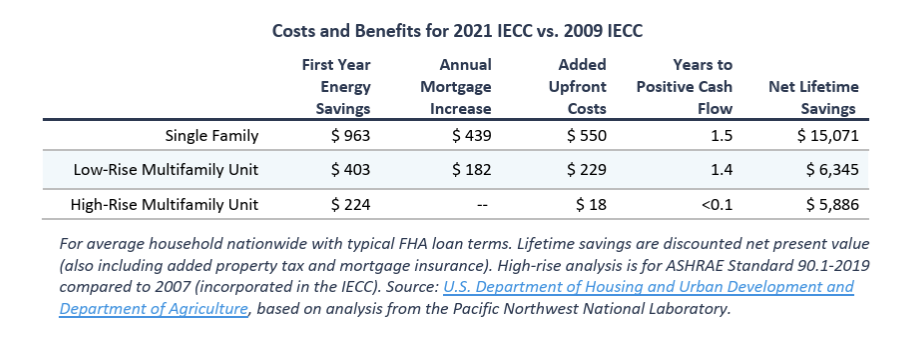
ACEEE cites federal research finding that “a typical household would save a net of $15,000 from a house built to the 2021 IECC compared to one built to the 2009 code.”
Northeast Energy Efficiency Partnerships (NEEP), a Massachusetts-based non-profit, is likewise concerned about the changes proposed for the 2030 IECC. Specifically, NEEP cautions against the floated two-track framework: one code would focus on minimum requirements, the other on advanced measures such as electric-ready and net-zero provisions.
“A divided structure introduces additional complexity, creates uncertainty for state and local adoption, and makes it harder to ensure that forward‑looking measures remain accessible and consistently applied,” writes NEEP's Dragana Thibault.
“A cohesive code also supports the long-standing expectation that each new edition of the IECC represents steady progress in building performance and affordability. States, agencies, and practitioners rely on this continuity to conduct cost-benefit analysis, plan implementation, and maintain alignment across jurisdictions."
Bonus: Drink beer, capture carbon
It’s not often that two of my passions – climate protection and craft beer – come together in the same story.
Almanac Beer Company recently launched Flow – Clean Air Edition, a West Coast Pale Ale, a brew it says is “the world's first beer carbonated using CO₂ captured from the atmosphere through onsite Direct Air Capture.”
“We’re literally taking carbon out of the environment. It’s pretty surreal and amazing,” Damian Fagan, the head of the Almanac Beer Company, told The New York Times’ Rachel Nuwer.
Almanac installed a modular DAC unit from the startup Aircapture at its brewery in Alameda, California, located not far from where I live in Concord, to pull carbon dioxide from ambient air for use in the brewing process.
Aircapture’s DAC units, which capture 100 to 1,000 tons of carbon dioxide per year, aren’t just a more reliable onsite source of CO2, they will save breweries money.
“Liquid carbon dioxide purchased through Aircapture is 15 to 20 percent cheaper than conventional commercial products. That adds up to tens of thousands of dollars in savings over the year,” Fagan told Nuwer. “We’re a small local business, and this is already making a real impact.”
“The fact that this is better for the environment is a great side benefit,” he said.