
What I’m reading: Lowering taxes to electrify industrial heat, high-speed rail update, electric ferries, and Trump slashes energy efficiency programs


Quitting Carbon is a 100% subscriber-funded publication. To support my work, please consider becoming a paid subscriber or making a one-time donation.
Welcome back to another recap of highlights from what I’ve been reading. Enjoy the weekend. And thanks, as always, for reading.
Tweaking taxes to incentivize electrification of industry
Last week, I published my conversation with Industrious Labs’ Teresa Cheng on recently passed legislation that aims to decarbonize the industrial sector in California.
One of the biggest barriers to getting manufacturers off fossil fuels and reducing emissions in the industrial sector, in California and beyond, is expensive electricity.
In new research, Sem Oxenaar and Tom Butler, researchers at the Regulatory Assistance Project, take this issue head on by suggesting policies that could make electricity more competitive in providing clean heat for industrial customers in Europe.
“Electrification of industrial heat is a key route to decarbonisation and modernisation, but, the high price of electricity compared to fossil gas remains a major barrier. Reducing taxes and levies on electricity can quickly and effectively improve incentives to electrify,” argue Oxenaar and Butler.
They recommend two actions for governments to provide cost-relief for industrial heat users.
“First, putting in place immediately a ‘Clean Heat Exemption’ reducing taxes and levies for very-efficient industrial heat pumps and system-serving flexible technologies. And as an extension, to start a process of taxes and levies reform to reduce prices for all industrial end-users.”
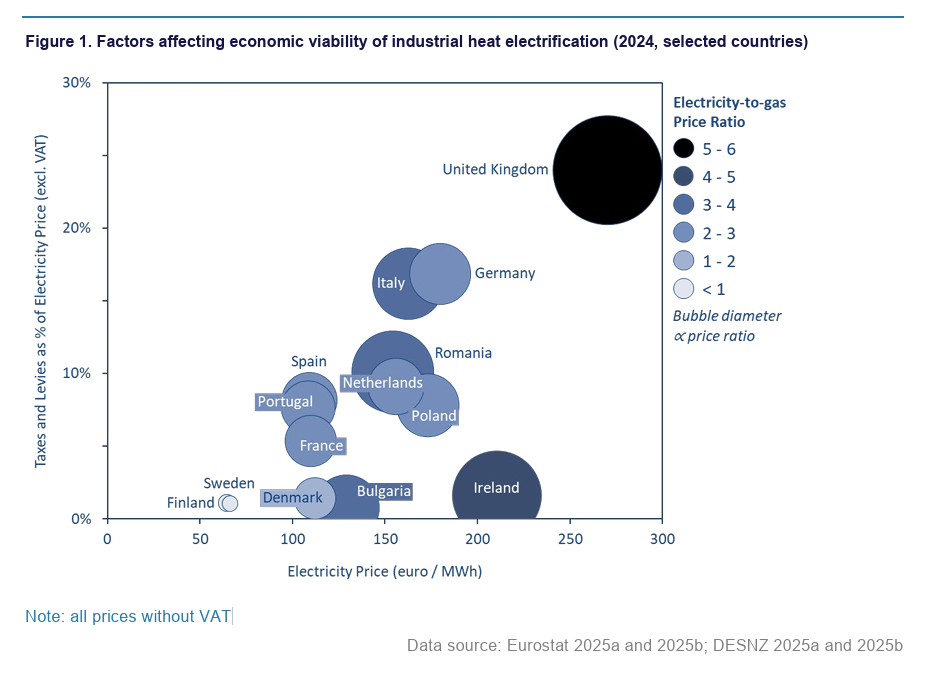
Denmark is one European economy that has already started reducing electricity taxes to incentivize electrification (as illustrated in the chart above). Experts had long urged the Danish government to take this step, as I wrote about in my e-book on the country’s energy transition (published in April 2016).
Now, the Danish government has gone further.
“The government will lower the electricity tax in 2026 and 2027. In fact, they will almost completely eliminate it,” Danish public broadcaster DR reported earlier this year.
“Today, consumers pay 72.7 øre [11 cents USD] per kilowatt-hour, but from January 1, 2026, the tax will drop to just 0.8 øre per [1 cent USD] kilowatt-hour. This corresponds to the EU's minimum tax,” wrote DR’s Dennis Kragelund.
High-speed rail update
California’s high-speed rail project to lay track next year: It’s fair to say that – at least so far – California’s leaders have over promised and under delivered on the state’s high-speed rail system. The planned San Francisco to Los Angeles bullet train is years behind schedule and billions over budget.
And yet, I’m more optimistic now than I’ve ever been the project will actually get built.
The California High-Speed Rail Authority appears to have made a smart hire with the system’s current CEO, Ian Choudri.
Choudri successfully lobbied the Legislature this year to dedicate $1 billion annually from the state’s cap-and-invest program to high-speed rail construction through 2045 – a critical step, he contended, to attract private investors to the project. And he’s been relentlessly focused on finding ways to build faster, control the project’s spiraling costs, and diversify its revenue streams – including potentially leasing land in its right-of-way for data centers.
Despite all the negative press and delays, the public still backs the project. Sixty-two percent of registered California voters support continuing construction on the system, according to a recent poll.
And as anyone who has driven Highway 99 recently through California’s Central Valley can attest, construction is well underway on the project.
Last week, the California High-Speed Rail Authority announced a $3.5 billion Request for Proposals “that will deliver the first true high-speed rail track and systems ever built in the United States.” The Authority plans to begin track installation on the initial 119-mile Central Valley segment next year.
“More than 70 miles of guideway are complete, along with nearly 60 fully completed major structures, and 30 more structures underway across Madera, Fresno, Kings and Tulare counties,” according to the Authority.
And according to an Authority report released in August, passenger service could start on the system’s initial segment by January 1, 2032, “almost two years earlier than the Dec. 31, 2033, deadline the California High-Speed Rail Authority has been working to satisfy in the Central Valley,” reported the Fresno Bee’s Erik Galicia.
China’s high-speed trains squeeze airlines: Why should California persevere in building its high-speed rail system despite all the hurdles and delays? One need only look to China to see what happens when travelers are given the option to ride high-speed trains – fast, convenient electric trains grab market share from fossil fuel-burning planes.
“China’s airlines are stuck in a difficult paradox, according to a new industry report: while their passenger numbers have risen, they are struggling to secure profits as competition intensifies on the most common routes and a world-leading high-speed rail network offers an appealing alternative for many of the country’s travellers,” Mia Nurmamat reported last month for the South China Morning Post.
“The report said the rapid expansion of China’s railway network has fundamentally reshaped domestic travel patterns, pushing airlines into even fiercer competition along their remaining profitable corridors. ‘On many city pairs under 1,000km (621 miles), rail offers faster downtown-to-downtown travel, lower fares and in some cases, higher frequency, eroding the pricing power of airlines,’ it said.”
And China’s world-leading high-speed rail network could get better still.
“Not only does it appear that China has developed maglev trains that will travel up to 370 mph, but they’ve figured out how to silence the resulting ‘tunnel booms’ that were long viewed as a barrier to widespread adoption,” CoMotion News’ Jack Craver reported recently.
“Researchers have figured out that putting soundproofing buffers at the mouths of tunnels can reduce the shock waves by 96%. Though no formal routes have been planned, it is widely expected that one will eventually connect Beijing and Shanghai, reducing the travel time from 4.5 hours to 2.5 hours – comparable to a flight but without all the hassle and waiting that air travel requires.”
Travel times could be slashed in Europe, too, with a €345 billion ($402 billion) rail plan announced by the European Commission last month.
The plan “set a goal that all major hubs in the European Union be linked by train services running at least 200 kilometers per hour (125 miles per hour) by 2040, with many services surpassing 250 kph (155 mph),” writes Bloomberg CityLab’s Feargus O'Sullivan.
“If fully realized, the time savings offered by this upgrade and expansion would be spectacular: Trains from Berlin to Copenhagen would take four hours instead of the current seven, journey times between Warsaw and Vienna would fall to four hours and 15 minutes instead of the current seven and a half hours, while travel times between Madrid and Lisbon would drop by two-thirds, to three hours from the current nine.”
Meanwhile, Amtrak recently celebrated the arrival of upgraded, next-generation Acela trains on its Northeast Corridor service that will top out at just 160 mph – 10 mph faster than existing Acela trains.
Nevertheless, Americans are still eager to ride trains. Despite having nothing in its system approaching true high-speed rail outside of the Northeast Corridor, Amtrak set ridership (34.5 million rider trips) and ticket revenue ($2.7 billion) records in the fiscal year ending on September 30.
Electrification at sea – ferries and tugboats
At sea, cheaper, more powerful batteries are unlocking opportunities to electrify ferries and tugboats at ports and harbors around the world.
Australian shipbuilder Incat Tasmania is designing and building two new battery electric ferries for Danish ferry operator Molslinjen. “The two new ferries, which will operate on the busy Kattegat route between Jutland and Zealand, will each measure 129 metres in length and be powered by approximately 45,000 kWh battery systems,” writes The Driven’s Joshua S. Hill.
In San Diego, California, “two long-running, diesel-powered ferry boats used by the San Diego-Coronado Ferry will soon be replaced by fully electric boats. Flagship Enterprises, which operates the ferry, estimates the new boats will be ready to take over in fall 2026,” reports the San Diego Union-Tribune’s David Garrick.
New York City launched its first hybrid-electric ferry, the Harbor Charger, in August. “The boat is the first of its kind in New York state – and it’s one of only a handful of hybrid-electric ferries to operate nationwide,” writes Canary Media’s Maria Gallucci.
Washington State Ferries (WSF), which operates the US' largest ferry system, plans to operate a fully hybrid-electric fleet by 2040. The transition to emission-free service includes "converting six existing vessels to hybrid-electric power, building 16 new hybrid-electric vessels and adding shore charging to 16 terminals," according to WSF. Terminal electrification will start at Colman Dock in Seattle next year.
And in Perth, Western Australia, transportation officials recently announced plans “to expand ferry services on the Swan River in the south of Perth, with five new electric ferries and a new ferry terminal capable of delivering high voltage charging,” reports The Driven’s Hill.
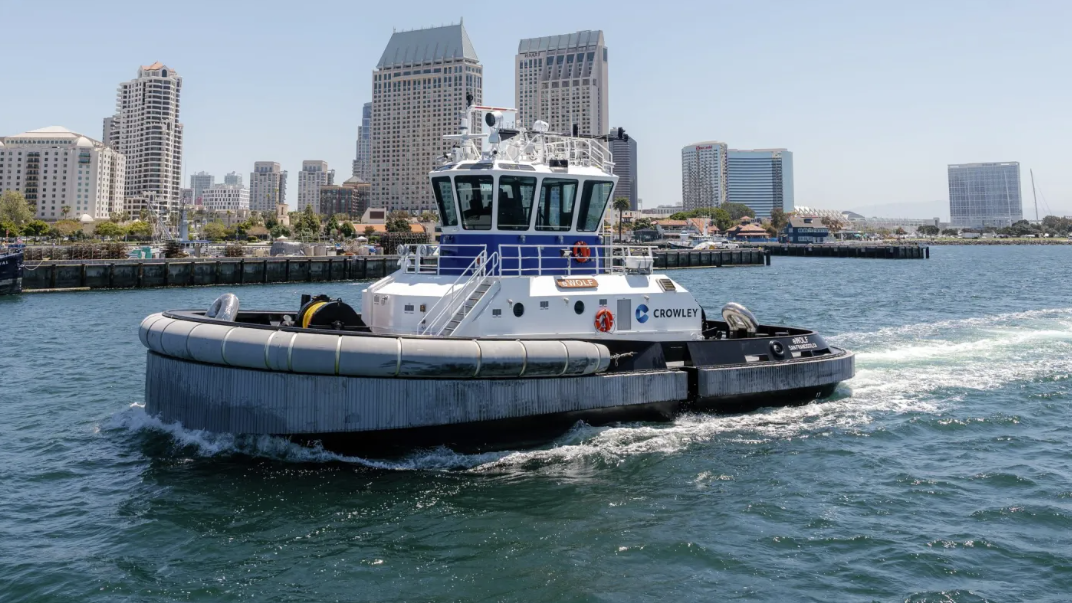
Ports in California are welcoming electric tugboats, too. The eWolf, the US’ first all-electric tugboat, was christened last summer and is operating on San Diego Bay. Los Angeles startup Arc Boats recently signed a $160 million deal to supply electric tugboats to Curtin Maritime. “The new hybrid-electric tugs are expected to hit the waters around the Los Angeles port in 2027. Curtin has ordered eight tugs – at around $20 million apiece – and Arc will build them in conjunction with Snow & Co. shipyard,” writes TechCrunch’s Sean O'Kane.
Trump wants more energy, so why is he slashing energy efficiency programs?
It’s a paradox. The Trump administration has declared a “National Energy Emergency,” as it wages a war against wind and solar power. And the administration that purports to be so concerned about securing enough electricity to meet surging demand from data centers is making it harder to save energy, too.
Energy Wire’s Brian Dabbs published a helpful rundown this week of the administration’s efforts to dismantle programs that reduce electricity demand:
“The Department of Energy has scrapped its energy efficiency office and is rolling back regulations in its appliance standard program, which forces manufacturers to increase efficiency levels for household products and industrial equipment. The agency is also proposing to eliminate the Weatherization Assistance Program, a half-century-old initiative that subsidizes equipment efficiency upgrades for low-income households. EPA is waffling on whether to continue Energy Star, a program that certifies efficient household equipment and buildings. And Trump’s One Big Beautiful Bill Act quickened the expiration of tax credits for residential energy efficient upgrades.”
Republicans in the House are also attempting to weaken energy efficiency programs.
Robert Walton reported at Utility Dive last month that a House subcommittee had “advanced several pieces of legislation to weaken energy efficiency programs, cancel standards for manufactured homes and eliminate some home rebates, building codes and job training programs.”
But at least one critical efficiency program may be granted a reprieve.
On Wednesday, “the full House Energy & Commerce Committee unanimously advanced bipartisan legislation to reauthorize the Weatherization Assistance Program (WAP) through 2030 in a 50-0 vote,” according to a Building Performance Association press release.
“The compromise bill would ensure the Department of Energy remains statutorily required to continue to operate WAP,” the Association added.