
What I’m reading: UK unveils Warm Homes Plan, U.S. and global transit expansion, research roundup, and more


Quitting Carbon is a 100% subscriber-funded publication. To support my work, please consider becoming a paid subscriber or making a one-time donation.
Welcome back to another recap of highlights from what I’ve been reading. These roundups typically arrive in your inbox every other Friday. But the holiday as well as a few events on my calendar last week pushed this issue to today. Thanks for your patience.
And thanks, as always, for reading and sharing this newsletter.
UK government unveils the “Warm Homes Plan”
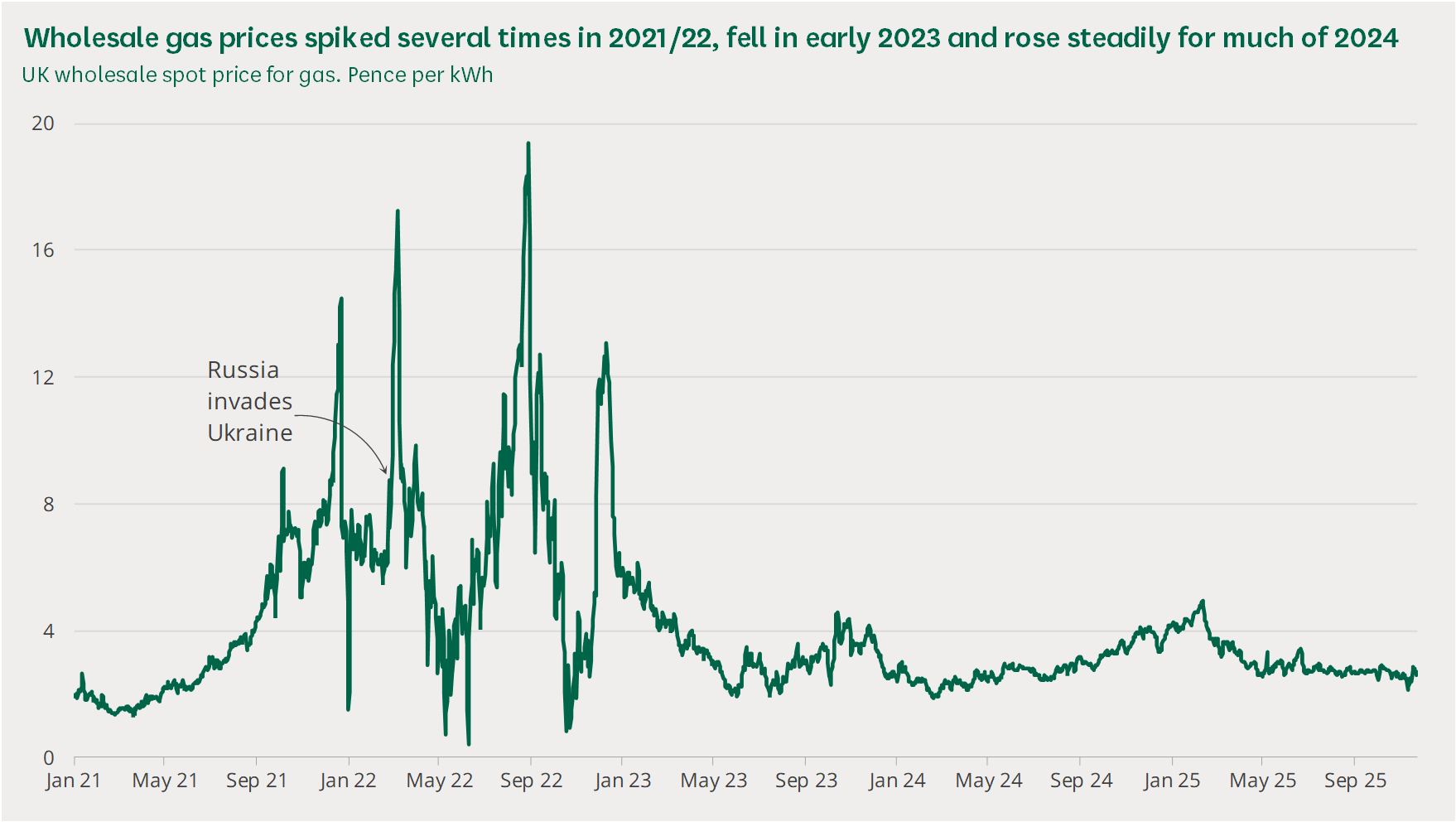
UK energy prices started to rise in the summer of 2021 as fossil fuel demand began to recover after Covid-19 lockdowns. Prices, especially for wholesale gas, surged again in the wake of Russia’s invasion of Ukraine in February 2022.
Nearly four years on, UK households are still grappling with stubbornly high utility bills.
Last week, the country’s Labour government published a £15 billion ($20.2 billion) “Warm Homes Plan” designed to reduce bills by incentivizing households to install solar panels, batteries, and heat pumps.
“The Warm Homes Plan will deliver £15 billion of public investment, roll out upgrades to up to 5 million homes that could save them hundreds on energy bills and help to lift up to a million families out of fuel poverty by 2030,” according to a Department for Energy Security and Net Zero press release.
Reporting for the Guardian, Fiona Harvey and Jillian Ambrose note that the plan does not include a phaseout date for fossil gas boilers.
“Labour’s principal attempt to solve the UK’s cost of living crisis, the £15bn warm homes plan, will overhaul 5m dwellings, aiming to cut energy bills by as much as £1,000 a year, in the biggest public investment yet made into home upgrades,” they write.
Harvey and Ambrose report that the plan comprises five schemes in England:
“£5bn for upgrades, including insulation, solar panels, batteries and heat pumps, for people on low incomes. £2bn towards low-cost loans for people who can afford them. £2.7bn for the boiler upgrade scheme, by which people can swap their existing gas boilers for £7,500 on a new heat pump. £1.1bn for heat networks, which distribute heat from a central source, which could be a large heat pump or geothermal or other low-carbon source. £2.7bn towards innovative finance through the warm homes fund, which could include schemes such as green mortgages offering a lower interest rate to homes that have been insulated and equipped with solar panels and heat pumps.”
Writing at Bluesky, BusinessGreen Editor-in-Chief James Murray observed: “This will get massively overshadowed today and as ever the devil is in the detail, but it should be one of the best things Labour has done. It has the potential to improve the lives and finances of millions of people.”
“The Warm Homes Plan has a really good mix of grants, loans, and crucially delivery planning that should allow economies of scale and street by street improvements,” he added. “It’s not perfect, of course. A lot depends on the rate of interest for the loans (please can it avoid the scandal of student loans) and there being a sufficient skills base to do the work well. Plus it could do with more funding given the scale of the challenge.”
“But part of the reason it’s taken so long is Labour does seem to have squared it off with the energy companies, social housing providers, and local authorities that will lead the work. There’s lots that can go wrong with it, as previous efficiency schemes have proved. But the early signs at least are encouraging,” he concluded.
Transit projects opening in the U.S. and around the world in 2026
Transportation is the largest source of U.S. greenhouse gas emissions. Eliminating tailpipe emissions from vehicles will be essential in reducing emissions from the sector but so too will be making it easier for people to get around in something other than a private car.
Every January, the urbanist Yonah Freemark publishes lists of transit projects that are scheduled to open in the coming year, and those that were completed in the previous year, in North America and around the world at his site The Transport Politic. Freemark published his North America roundup on January 1 and global review on January 20.
The lists make for fascinating reading.
Despite the Trump administration’s hostility towards public transit, light-rail, streetcar, commuter rail, and bus-rapid transit lines years in the making are opening across the country in 2026. Notable projects coming online in the U.S. this year include the first phase of the D Line subway extension and LAX Airport Connector automated people mover in Los Angeles and Seattle’s Link 2 Line light-rail corridor.
But the lists also make it clear the U.S. is falling behind its peers in building new public transit. And no surprise, China is now the runaway global leader.
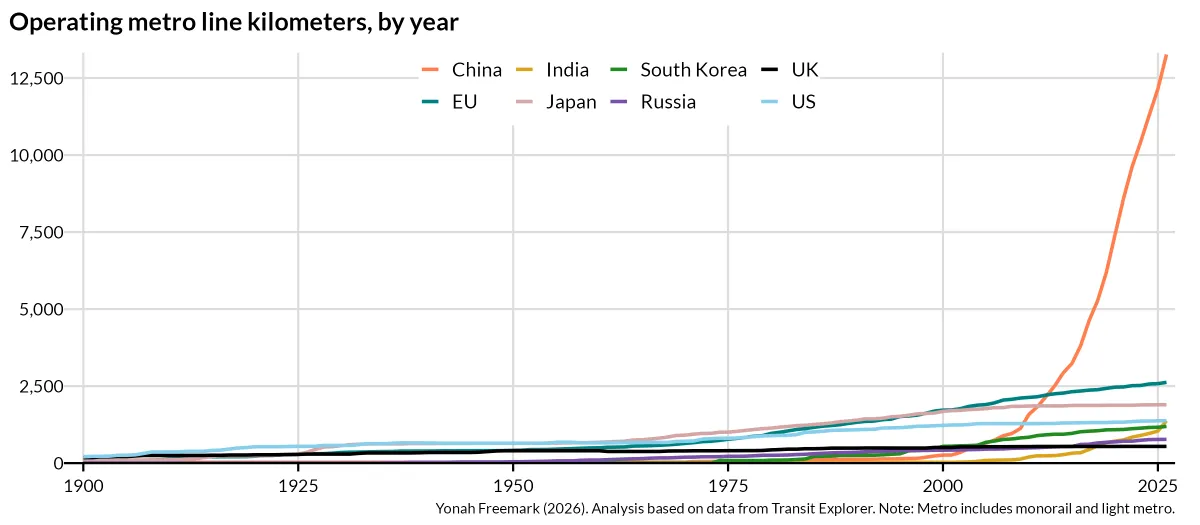
“The net impact of all of the expansion of metro systems in Chinese cities over the past two decades has been the creation of by far the world’s largest network of metro lines. China now has 12,500 kilometers [7,767 miles] of operating metro lines. That’s five times as much as the entire European Union (EU) – and nine times as much as the United States,” writes Freemark.
“Based on current plans, India will pass the United States in terms of the length of its metro systems by the end of 2026,” he adds.
“As China’s and India’s cities have built up their metro lines, so have EU cities, though at a slower rate; at the same time, however, Japan and the United States have barely expanded their systems – even though they were the world leaders until the 1970s.”
Clean energy organizations sue to lift Trump’s renewables “blockade”
In my recent column on the Trump administration’s bogus energy affordability talking points, I mentioned the July 2025 memo signed by Interior Secretary Doug Burgum that has frozen solar and wind projects on federal lands.
That memo is now being challenged in court.
“In recent weeks, a coalition of clean energy organizations sued to overturn the July memo and other actions from Interior and the U.S. Army Corps of Engineers, which issues permits for energy projects near navigable waters,” reports Canary Media’s Maria Galluci.
“Both the Army Corps and Interior say they’re prioritizing projects that generate the most energy per acre, a measure that favors coal, oil, and gas and undercuts renewables — and which has its roots in fossil-fuel industry misinformation,” she adds.
Research roundup
Here’s another roundup of noteworthy reports and studies you might have missed:
Global aviation emissions could be halved through efficiency: As I’ve written here before, much can be done today to reduce emissions from the aviation industry, including measures on the ground and at the gate.
A study published earlier this month finds that relatively simple efficiency measures could generate substantial emissions cuts from global aviation.
“A new study co-led by the University of Oxford has found that global aviation emissions could be reduced by 50-75% through combining three strategies to boost efficiency: flying only the most fuel-efficient aircraft, switching to all-economy layouts, and increasing passenger loads,” according to a University of Oxford press release.
“Crucially, the study shows that around a 11% reduction in global aviation emissions is achievable immediately, by using the most efficient aircraft that airlines already have more strategically on routes they already fly.”
Hydropower + batteries = longer dam life, more revenue: “Hydropower has traditionally acted as the battery of the grid, with water stored in reservoirs ready to spin turbines when needed. But now our grid ‘battery’ has the opportunity to have batteries of its own,” says Vishvas Chalishazar, a senior power systems research engineer at the Pacific Northwest National Laboratory (PNNL).
In new research, “Chalishazar and his colleagues modeled the operation of a real hydropower plant paired, hypothetically, with a 60-megawatt, 2-hour battery system. The researchers found that the added battery could help the hydropower plant generate $6 million more in revenue every year while reducing wear and tear on its turbines,” according to a PNNL press release.
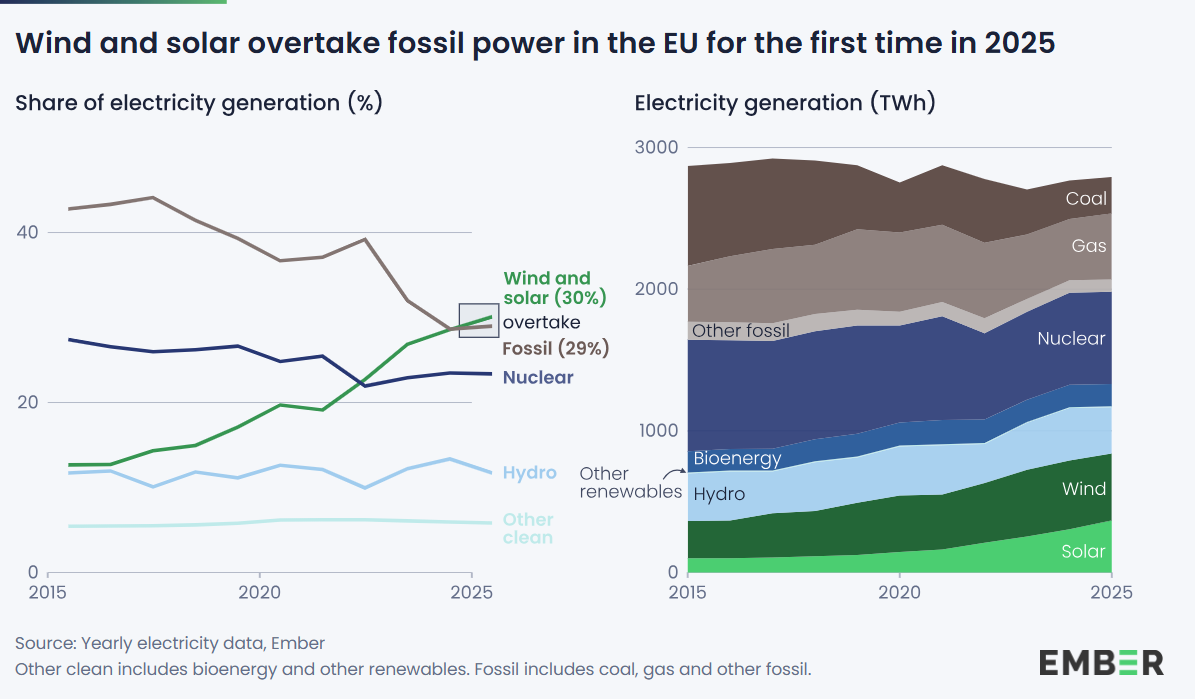
Clean energy soars in Europe and California: New research finds that two of the world’s largest markets, the EU and California, logged significant energy transition milestones last year.
“In 2025, the EU took an enormous step forward towards a clean power system backed by wind and solar,” reports the energy think tank Ember in its latest European Electricity Review. “For the first time, wind and solar produced more electricity than fossil fuels in the EU. Homegrown renewables remained nearly half of EU power, as record-breaking solar worked in tandem with wind.”
“The next challenge will be to put a serious dent in the EU’s reliance on expensive, imported gas. By investing across the power system to harness the potential of batteries, grids and electrified tech, the EU can make use of homegrown renewable power to stabilise prices and insure against energy blackmail,” writes Beatrice Petrovich, a senior energy analyst with Ember.
In the Golden State, the California Energy Commission (CEC) shared data finding that with each year, “more hours of the day are powered entirely by clean energy.”
“In 2025, California’s grid ran on 100% clean energy more than 50% more hours than in 2024,” according to the CEC.
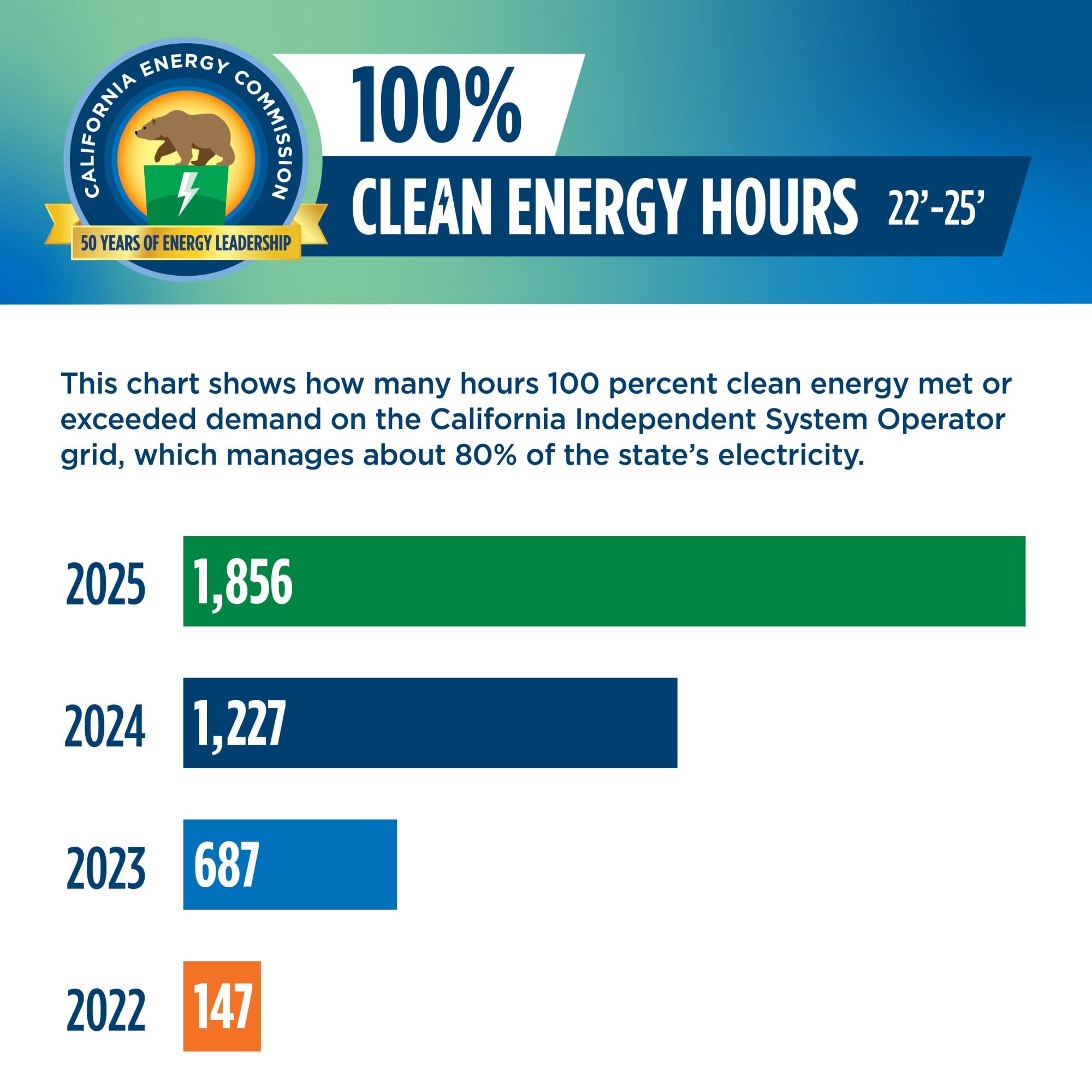
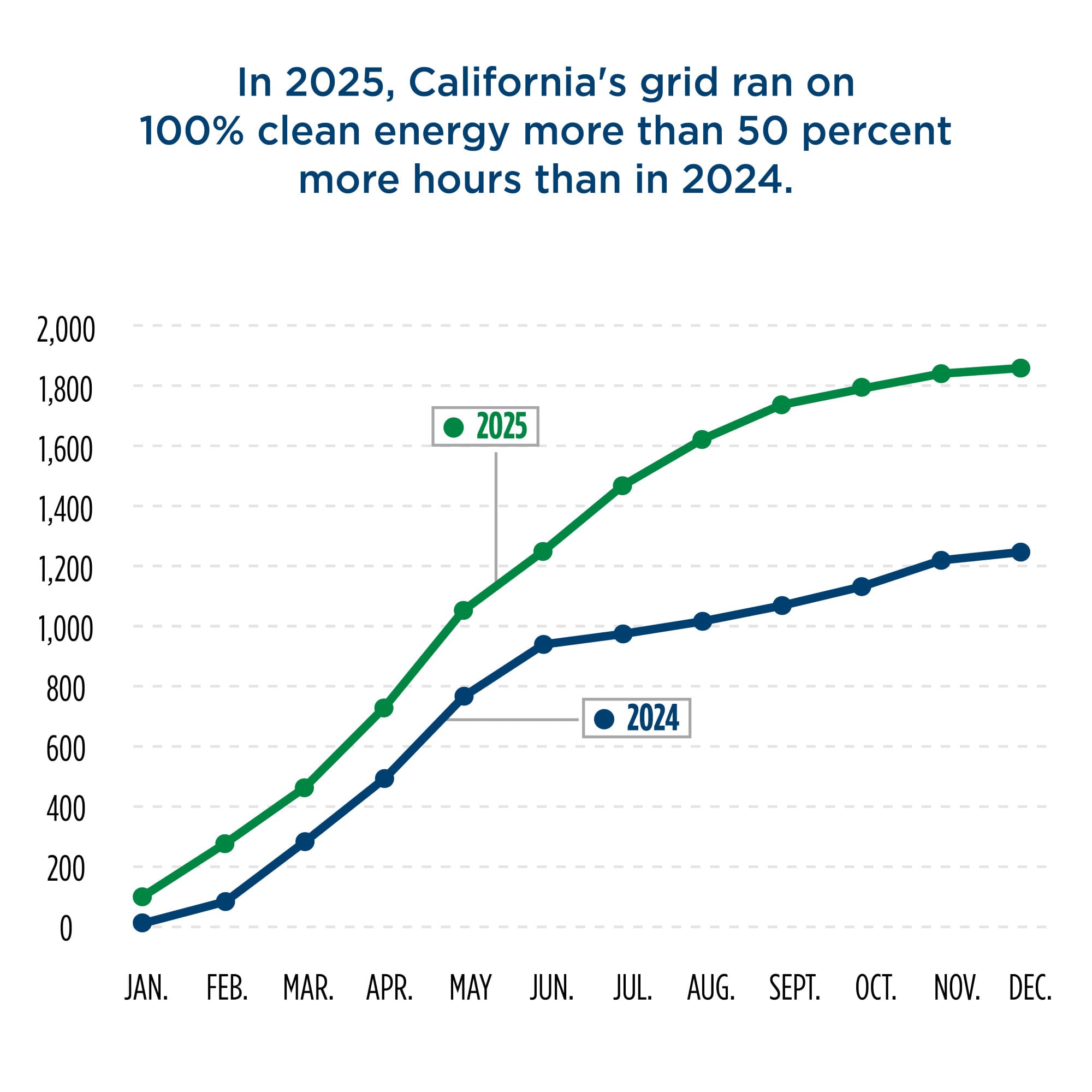
Credit: California Energy Commission.
China and India log energy transition milestones last year, too: “Coal power generation fell in both China and India in 2025, the first simultaneous drop in half a century, after each nation added record amounts of clean energy,” writes Lauri Myllyvirta, lead analyst at the Centre for Research on Energy and Clean Air, in an analysis published by Carbon Brief.
“Electricity generation from coal in India fell by 3.0% year-on-year (57 terawatt hours, TWh) and in China by 1.6% (58TWh). The last time both countries registered a drop in coal power output was in 1973,” writes Myllyvirta.
Bonus: Weight-loss drugs: an unexpected climate solution
Returning to the subject of efficiency in the aviation industry, one thing all airlines obsess over is finding ways to shed weight on their planes. Every extra pound, after all, means more fuel burned during the flight.
On that score, it turns out the Americans’ recent embrace of weight-loss drugs is doing the airlines – and the planet – a favor. Airlines have largely recovered from their pandemic declines, with more bodies in seats on most flights, but because of the weight-loss drugs, there is less of us in each seat.
“As Americans slim down with the help of weight-loss drugs, U.S. airlines could be among the surprise beneficiaries, a new report suggests,” reports The Washington Post’s Lori Aratani.
Aratani spoke with Sheila Kahyaoglu, an equity analyst at financial firm Jefferies, which led the study:
“Using a Boeing 737 Max 8 as an example, Kahyaoglu calculated that if the plane were carrying 178 passengers who weighed an average of 180 pounds, the aircraft’s total weight, including fuel and cargo, would be roughly 181,200 pounds. But if those passengers lost an average of 10 percent of their weight to reach an average of 162 pounds, the total load would be about 3,200 pounds lighter. For American, Delta, Southwest and United, which are expected to consume roughly 16 billion gallons of fuel in 2026 at a cost of roughly $38.6 billion — that difference in weight could translate to about $580 million in fuel savings per year, the report estimated.”