
What I’m reading: Why we need offshore wind, Cuba's solar revolution, research roundup, and more
Quitting Carbon's biweekly roundup of energy transition developments you might have missed.


Quitting Carbon is made possible by paid subscribers. Support independent energy journalism by becoming a paid subscriber or making a one-time donation.
Welcome back to another recap of highlights from what I’ve been reading.
I'll be back in your inbox next week with an interview featuring Sam Irvine, senior strategic initiatives manager with the not-for-profit public agency MCE, to talk about why the electricity provider is so bullish on virtual power plants. Thanks, as always, for reading.
Why we need offshore wind
If you look only at the upfront costs, offshore wind is a harder sell than cheaper clean energy technologies like onshore wind and solar. That’s why taking the longer view, and accounting for total system costs and benefits, is so important.
I wrote last fall, for example, about how Ørsted’s South Fork Wind project offshore New York was already delivering power to the grid when it is needed most and would save ratepayers money by displacing power from fossil gas-fired power plants.
Australia’s offshore wind market lags even the beleaguered U.S. market. No projects have been built Down Under, but many gigawatts of projects are planned, especially off the coast of the state of Victoria.
A new report finds that investing in offshore wind in this area, Gippsland, is a good bet.
“Building just one-third of the offshore wind capacity currently proposed for the Gippsland zone off the coast of Victoria would cut household energy bills by $150 [$106 USD] a year, avoid around 900 km of new onshore transmission, and slash the state’s dependence on gas,” reports Renew Economy’s Sophie Vorrath, writing about a new report from the consultancy Jacobs.
“Using data from the Australian Energy Market Operator’s step change scenario in its Integrated System Plan, as well as from the Commonwealth Scientific and Industrial Research Organisation’s GenCost report, the study finds that the savings and avoided costs delivered by offshore wind more than offset its high cost of capital,” writes Vorrath.
“That is,” she goes on, “while the capital and operating costs of the Offshore Wind scenario are higher than the scenario with no offshore wind ($3.7 billion and $2.7 billion higher, respectively) – much bigger savings are made on transmission, fuel, and social licence and landowner compensation.”
More on the push to fund energy programs via budgets, not utility bills
Last week, I published a column arguing that lawmakers should move to fund critical clean energy programs from their jurisdictions' general budgets instead of customers' utility bills.
On Tuesday, California state Senator Josh Becker (D) amended one of his pending bills (SB 905) to do just that.
Becker’s amended bill will “introduce a bevy of proposals aimed at reducing electricity rates and reining in utility company profits,” reports Politico’s Noah Baustin.
“It would require the California Public Utilities Commission to reduce the profit that utilities are able to collect on lower-risk investments, like burying powerlines underground. It would tie the compensation for utility executives to electricity rates,” he writes.
“And it would create a fund that the state could use to pay for wildfire and other grid investments benefiting the public with taxpayer, instead of electricity customer funds.”
California program helps homeowners rebuild all-electric homes
Last week, the California Public Utilities Commission announced that customers of the state’s six investor-owned electric utilities whose homes were destroyed by wildfires and other natural disasters can apply for assistance to rebuild all-electric homes.
The $50 million Rebuilding Incentives for Sustainable Electric Homes program will begin accepting applications from customers in the Bear Valley Electric Service, Liberty Utilities, Pacific Gas and Electric Company, PacifiCorp, San Diego Gas & Electric, and Southern California Edison service areas on April 6.
Cuba’s rapid solar revolution, courtesy of China
Donald Trump’s quest to force Cuba’s leaders to bend to his will by choking off the country’s oil supply has plunged much of the island into nighttime darkness.
Cuba still generates most of its electricity by burning oil. But that is beginning to change, thanks to a surge in solar panels imported from China.
“Chinese exports of solar equipment to Cuba skyrocketed from about $5 million in 2023 to $117 million in 2025 and show no sign of stopping, according to the British energy think tank Ember,” report the Washington Post’s Rebecca Tan and Rudy Lu.
“Beijing pledged last year to help Cuba build more than 92 solar parks by 2028, and more than half of these projects have come online, authorities say,” they write. “Because Cuba’s energy demands are comparatively low, even a small amount of additional input has made a marked contribution.”
How much of a contribution? Tan and Lu reached out to Ember analyst Dave Jones for context:
“Solar could now be responsible for as much as 10 percent of Cuba’s electricity generation, according to Ember analyst Dave Jones, up from almost nothing a year ago. That would be among the fastest expansions of solar energy anywhere, Jones said, and place Cuba ahead of most countries – including the U.S. – in the share of electricity generated by sun power. ‘Cuba,’ he said, ‘is perhaps in the middle of one of the most rapid solar revolutions.’”
Here’s another roundup of noteworthy reports and studies you might have missed:
EV owners love their cars, fleet managers love EV savings
According to a new survey, EV owner satisfaction in the U.S. has never been higher.
JD Power’s 2026 U.S. Electric Vehicle Experience Ownership Study finds that “overall satisfaction among current battery electric vehicle (BEV) owners is at its highest level since the study’s inception in 2021.”
“Notably, nearly all owners of new BEVs (96%) say they would consider purchasing or leasing another BEV for their next vehicle,” said JD Power in a press release.
One reason EV owners are so happy is because their vehicles are so cheap to operate.
“A new study from consulting firm EY and Eurelectric, a trade association for Europe's electricity industry, makes it hard for bean counters to ignore the savings of going electric,” writes InsideEVs’ Rob Stumpf.
“The study argues that switching a corporate fleet from gas to electric could cut total vehicle operating costs by as much as 50%,” he adds. “That's thanks to cheaper energy costs (versus gasoline), lower maintenance requirements, and various regulatory perks that favor EVs as a whole.”
The report “finds that companies that move from diesel to battery-electric vans can achieve cost savings between 15% and 40%,” he writes.
UK must accelerate its energy transition; Trump’s Iran war could be the accelerant
Energy advisory firm DNV finds in its annual Energy Transition Outlook report for the UK “that the country is transitioning fast – but not fast enough to hit the UK’s decarbonization targets, namely Clean Power 2030, Nationally Determined Contribution (NDC) 2035 and net zero by 2050,” according to a press release.
“Quite simply, we are risking progress by siloing debates around the energy transition, focusing narrowly on individual elements rather than the whole system,” says DNV’s Hari Vamadevan.
What could alter this trajectory? Perhaps another global fossil fuel price shock.
“The total economic cost inflicted on the UK from a single spike in fossil fuel prices is likely to be similar to the investment required to entirely retool the economy for a net zero future,” writes BusinessGreen’s Michael Holder.
Reporting on a Climate Change Committee analysis published last week, Holder writes that “under a wide range of scenarios achieving net zero emissions by 2050 offers a more cost-effective path for the UK economy than continuing to rely on fossil fuel markets, which are inevitably exposed to the kind of supply shocks and price spikes that have followed this month's US-Israeli attack on Iran.”
So far, Donald Trump’s war of choice in Iran, and the resulting surge in energy prices globally, appears to have jolted UK’s Labour government into bolder action.
Last Sunday, Energy Secretary Ed Miliband announced what the government calls an “accelerated package of energy interventions to boost the UK’s energy security.”
Among the measures in the package are pledges to fast-track regulatory approvals for plug-in solar systems and to bring forward the country’s next renewables auction to July.
On Tuesday, Politico’s Charlie Cooper reported that the Labour government “is expected to publish a long-awaited plan to decarbonize new homes [the Future Homes Standard] next week, with ministers set to mandate low-carbon heating for all new-builds and solar panels on the vast majority.”
In a report released Wednesday, the Common Wealth think tank outlines how “household energy bills could be reduced by up to £203 [$271] a year by stopping expensive fossil gas setting the price of energy in the UK,” reports the Guardian’s Matthew Taylor.
The report “sets out how the government can cut the link between gas prices and electricity bills, saving consumers hundreds of pounds a year and stopping renewable energy companies, which are being paid the price of expensive gas, from reaping unearned windfalls,” he writes.
Is the government serious about taking more aggressive action? We shall see.
But here is Prime Minister Keir Starmer saying the UK must “go further and faster on renewables,” courtesy of Carbon Brief’s Leo Hickman:
Kier Starmer: "What gives us control is renewables. Our own home-grown energy which is then more secure and more independent. That’s why I think we should go further and faster on renewables. Let’s get control of our own energy…so we don’t have to keep worrying that our bills are going to go up"
— Leo Hickman (@leohickman.carbonbrief.org) 2026-03-16T11:21:19.463Z
How much are you paying for utility profits?
Multiple factors are driving up electricity bills across the U.S., including utility investments in transmission and distribution grid upgrades and measures to mitigate wildfire risk.
Another one, for households served by investor-owned utilities, is utility profits.
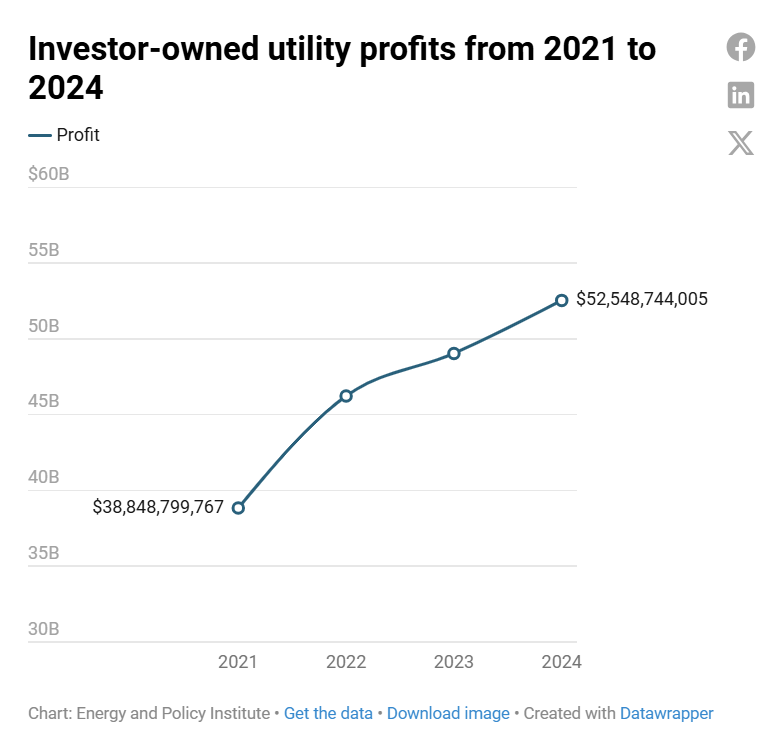
The Energy and Policy Institute (EPI), a utility watchdog organization, published a report last week providing what it calls “the first systematic look at how much of each dollar spent on electricity ultimately goes to investors.”
Using publicly reported financial data, EPI developed a companion calculator that enables households to see how much of their monthly utility bill goes to profits.
“Electric utilities kept about 15 cents of every dollar they collected as profit last year. For a customer paying a $200 monthly electric bill, that means roughly $30 went to corporate profits. This profit share has been rising, up from around 13% on average between 2021 and 2024,” according to EPI.
Bonus: Calaveras Big Trees State Park
I mentioned in my last roundup that I was about to spend the coming weekend in California's Gold Country. A highlight of that trip was a late-winter hike among the giant sequoias in the North Grove of Calaveras Big Trees State Park.




Credit: Justin Gerdes.