Here’s what it will take to unlock the potential of advanced energy communities
Solvable policy barriers are holding back the adoption of proven technologies that are the building blocks of all-electric, zero-carbon, grid-flexible communities, experts said at a symposium convened in Oakland, California.

Quitting Carbon is made possible by paid subscribers. Support independent energy journalism by becoming a paid subscriber or making a one-time donation.
Attend a clean energy conference today and you're likely to hear one of the speakers invoke a symphony to fix in the mind’s eye the interplay of devices in homes and businesses with the grid.
Most of the technologies we will need to decarbonize our homes and communities already exist. But until recently, these distributed energy resources (to use the term preferred by wonks), heat pumps and smart thermostats, solar panels and batteries, electric vehicles and chargers, were treated as stand-alone technologies.
But just as a conductor guides musicians to make beautiful music in an orchestra, the basket of technologies needed for a carbon-free home or office are most effective when operated together.
Musicians read sheet music to know when and how to contribute their sounds to the mix. But the sheet music that is needed to conduct the suite of technologies that will power electrified, zero-carbon homes and neighborhoods is still being written.
Last week, The Climate Center, a Santa Rosa-based energy and climate policy non-profit, convened a day-long symposium at the California Endowment Oakland Conference Center to mark the 10-year anniversary of an initiative funded by the California Energy Commission that supported the development of so-called “advanced energy communities.”
Local groups launched four pilot projects, two in Northern California (Oakland, Richmond) and two in Southern California (Lancaster, Los Angeles County), that demonstrated how “community-led and community-scale decarbonization projects can make our energy system more reliable, equitable, and affordable.”
The four projects sought to ensure “equitable access to distributed energy resources, including energy storage and community-scale microgrids, building efficiency and electrification, EV deployment and Virtual Power Plant (VPP) programs,” according to The Climate Center.
The symposium brought together participants from the four projects, as well as policymakers and clean energy experts from across California, to talk about what the projects got right, the lessons learned, and what policy changes are needed to build advanced energy communities statewide.
Policy barriers
The four pilot projects utilized a mix of different technologies and strategies.
The Oakland EcoBlock project, for example, sought to scale a replicable template to retrofit an entire block of older residential buildings. And for the Richmond project, the local community choice aggregator (CCA), MCE, designed a first-of-its-kind VPP tariff offering on-bill credits to participating residential and commercial customers.
The project participants highlighted policy barriers that prevent the innovative solutions demonstrated in the pilots from scaling much faster. I won’t mention them all here. For a deep dive into all the challenges and lessons learned, the full slide deck from the day’s presentations is well worth your time.
Instead, I’ll focus on three barriers that came up time and again throughout the day.
Scaling low-cost financing for retrofits
The high upfront cost to install heat pumps, rooftop solar panels, and other equipment that can be aggregated into bidirectional virtual power plants prevents low-income households from decarbonizing their homes and participating in the energy transition.
One solution for this barrier was referenced often: tariffed on-bill financing. These programs enable households or businesses to invest in energy upgrades at no upfront cost via zero- or low-interest loans that are paid back through a tariff tied to the utility meter rather than the individual customer.
On-bill financing programs already exist for commercial customers in California. Pacific Gas and Electric’s (PG&E) business customers, for example, can take out interest-free loans from $5,000 to $250,000, with a payback period up to 120 months. The loan is paid back via a line item on the customer’s monthly utility bill.
Speakers at the symposium urged the California Public Utilities Commission (CPUC) to move faster to authorize on-bill financing for residential customers statewide.
The CPUC recently approved Southern California Edison’s request to launch a small $7.2 million residential on-bill financing pilot.
“Programs like Revolving Loan Funds and Tariffed On-bill Financing are needed for AEC [advanced energy communities] solutions to scale rapidly,” said Chris Sentieri, a principal with Community Energy & Equity Resources (CEER), who advised the Richmond project.
Free the data!
Several speakers, including CEER’s Sentieri, said a lack of data prevents CCAs from earning more revenue, which could reduce customers rates, and makes it harder to integrate distributed energy resources into virtual power plants.
Sentieri noted that CCAs experience a two- to three-day delay in receiving meter data from the state’s investor-owned utilities (IOUs), making it difficult for them to participate in the California Independent System Operator’s real-time energy market.
(A reminder for readers outside of California: IOUs like PG&E handle billing and operate the poles and wires to transmit and deliver electricity in their service territories; CCAs like MCE procure and/or generate electricity for their member communities within those territories.)
Similarly, community choice aggregators and demand response (DR) providers also “have limited access to data needed to implement and manage VPP and DR programming,” Sentieri added. “CCAs and DRPs need increased access to granular grid and load data to effectively optimize VPP/DR program performance.”
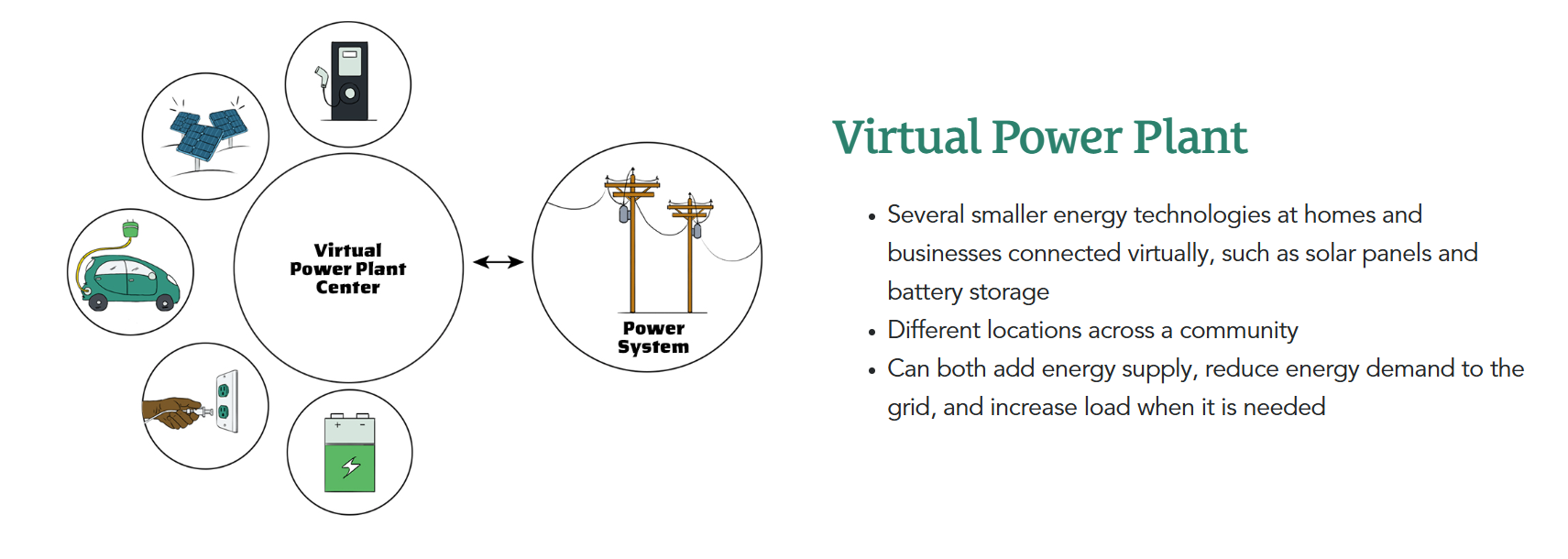
Or, as Sam Irvine, MCE's senior strategic initiatives manager, put it: “Without coordination, flexibility becomes discordance instead of value.”
Sentieri said billions of dollars are being left on the table for CCAs in California today because of the lack of access to real-time meter data.
The consensus view of the four project participants, as well as many of the experts who spoke during the event, was that meter data should be made freely accessible to public entities like the state’s CCAs, which serve more than 15 million customers in California.
Reform Rule 218 to unlock community microgrids
Perhaps the biggest bugbear for speakers at the symposium is Rule 218, the so-called “over-the-fence” rule, language in the California Public Utilities Code that determines what is and is not an “electrical corporation” under state law.
The rule has been amended a few times to, for example, exempt cogeneration projects and EV charging facilities. Microgrid backers want to see the rule amended again to make it easier to build community microgrids.
“PUC 218 will likely need to be changed to realize the full potential and benefits of community microgrids!!!” Allie Detrio, chief strategist with Reimagine Power, wrote in her symposium presentation (emphasis in original).
She called on policymakers to: “change PUC 218 to exempt microgrids that are owned and controlled by customers and communities (from overly onerous CPUC regulation and oversight); create a Community Microgrid Operator (CMO) designation in statute and implement accompanying regulatory framework; and allow CMOs to develop microgrids with master meter/submetering tech and local distribution infrastructure that can cross rights of way and serve multiple customers.”