What I’m reading: Big batteries are transforming the grid, GAO warns on clean energy staffing cuts, research roundup, and more


Quitting Carbon is made possible by paid subscribers. Support independent energy journalism by becoming a paid subscriber or making a one-time donation.
Welcome back to another recap of highlights from what I’ve been reading. Thanks, as always, for reading.
Big batteries are transforming the grid
Let’s start with some good news.
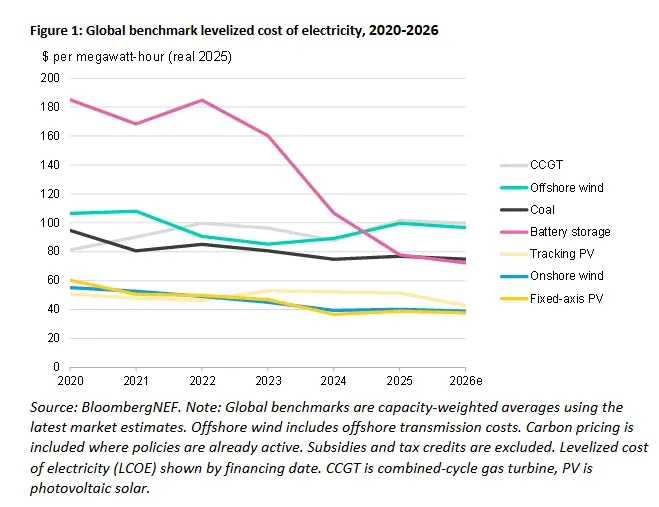
Plunging costs for battery packs means that it’s cheaper by the day to deploy utility-scale grid batteries to balance the output from solar and wind projects.
On Wednesday, research firm BloombergNEF released its 2026 Levelized Cost of Electricity report. Writing about the report at BusinessGreen, Stuart Stone reported: “The analysis of more than 800 recently financed projects found that the global benchmark cost for a four-hour battery project fell 27 per cent year-on-year to $78 per megawatt-hour (MWh) in 2025, marking a record low since BloombergNEF (BNEF) began tracking such costs in 2009.”
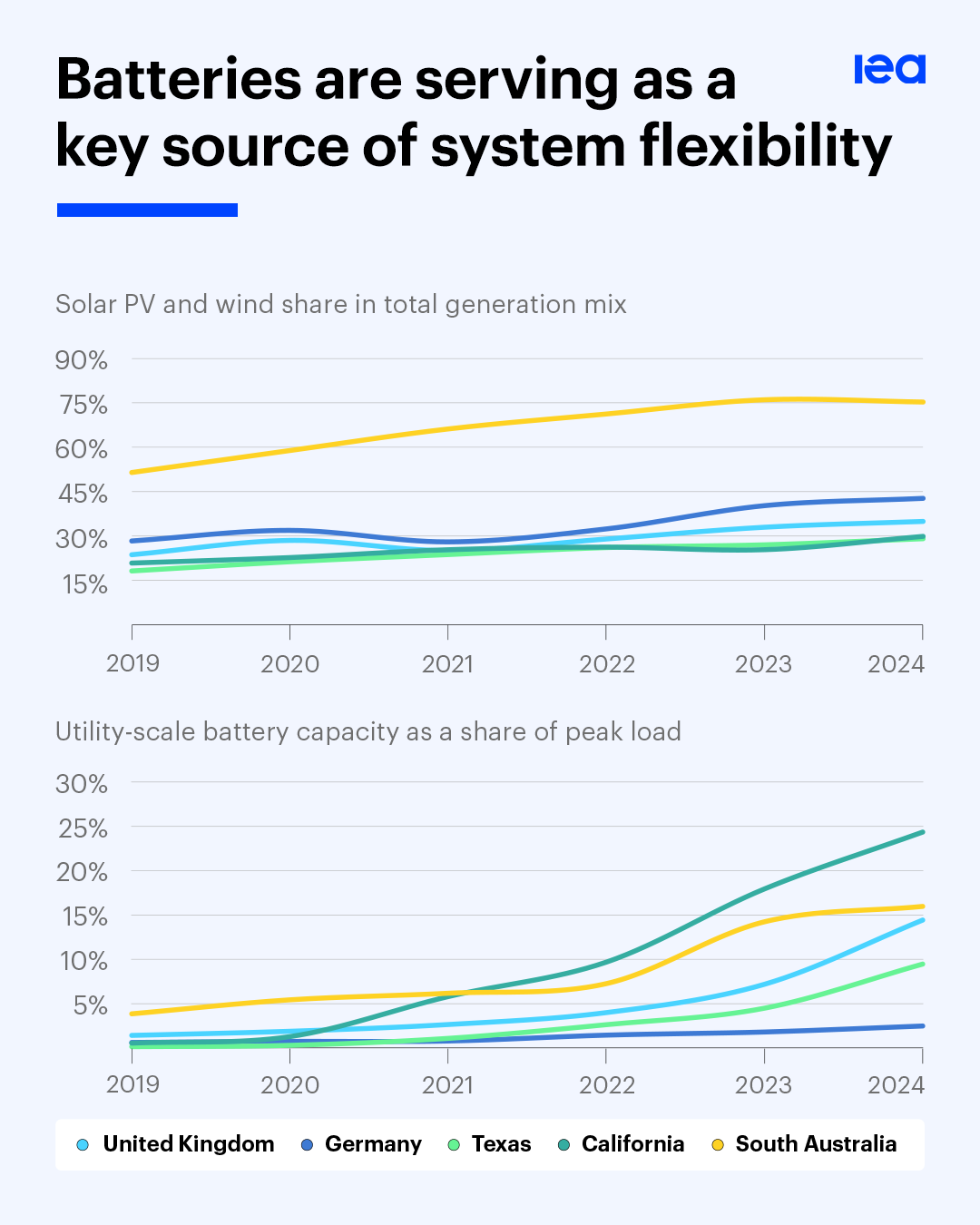
In the states and countries that are leading the global energy transition – places like California, Germany, South Australia, Texas, and the United Kingdom – more affordable utility-scale batteries are making it possible for solar and wind power to account for 30% or more of the total generation mix, with battery capacity reaching up to 25% of peak load.
The chart below from the International Energy Agency (IEA) nicely illustrates the trend. As the IEA notes: “these batteries have become a significant source of short-term flexibility for power systems, with a growing role in supporting the security of energy supply more broadly.”
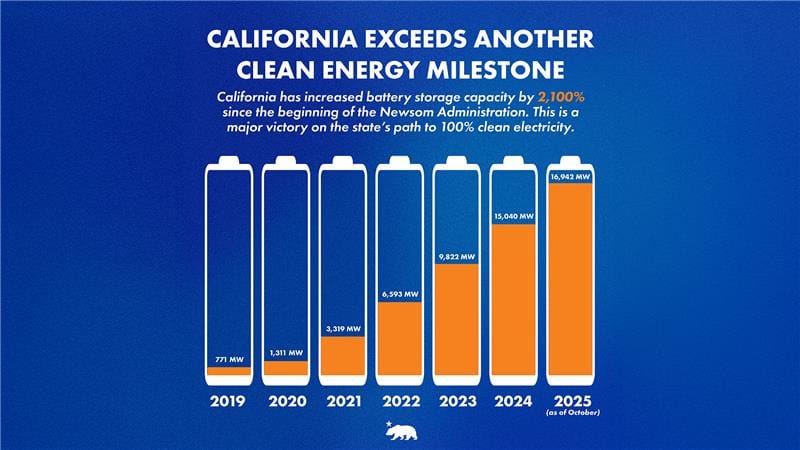
California’s installed battery storage capacity was 17,000 megawatts as of October 2025 – one-third of the storage capacity estimated to be needed for the state to achieve its 2045 climate and clean energy goals.
In Australia, nearly a dozen utility-scale battery energy storage projects, with a combined capacity of 1.9 gigawatts (GW) and 4.9 gigawatt-hours (GWh), came online last year. “This annual total of 4.9GWh not only sets a new benchmark for the industry but also surpasses the combined output of all storage projects commissioned between 2017 and 2024,” reports Energy Storage News’ George Heynes.
The presence of so many large grid batteries in markets like California and Australia has enabled battery storage projects to displace fossil gas peaking power plants.
“Battery storage is no longer just enabling renewables – it is actively replacing gas generation,” finds a report published earlier this month by consultancy Rystad Energy, as reported by Renew Economy’s Giles Parkinson.
“Australia has emerged as one global proof point, alongside California, that large-scale battery energy storage can assume a central role in resource adequacy and peak supply in grids with high solar penetration,” write analysts at Rystad.
Congress’ watchdog warns that deep staffing cuts imperil federal clean energy projects
In a column last week, I noted that the 2026 budget bills signed by Trump last month included funding for critical energy efficiency and clean energy programs at levels that matched or even exceeded those in last year’s budget.
But I also warned that two questions loom: “Will agencies have enough staff to fulfill Congress’ will and implement programs and projects the president does not like, and will [Russell] Vought allow agencies to spend money on those same initiatives?”
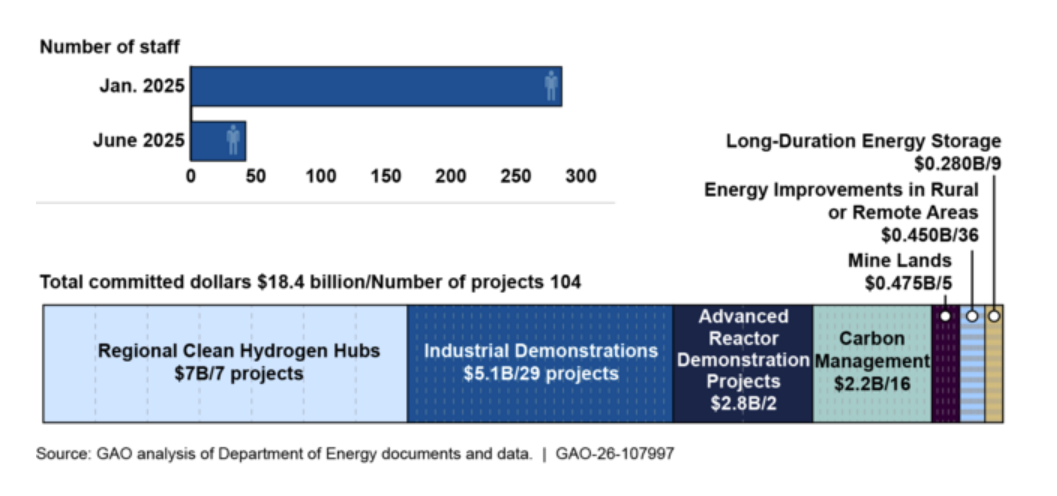
It so happens that just after that column was published, the Government Accountability Office (GAO) released a report warning that staffing cuts had so weakened the U.S. Department of Energy’s (DOE) Office of Clean Energy Demonstrations that it was incapable of managing billions of dollars of project funding appropriated by Congress.
In its typically understated language, here’s the GAO reminding the Department of Energy of its obligation to follow the law:
“The Department of Energy created the Office of Clean Energy Demonstrations in 2021 to manage $27 billion in funding for clean energy projects. As of November 2025, OCED had committed over $18 billion to about 100 projects. OCED needs to oversee these projects and had developed a plan to do so. However, a significant decrease in its workforce and other changes in 2025 have reduced its oversight capacity. A proposal to cut its entire budget creates further uncertainty. DOE faces the risk that it will not be able to robustly oversee these funds.”
“Currently, it is unclear how DOE plans to meet its statutory requirements to manage projects given OCED’s limited capacity. … Without a plan to meet the statutory requirements of managing projects and assessing lessons learned, DOE faces increased risks of not having the capacity to manage and oversee billions of dollars of federal funding for demonstration projects,” the report warns.
Research roundup
Here’s another roundup of noteworthy reports and studies you might have missed:
Offshore wind would save households billions, ease grid stress, on the U.S. East Coast: Two new studies underscore why the Trump administration’s efforts to stop the construction of five offshore wind farms on the East Coast would be so harmful for consumers and the power grid.
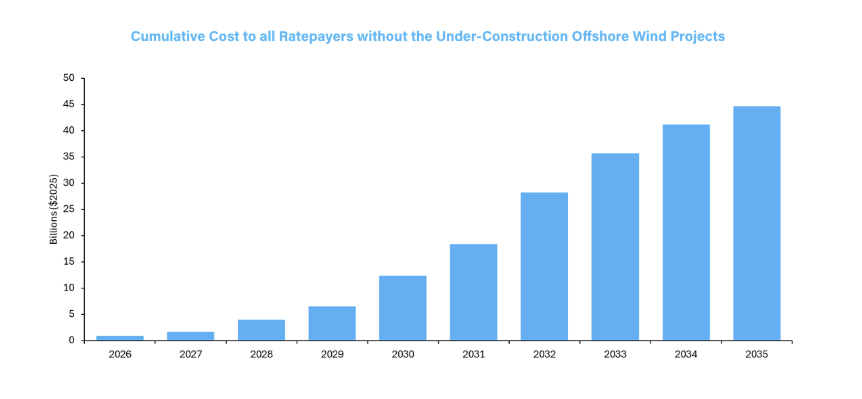
“Cancelling five major offshore wind projects could raise electricity costs for customers on the East Coast by an estimated $45 billion over the next decade,” according to the American Clean Power Association (ACP).
A new ACP analysis finds that without the 6 gigawatts of capacity from these five projects: “Wholesale electricity prices would rise significantly during evening peaks and winter hours – including intense winter storms like Fern; power systems would rely more heavily on non-renewable sources and leave customers more exposed to price volatility; and grids would lose access to low-cost, winter-peaking clean energy that helps stabilize prices during periods of high demand.”
And when power demand is strained during frigid New England winter cold snaps, “offshore wind projects could lower the risk of demand-driven power outages by more than half,” writes Energy Wire’s Ian M. Stevenson about a new Union of Concerned Scientists analysis.
“The Union of Concerned Scientists used wind speed data from the 2024-2025 winter season to explore what may have happened had two offshore wind projects been fully online – Vineyard Wind 1 and Revolution Wind,” writes Stevenson.
“The result, the new study found, is that high wind speeds during the cold season would have sent enough extra power to the grid to cut the number of days that the grid experienced elevated risk of an energy shortage by 55 percent.”
Yes, EVs are cleaning up the air: Write about clean energy and mobility long enough and you’ll eventually get this question: Are electric vehicles really that much cleaner than gas cars?
Two new studies confirm not only that EVs make the air cleaner for EV and non-EV drivers alike, but they are definitively cleaner than the fossil fuel-powered cars they are replacing.
“A new study from the University of Southern California’s Keck School of Medicine used satellite data to confirm that zero-emission cars do have a clear and positive impact on air quality. ... For every 200 new zero-emissions vehicles registered in a California neighborhood between 2019 and 2023, NO₂ levels dropped by 1.1%,” writes InsideEVs Iulian Dnistran.
Writing at the Zero Emission Transportation Association’s weekly newsletter, Research Director Corey Cantor highlighted a new Nature study that analyzes the life-cycle carbon footprints of light-duty vehicles across power trains.
“Under all modeled scenarios, including varying climate, electricity grids, and battery lifetime, battery electric vehicles reduce greenhouse gases relative to comparable internal combustion vehicles, including hybrids,” the authors conclude.
“This is a great report to keep on file for the next time you see a question around how clean EVs are – break glass in case of a factual emergency,” writes Cantor.
Surging renewables could accelerate China’s emissions peak: China’s breakneck pace of renewables deployment means there is a real chance the country peaks its climate pollution well ahead of the government’s “before 2030” target.
“This year China will see its solar capacity outstrip its coal capacity for the first time, according to an industry group. In its latest projections, the China Electricity Council says that, by the end of 2026, wind and solar will account for nearly half of China’s power capacity. Including hydro and nuclear power, clean energy will amount to nearly two-thirds of total power capacity, while coal will amount to a third,” Yale Environment 360 reported earlier this month.
Yes, power capacity is not the same as power generation, but these are impressive milestones, nonetheless.
In a new analysis for Carbon Brief, Lauri Myllyvirta, lead analyst at the Centre for Research on Energy and Clean Air, notes that in 2025 in China “solar power output increased by 43% year-on-year, wind by 14% and nuclear 8%, helping push down coal generation by 1.9%.”
Overall, he writes, “China’s carbon dioxide (CO2) emissions fell by 1% in the final quarter of 2025, likely securing a decline of 0.3% for the full year as a whole. This extends a ‘flat or falling’ trend in China’s CO2 emissions that began in March 2024 and has now lasted for nearly two years.”
Don’t forget about energy efficiency to meet demand: Findings in a new American Council for an Energy-Efficient Economy (ACEEE) report are a useful reminder of why energy efficiency is “called the ‘first fuel’ in clean energy transitions.”
“The fastest and cheapest way to alleviate rapid electric load growth is through expanding investment in energy efficiency and demand flexibility,” according to ACEEE.
How cheap? Less than half the cost of even the cheapest new gas plants.
“Utility energy efficiency programs … save energy for a median cost of only $21 per megawatt-hour, the report found. That’s less than half the cost of generating electricity with even the least expensive new gas-fired power plants, which typically range from $45 to $108 per megawatt-hour.”
The benefits of sharing power across the Western United States: “Utilities and other energy providers in the West need to add more than 12,600 miles of new electric transmission lines in the next decade — at an estimated cost of $60 billion — in order to reliably meet rising demand, integrate renewable energy and address aging infrastructure in the existing electrical grid. That’s the top conclusion of an unprecedented interregional transmission study released this week,” The Oregonian’s Ted Sickinger reported on February 6.
The study was prepared by the Western Transmission Expansion Coalition (WestTEC), which “brought together more than 70 organizations from across the energy industry in the Mountain and Pacific coast states, including the Northwest’s largest utilities, the Bonneville Power Administration and organizations representing municipal and consumer-owned utilities,” writes Sickinger.
Meanwhile, Western states have already saved billions of dollars by sharing power across their borders.
The California Independent System Operator (CAISO) announced last week that the Western Energy Imbalance Market (WEIM) generated $1.62 billion in economic benefits for participants in 2025. The WEIM, which is operated by CAISO, enables balancing authorities across the West (e.g., utilities such as Arizona Public Service, Los Angeles Department of Water and Power, and Portland General Electric) to buy and sell electricity in real time.
The market has saved $8.24 billion for participants since its launch in 2014, according to CAISO.
China's take on Trump's retrograde climate policy
How does the Trump administration's abandonment of the clean energy transition look from China?
Last week, Leo Hickman, the editor and director at Carbon Brief, shared this editorial cartoon from Xinhua, China's state news agency, on Bluesky:
China's Xinhua news agency has just published this editorial cartoon in response to Trump's rejection of climate policies. It is pretty clear that China views this as a HUGE geopolitical fumble by the US leaving the field clear for China's to win the global race to clean-tech hegemony
— Leo Hickman (@leohickman.carbonbrief.org) 2026-02-14T12:20:17.704Z
Bonus 1: Words to live by
The Athletic's Richard Sutcliffe opened his recent feature marking the five-year anniversary of actors Ryan Reynolds and Rob Mac's purchase of Wrexham, a Welsh professional football club, with this sage advice from Reynolds:
“Ryan Reynolds is the first to admit the origins of his friendship with Wrexham co-owner Rob Mac are a little unorthodox," writes Sutcliffe.
“Rob and I first met from absolutely nothing,” says the Canadian. “From vapours, really. It’s not how you usually meet someone. But, after I turned 40, I remember thinking, ‘If I see something beautiful or something I love, I will say it, rather than keeping it to myself and moving on with my day’.”
Those are words to live by, at any age.
Bonus 2: Journalism won't survive if this isn't fixed
Last week, the Pew Research Center released a report on “Americans' complicated relationship with news.” The study found ‘no consensus about the importance of following the news,’” writes NiemanLabs' Hanaa' Tameez.
“But there was one thing Americans seemed to agree on,” she adds, “they don’t pay for news.”
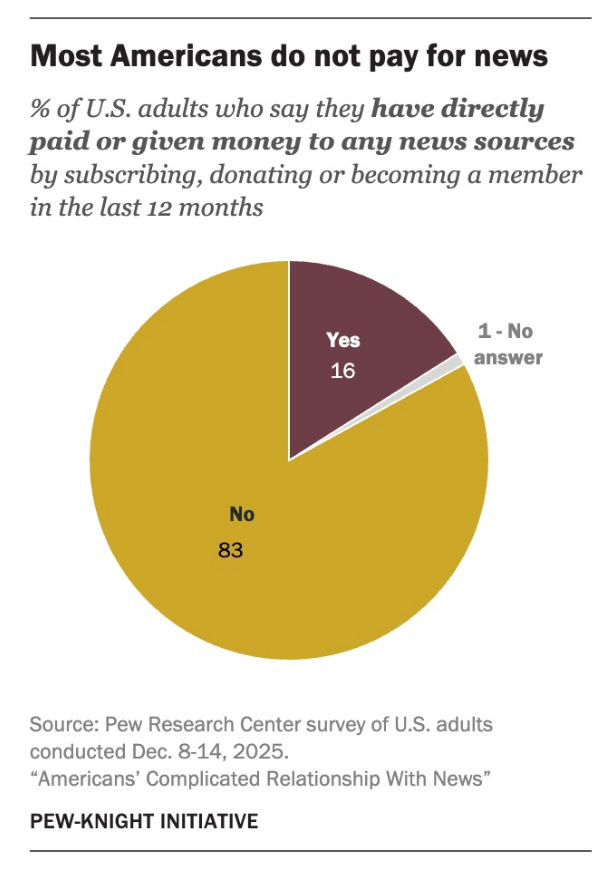
“Eighty-three percent of respondents said they did not pay for any news sources (by subscribing, donating, or becoming members) in the last 12 months. Many cited free news options as a reason not to pay. ... Only 8% of respondents believe individual Americans have a responsibility to pay for news.”
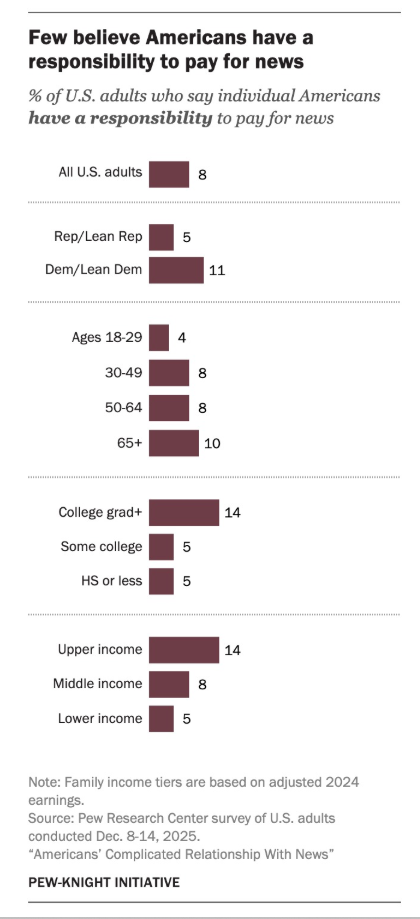
I don't know how to fix this other than to urge you to support newsletters like this one and others that matter to you.
Unless more readers begin to think of journalism like any other creative endeavor they value and are willing to pay for – be it a movie, a concert, a play, or a novel – the reporting and analysis you read every day won't survive for long.