
What I’m reading: California offshore wind ports funding, repowering solar farms with batteries, electric aviation update, a shortcut to electrify existing homes, and more


Quitting Carbon is a 100% subscriber-funded publication. To support my work, please consider becoming a paid subscriber or making a one-time donation.
Welcome back to another recap of highlights from what I’ve been reading. Thanks, as always, for reading and sharing this newsletter.
California offers timeline on next phase of offshore wind ports funding
As the Trump administration wages its war against the offshore wind industry, attempting to halt projects under construction on the East Coast, in California, policymakers are preparing to build wind projects off its coast.
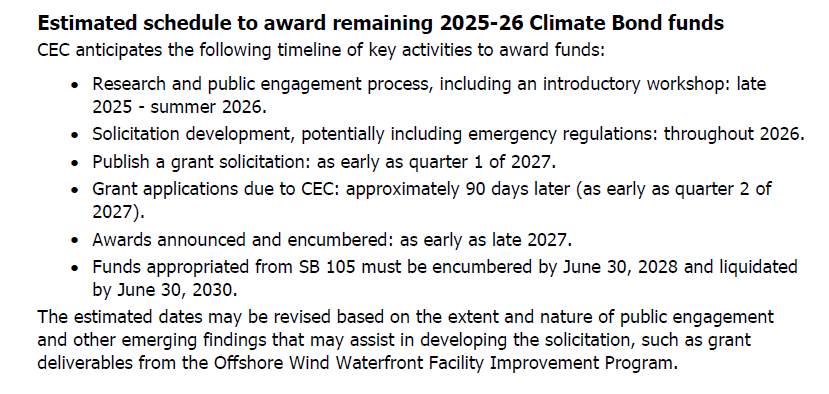
The California Energy Commission (CEC) released a report last month providing a tentative timeline for it to disburse more of the funding set aside for offshore wind ports infrastructure under Proposition 4, the “climate bond” approved by voters in November 2024.
Prop 4 made up to $475 million available to support offshore wind ports construction and expansion in the state. The Legislature included $225.72 million of that funding in a budget bill that passed last year (SB 105).
The CEC awarded $42.75 million to five projects in October 2025, the first tranche of the offshore wind infrastructure funding from Prop 4. In the new report, the CEC outlines how it plans to distribute the remainder of the funds set aside by the Legislature last year.
“The CEC plans to award the remaining appropriated but uncommitted Climate Bond funds (approximately $183 million) by developing one or more competitive grant solicitations that aim to advance the readiness of California ports for floating offshore wind staging, integration, manufacturing, and assembly,” according to the report. “A grant solicitation may be released in early 2027.”
The state estimates an investment of $11-12 billion will be required to upgrade California ports to develop 25 gigawatts of offshore wind power capacity.
Repowering existing solar farms with batteries
I’ve reported on the potential for solar repowering a few times here at Quitting Carbon. I’ve noted that the first wave of utility-scale solar projects, especially those lacking storage, could be ideally suited for repowering.
This battery-led repowering is now advancing in at least two states.
In North Carolina, under a new Duke Energy proposal now before state utility regulators, “project owners could lock in favorable long-term renewals pending one main condition: They have to add batteries,” Elizabeth Ouzts reported last week for Canary Media.
“If it’s green-lit by the North Carolina Utilities Commission, it would represent the first systematic move toward ‘repowering’ large-scale solar facilities in the state. The potential is enormous: Contracts expiring in the next five years total 1.9 gigawatts – an amount equal to more than a quarter of North Carolina’s entire utility-scale solar fleet,” she writes.
In Virginia, a pair of bills progressing through the General Assembly “would fast-track adding battery energy storage to existing solar farms,” reports Cardinal News’ Matt Busse.
The bills, SB 443 and HB 891, “would allow battery storage to be added as an accessory use on any land where a local government has given the OK for a utility-scale solar power facility,” he adds.
“This is a very limited approach that can add significant capacity to the grid and makes the most of existing infrastructure and the land that is already under permit without disturbing new farm and forest land,” Philip Scranage, from energy developer AES, said during a recent legislative committee hearing on the bills.
The electric aircraft market is ready for liftoff
I reported last week on efforts underway at the California Air Resources Board to develop policies to reduce emissions from the state’s aviation industry. The initiative is focused on a near-term push to decarbonize airport operations on the ground and at the gate.
But as I have reported here at Quitting Carbon, startups and manufacturers are also on the cusp of commercializing all-electric planes.
A new report offers an optimistic assessment of the potential to scale the emerging market.
“The nascent market for electric planes and electric vertical take-off and landing aircraft (eVTOL) is continuing to advance and could deliver tens of thousands of new aircraft in the coming decades, as new commercial technologies emerge and regulators grant approval for zero emission operators,” writes BusinessGreen’s James Murray about a new report from research firm Berg Insight.
The new report, he adds, “predicts almost 100,000 electric aircraft could be in operation by mid-century, as commercial operators look to cut costs and emissions and the private aviation market expands.”
Murray notes that “the report underscores how a sizeable ecosystem of electric aircraft developers has emerged in recent years, despite significant economic headwinds and technical challenges.”
Among those technical challenges is developing lithium battery packs that can satisfy regulators’ exacting standards for safety.
On that score, H55, a Swiss startup that produces electric propulsion systems for aircraft, claims to have achieved a significant milestone.
“Electric aviation has faced a single, unresolved bottleneck: proving to regulators that high-energy propulsion batteries can safely contain worst-case failures,” the company said in a Monday press release.
H55 announced that “it has completed the industry’s first regulator-required and authority-witnessed propulsion battery module certification test sequence – addressing a critical gating factor that has constrained the commercialisation and financing of electric aircraft programs.”
“By completing this regulator-approved propulsion battery module test campaign, H55 has materially reduced the primary constraint that determines which electric aviation technologies can commercialise,” said the company.
H55 supplies the electric propulsion system for the Bristell B23 Energic, the all-electric plane I watched complete a demonstration flight at the Biggest Little Air Show at the San Carlos Airport last June.

A shortcut to electrify existing homes
Yesterday, California utility Pacific Gas and Electric Company (PG&E) and San Francisco-based startup Span announced a partnership that aims to make it easier to fully electrify existing homes.
Older homes often require expensive electric panel upgrades before heat pumps, induction cooktops, or other electric appliances can be installed. Thankfully, I was able to avoid this hassle when I completed my own home electrification project.
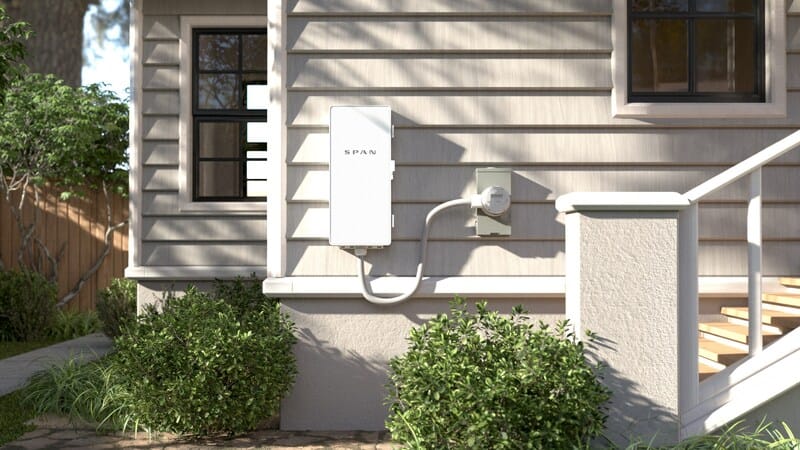
Under the new collaboration with PG&E, Span will install its Edge load management devices at the meter, which means that even homeowners who live in homes much older than my own can likewise avoid the need for costly electric panel or service upgrades when fully electrifying their homes.
Here’s how the program will work when it launches this summer.
As part of PG&E’s new PanelBoost program, “PG&E will supply the SPAN Edge device for customers as an add on to their electric meter, and customers will be responsible for the costs for an electrician to install the device and for costs to wire any new appliances and loads connecting to the device,” according to a press release.
The companies claim that Span's Edge devices can be installed faster and for less than service upgrades.
The devices “offer utilities a reliable, flexible load-shaping tool and give customers a lower-cost path to electrification – avoiding service upgrades that can cost $6,000 to $40,000 and take months to complete. In comparison, the cost estimate for a customer to have an electrician to install a Span Edge device through PanelBoost could be between $500-$2,000 dependent on a range of factors.”
According to PG&E, more than 600,000 homes across its service area in Northern and Central California “are likely to require some type of electric service upgrade in the next decade to meet electrification demand.”
The ongoing crisis at DOJ’s environment division
In a roundup published nearly one year ago, I reported on the crisis at the U.S. Department of Justice's environment division, then just a month after Donald Trump’s inauguration to a second term as president.
I wish I could report that conditions at the beleaguered division have improved since then. Unfortunately, according to reporting by Politico’s Pamela King, the situation today is even worse.
“One year after President Donald Trump’s return to the White House, at least a third of the lawyers on staff at the Justice Department’s environment division have walked out the door, gutting the government’s capacity to defend its own energy and climate policies and kneecapping its power to keep polluters in check,” writes King.
“Over the last 12 months, at least 140 lawyers have departed – by force or by choice – DOJ’s Environment and Natural Resources Division [ENRD], according to interviews with 11 former attorneys across the division’s 10 sections and analysis by POLITICO’s E&E News,” she adds.
The exodus of talented lawyers, and loss of institutional knowledge, is of grave concern to John Cruden, who led ENRD during the Obama administration.
“Of all the many issues that trouble me about this administration, their treatment of our extraordinary career workforce is first on the list. The brain drain from the environment division that I served in for over 20 years and then led, has been extraordinary,” Cruden told King.
Longtime readers of this newsletter may recall Cruden's name. I mentioned in last year's roundup on this topic that I had interviewed Cruden in the closing days of the Obama administration for a profile I published with Santa Clara Magazine. You can read that profile here.

Bonus: California nears completion of “world’s largest” wildlife crossing
Some good news to close us out.
On Monday, Governor Gavin Newsom (D) announced that the California Transportation Commission had allocated the final $18.8 million in funding needed to complete the Wallis Annenberg Wildlife Crossing over US Highway 101 northwest of Los Angeles.
“The crossing is the first of its kind in California and provides safe passage for wildlife across US 101, reducing wildlife-vehicle collisions and supporting long-term species viability by allowing movement,” according to a press release from Newsom’s office.
“After more than 30 years of conservation work in the area, this wildlife crossing will reconnect protected lands in the Santa Monica Mountains and the Sierra Madre Range on both sides of the highway.”