What I’m reading: East Coast offshore wind farms nearing completion, plug-in solar goes nationwide, building electrification update, and more


Quitting Carbon is made possible by paid subscribers. Support independent energy journalism by becoming a paid subscriber or making a one-time donation.
Welcome back to another recap of highlights from what I’ve been reading. Enjoy the weekend. As for me, I'll be spending this weekend in one of my favorites places, California's Gold Country.
I'll be back in your inbox next week. Thanks, as always, for reading.
Developers race to finish East Coast offshore wind farms
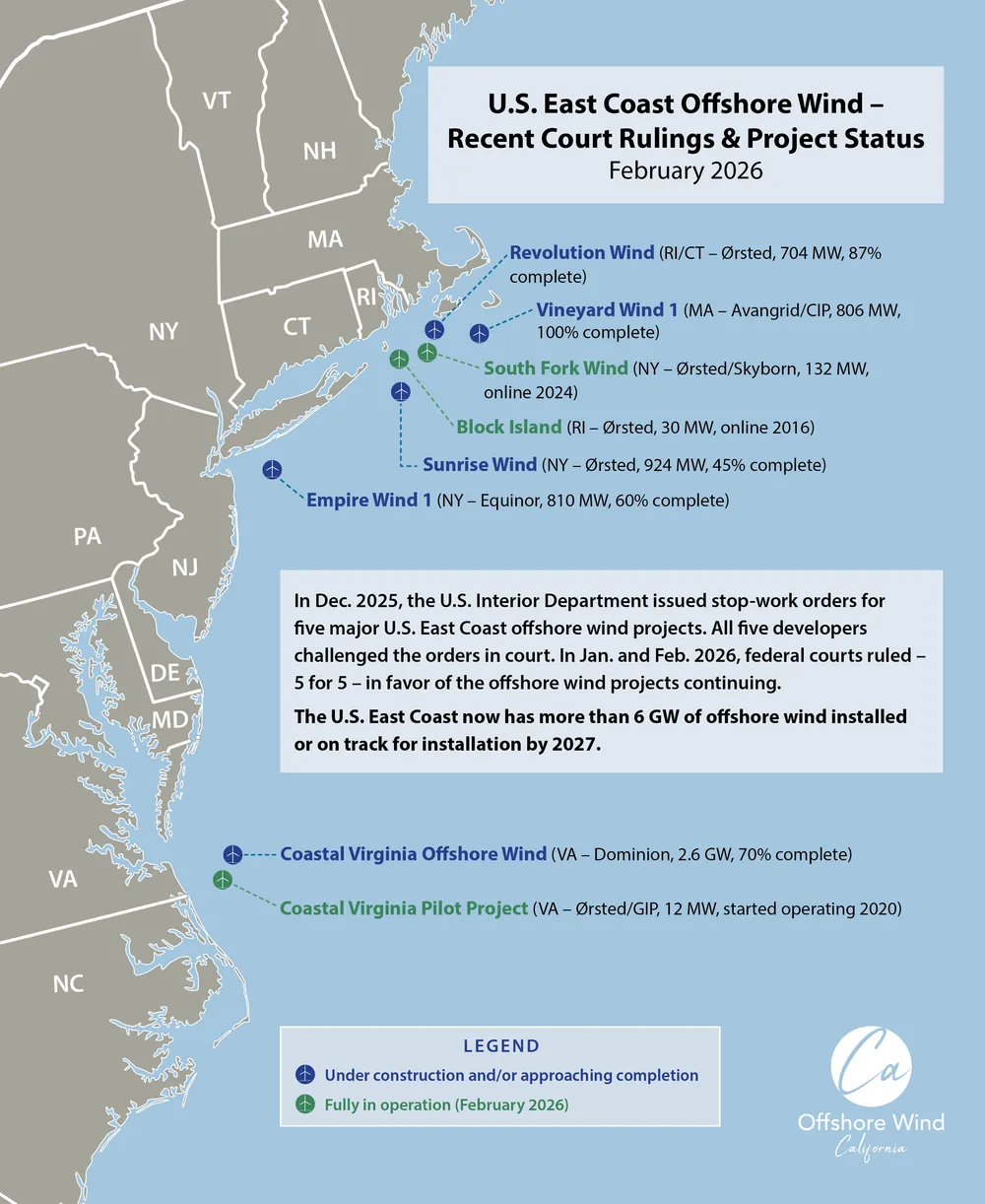
Five offshore wind farms on the U.S. East Coast are nearing completion after federal courts allowed all the projects to resume construction in rulings handed down between mid-January and early February. The U.S. Department of Interior had issued stop-work orders for the projects on December 22, 2025, a move eventually challenged in court by all five project developers.
Dominion Energy’s Coastal Virginia Offshore Wind project is more than 70% complete, WHRO’s Katherine Hafner reported last week.
“The company said this week it’s completed more than 70% of the wind farm and is on schedule to finish early next year. In the meantime, the turbines installed so far should start sending electricity to the grid by late March,” she writes.
Meanwhile, offshore Massachusetts, “Vineyard Wind is on the one-yard line,” writes E&E News’ Ben Storrow.
Iberdrola officials said on February 25, he adds, that “60 of the project’s 62 turbines have been installed off the coast of Massachusetts. Of those, 52 have been cleared to start generating power. Company executives said the final two turbines could be installed in a matter of days.”
Danish offshore wind developer Ørsted was days away from installing the first wind turbine at its Sunrise Wind project offshore New York, offshoreWIND.biz’s Adrijana Buljan reported last week.
Here is the status of all five projects as of February 2026, courtesy of a helpful map compiled by the trade group Offshore Wind California.
State lawmakers across the U.S. support plug-in solar
I had a feeling plug-in solar was poised to take off in the U.S. when I published a Q&A with a startup founder in the space last July. It turns out I was right.
The map below illustrates how, in the intervening months, bills related to plug-in solar, also known as “balcony solar,” have been taken up in statehouses across the country.
“As of mid-February, more than 50 bills related to plug-in solar were under consideration in 29 states and DC,” reports Brian Lips, a senior project manager with the NC Clean Energy Technology Center.
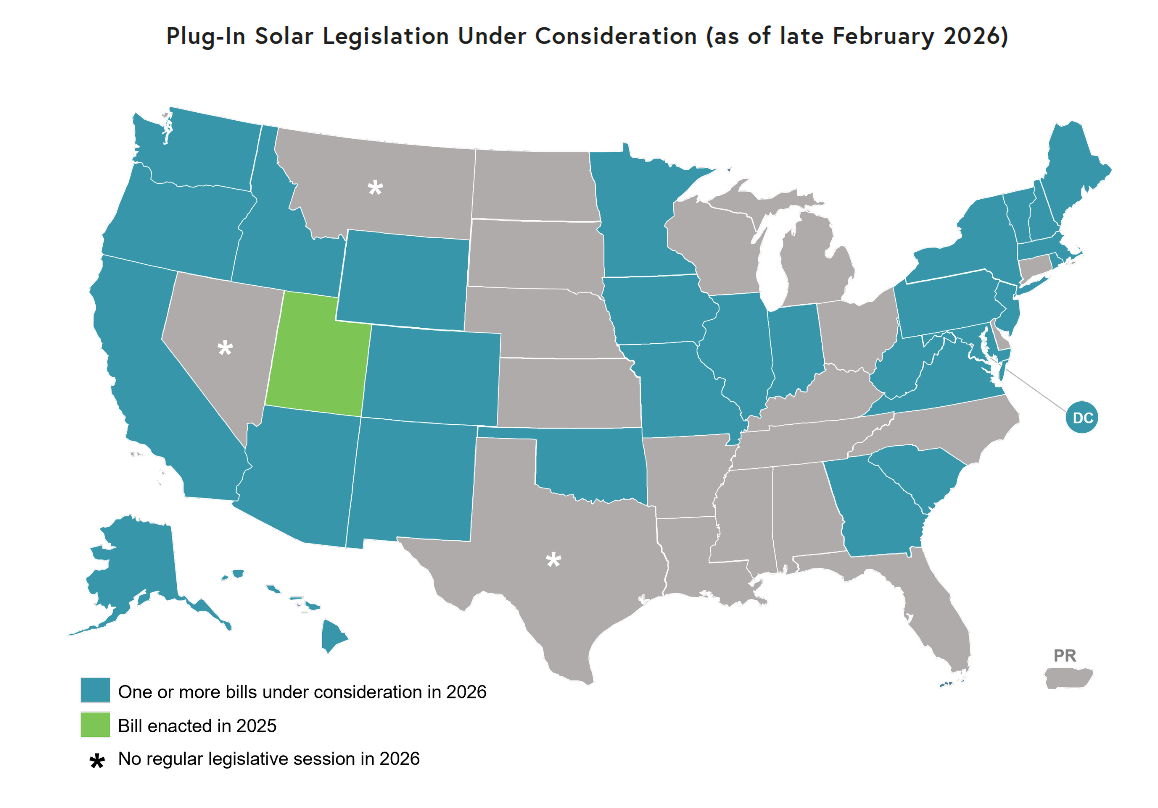
“Taken together, these legislative efforts suggest that plug-in solar is moving from a regulatory gray zone to a recognized product with a defined pathway to widespread use,” he adds.
“As more states standardize definitions, clarify exemptions from interconnection and net metering rules, and even preempt local or private restrictions, regulatory certainty will increase and help unlock broader adoption.”
Building electrification advances in California, Colorado, and Oregon
In a January roundup, I wrote about legislation introduced by California state Senator Scott Wiener (D) that aims to streamline permitting for heat pumps. That bill (SB 222) has since been passed out of the Senate and awaits a vote in the Assembly.
Last month, Wiener’s colleague in the Assembly, Marc Berman (D), introduced legislation that could accelerate adoption of heat pumps, induction cooktops, and other zero-emission electric equipment used in an all-electric home.
The Home Energy Choice Act (AB 2313), which is modeled on a program operating in New York state, offers “California homeowners the opportunity to electrify their home appliances when their utility is scheduled to replace the natural gas line connected to their homes,” according to a press release.
The bill would “offer Californians meaningful financial support to upgrade to significantly better home appliances,” according to Berman’s office.
“It is just common sense to give Californians a choice in the energy used in their homes. Why would we invest more than $20,000 per home in fossil fuel infrastructure when clean alternatives are available?” said Merrian Borgeson, California climate and energy director for the Natural Resources Defense Council.
At the California Public Utilities Commission, regulators are working on rules that would further erode fossil gas demand in the state.
“In December, staff released a draft proposal [R-2504010] considering phasing out ratepayer incentives and subsidies for gas efficiency measures,” according to the Building Decarbonization Coalition’s Madison Vander Klay.
“The proposal would phase-out ratepayer-funded energy efficiency incentives for non-cost-effective gas measures that are determined to have a Viable Electric Alternative (VEA) within retrofit projects, but argues that wider elimination would result in stranded assets.”
In Colorado, 2025 was “the year of the heat pump,” reports the Colorado Sun’s Mark Jaffe.
“In 2025, the number of heat pumps installed in the service areas of five major Colorado utilities more than doubled to 14,225, marking a twelvefold increase in three years,” he writes.
“The year is an inflection point where the electric heating and cooling technology has reached market acceptance and competitiveness, utility executives, installers and industry representatives say.”
The last stop on our tour of the West is Oregon, where new housing in the state “must be built with energy-efficient heat pumps instead of ducted air conditioning following an update to the state’s residential energy code the Oregon Building Code Division’s Residential and Manufactured Structures Board approved [on February 18],” Smart Cities Dive’s Ryan Kushner reported last month.
“The switch to mandatory heat pumps is expected to save residents of the newly constructed buildings an average of $125 a month in energy costs and more than $1,700 annually, per a Building Code Division analysis,” he writes.
Trump’s EPA pumps the brakes on electric school buses
It’s hard to think of better use of taxpayer dollars than getting rid of polluting diesel school buses.
The authors of the 2021 Bipartisan Infrastructure Law agreed, making $5 billion available to accelerate the retirement of diesel school buses across the country. The law was working as intended – until Donald Trump returned to the White House.
“Under the Biden administration, the Clean School Bus program funded replacement of 8,900 school buses in 1,300 school districts, 95 percent of them zero-emission battery electric vehicles,” Marianne Lavelle reported last month for Inside Climate News.
But Trump’s EPA plans to “revamp” the program, which it says “has forced unsafe and unreliable electric buses onto American schools.”
Lavelle notes that “the Clean School Bus program has been on hold since President Donald Trump took office, with $2.3 billion still unspent.”
On February 19, “the Environmental Protection Agency announced what it called a ‘revamp’ of the program, signaling it would no longer favor electric school buses. … Instead, the Trump administration is seeking to move to ‘a broad range of options,’ including buses fueled by natural gas, biofuel or hydrogen,” she writes.
“Demand for clean school buses has been high, and hundreds, if not thousands, of school districts waited for over a year only to recently discover their applications would not be honored,” Melody Reis, federal policy director at the advocacy group Moms Clean Air Task Force, told Lavelle.
“I can imagine they’re feeling disappointed and distrustful of the current EPA. It also means that thousands of kids who could have been riding electric school buses this school year are still riding the older, polluting buses that are harming our health and the environment.”
Bonus 1: Now boarding: cheap solar
Just how cheap are solar panels? Cheap enough that Scandinavian airline SAS is adding solar to boarding stairs, per the photo below shared by energy analyst Emil Dimanchev on Bluesky. Onsite renewables, it turns out, is just one of the ways airports and airlines are reducing emissions on the ground and at the gate, as I reported recently.
Solar is cheap, exhibit 3,141,592,653.
— Emil Dimanchev (@emildimanchev.bsky.social) 2026-02-25T18:35:26.944Z
Bonus 2: The “transmission mastermind” who sustained Ukraine’s grid
“Every time Russia attacks Ukraine’s power infrastructure, Ukrainian engineers risk their lives in the scramble to get electricity flowing again. It’s a dangerous job at best, and a lethal one at worst. It also requires creativity. Time pressure and equipment shortages make it nearly impossible to rebuild things exactly as they were, so engineers must redesign on the fly,” writes my friend, and energy transition chronicler extraordinaire, Peter Fairley.
In a new story for IEEE Spectrum, Peter profiles one of these remarkably brave engineers, “transmission mastermind” Oleksiy Brecht, who died in January while coordinating work at Ukraine’s most attacked electrical switchyard, Kyivska, west of Kyiv.
“Brecht’s life and death are a window into the realities of thousands of Ukrainian engineers who face conditions beyond what most engineers could imagine,” Peter writes.