What I’m reading: From crops to solar, Germany's heating transition, an innovative climate solution for renters, and more


Quitting Carbon is a 100% subscriber-funded publication. To support my work, please consider becoming a paid subscriber or making a one-time donation.
Welcome back to another recap of highlights from what I’ve been reading. This is the last time you’ll hear from me this year.
After the holiday break, I’ll share a list of the most popular stories published at Quitting Carbon in 2025.
Remember, through the end of this year, you can take advantage of a special offer to get one year of Quitting Carbon at a 25% discount.
Enjoy the holiday break, and thanks, as always, for reading.
From crops to solar in California’s Central Valley
If you live outside of California, you likely haven’t heard about the Valley Clean Infrastructure Plan. The project’s modest name belies its massive ambition.
At full build out, the project could include up to 21 gigawatts (GW) of solar energy, 21 GW of battery energy storage, and 400 miles of new transmission lines and substations, according to San Jose State University’s Dustin Mulvaney. Last week, the project was approved by the board of the Westlands Water District (WWD), which serves parts of Fresno and Kings counties in California’s Central Valley.
"The plan repurposes up to 136,000 acres of drainage-impaired and water supply-limited lands for solar generation, energy storage, and transmission infrastructure, using previously cultivated acreage to support clean energy development while reducing pressure to build on undisturbed lands," according to a WWD press release.
"The approval of the plan’s environmental review Tuesday paves the way for the company working with Westlands, Golden State Clean Energy, to start developing and then selling off the individual solar installations — as many as 20 gigawatts in all — that will fit into the region’s existing patchwork of fields and orchards," writes Politico’s Camille von Kaenel. "Construction wouldn’t begin until 2028 at the earliest and continue for around a decade."
Writing at Bluesky, Mulvaney cites the project as an example of how to build big solar projects faster.
"Westlands’ solar siting approach is programmatic: pre-zone large areas for solar, study impacts once in a Program EIR, then let individual projects tier off it. That speeds deployment, cuts litigation risk, and aligns generation with planned transmission."
Mulvaney and collaborators at the Roosevelt Institute and Climate and Community Institute highlighted Westlands’ expedited planning process for the Valley Clean Infrastructure Plan in a report, "Planning to Build Faster: A Solar Energy Case Study," published in October 2024.
Germany is planning for a future without fossil gas for heating
As Germany continues to decarbonize its power grid – renewables covered 56% of the country's gross electricity consumption this year – policymakers have stepped up their efforts to ensure that carbon-free electricity is used to displace fossil fuels for heating.
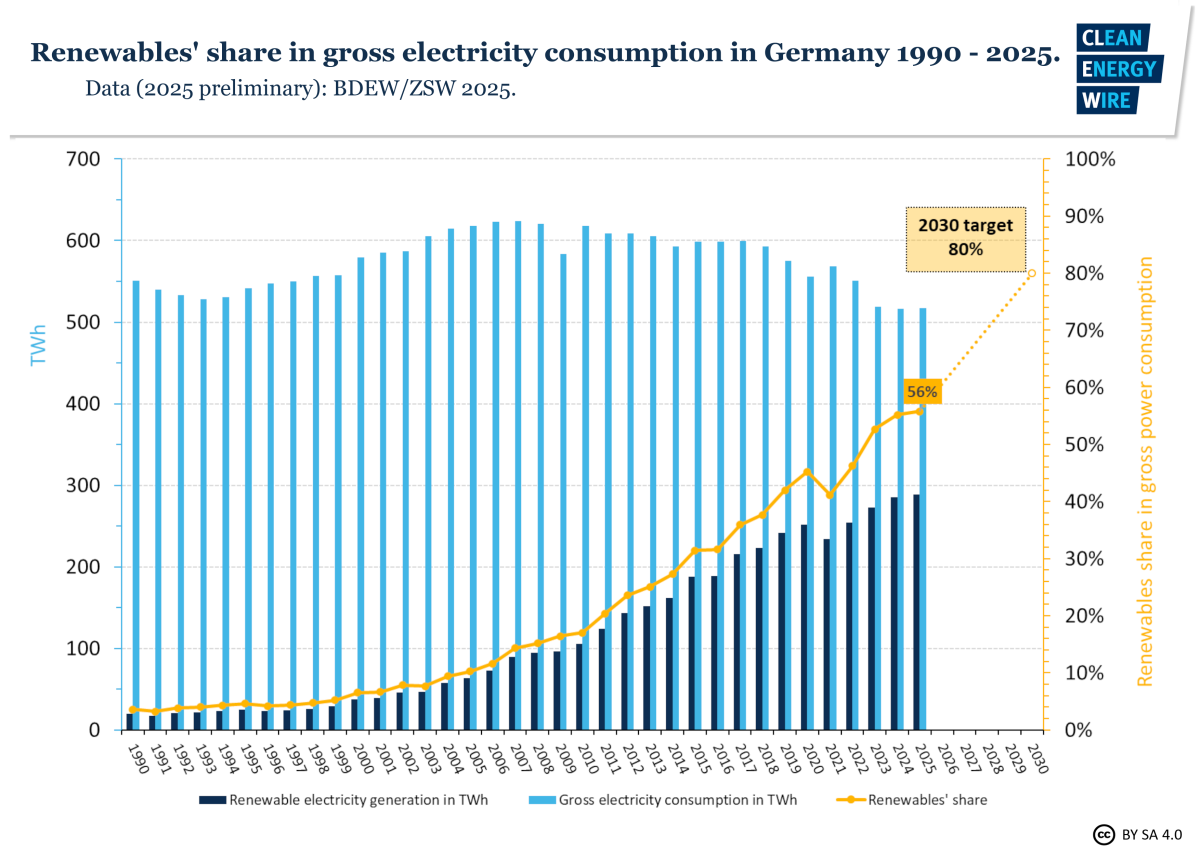
The indispensable site Clean Energy Wire is the best source of information I know of on Germany’s heating transition (as well as Germany and Europe’s energy transitions writ large). Here are some recent developments covered at the site that caught my eye.
"Heat pumps and district heating account for over 70 percent of heating systems in new homes in Germany, thereby driving forward the heating transition, shows data by energy industry association BDEW," Julian Wettengel reported in October.
"In 2024, 215,900 new apartments were completed in 76,100 new residential buildings in Germany. One quarter of the new apartments are connected to district heating, 46 percent use a heat pump, and 21 percent are heated by gas boilers," he writes.
In November, Wettengel’s colleague, Carolina Kyllmann, reported that Germany’s federal government is "preparing a draft law to enable local utilities to phase out gas grids as they plan for a climate neutral future."
"Utilities have voiced concerns that a lack of rules governing the phase-out remains a major obstacle in the decision-making process to decommission grids or convert them to green gas,” she adds. "According to the draft, utilities would have to inform affected users well in advance and provide information on alternatives and subsidies."
Similar efforts to plan the phase out of fossil gas pipeline networks are underway in California and Colorado, as I have reported here at Quitting Carbon.
Proactive government planning and outreach on any phase out will be essential because as gas customers leave the system, the customers who remain could see higher bills, as Benjamin Wehrmann reported earlier this month.
"Households that continue to rely on gas heating systems in Germany may face additional costs of more than 4,000 euros per year by 2045 due to rising grid fees, an analysis by research institute Fraunhofer IFAM has found."
He adds, "As more and more households are expected to switch to other heating technologies over the next 20 years, the remaining gas customers could see their costs rise by a factor of ten, as fewer customers would foot the bill for maintaining distribution grids, the researchers said."
Meanwhile, in the power sector, Germany recently scaled back its plan for new fossil gas power plants.
"Germany’s governing coalition parties have drastically reduced plans for new gas-fired power plants to be built over the coming years to serve as backup capacity for intermittent renewables while the country phases out coal," Wettengel reported last month.
"The facilities must be built in a way that allows them to be later converted to run on hydrogen," he went on. "The German government plans to hold auctions next year for state support to build new gas-fired power plants with a combined capacity of 10 gigawatts by 2032 – a drastic reduction compared to earlier plans to build up to 20 GW by the turn of the decade."
Energy savings + rent caps = happy tenants
Earlier in my career, I worked as a writer and editor for California’s statewide energy efficiency campaign. Because of that experience, I still get excited when I come across innovative policies and programs that save energy and reduce household utility bills.
The New York Times and the American Council for an Energy-Efficient Economy (ACEEE) recently covered programs in Nebraska and Florida, respectively, that offer apartment landlords incentives to upgrade their units, in exchange for limiting future rent increases.
"In a struggling area of Lincoln, a program pays for repairs and energy efficiency upgrades in rental buildings. In return, landlords must keep rents affordable," Cara Buckley reported last month for the Times. The story is included in the paper’s fantastic “50 States, 50 Fixes” series on local climate solutions.
Buckley focuses on the Regent, a nearly century-old apartment building in Lincoln’s low-income South of Downtown neighborhood.
"The Regent is among the dozens of buildings that the city of Lincoln has helped weatherize and repair since 2023, as part of a program to rehabilitate decrepit buildings and improve their energy efficiency without pricing out tenants," she writes.
In Florida, the Alachua County Energy Efficiency Program (ACEEP) is a rental housing efficiency program "that cuts utility bills and improves comfort while capping rent increases," writes ACEEE’s Mark Rodeffer.
The program was supported by ACEEE’s Energy Equity for Renters program.
ACEEP began enrolling new properties in the spring of 2024. "It provided up to $15,000 per house or apartment for a range of energy upgrades, including insulation, air sealing, window and door replacement, heat pumps, and more efficient water heaters, washers, dryers, and refrigerators. Participating property owners must agree to cap rent increases at the consumer price index for seven years if they receive $15,000 in upgrades, five years if they receive $10,000, or three years if they receive $5,000," writes Rodeffer.
"ACEEP went from struggling to find participants and at risk of losing its funding to becoming a countywide program lowering utility bills and increasing comfort and safety inside homes," he adds.
Bonus: Funding relief coming for public media
Last month, I highlighted the funding crisis facing public media in the U.S. after Republicans in Congress canceled funding for the Corporation for Public Broadcasting this past summer. When the federal funding was eliminated, supporters of public media mobilized to attempt to close the funding gap.
One such initiative, the Public Media Bridge Fund, just announced a $26 million first round of grants.
"More than 70 grantees – operating over 180 radio and television stations – nationwide will receive crucial funding in first wave of grants designed to sustain vital local news and cultural programming," the Bridge Fund said in a press release.

"Organizations in 25 states and territories received funding. Twelve of the licensees receiving grants are in Alaska, one of the states where public media organizations depend the most on federal funding," Current’s Tyler Falk reported earlier this month.
You can donate to the Public Media Bridge Fund here.