What I’m reading: Solar and wind repowering, the off-grid solar boom, adding wind for a cheaper grid, global energy transition tracker, and more
Quitting Carbon's biweekly roundup of energy transition developments you might have missed.


Quitting Carbon is a 100% subscriber-funded publication. To support my work, please consider becoming a paid subscriber, gifting a paid subscription, or leaving a tip.
Welcome back to another roundup of important energy transition developments you might have missed.
Programming note: I'll be in Berlin next week for an Energy Diplomacy Media Fellowship hosted by the German Agency for International Cooperation and my friends at Clean Energy Wire. With my days packed with workshops and site visits, I may not send a newsletter during the week. But expect to see reporting based on the trip in your inbox in the coming weeks.
Have a great weekend and thanks, as always, for reading.
More data on the solar and wind repowering opportunity
In the research roundup I published earlier this month, I cited data from a Foundry-Logic/Crux report released this fall on the potential to increase U.S. solar power capacity by tens of gigawatts through 2040 by repowering the country’s first generation of large-scale projects.
That report was followed by research published earlier this month by the research and consulting firm Wood Mackenzie on the enormous opportunity to repower solar and wind projects.
“Repowering,” as the name suggests, takes place when a solar or wind project owner upgrades an existing project by replacing individual components, or installs new more powerful turbines or PV panels, to extend the life of the project or increase its power generating capacity.
As with the earlier Foundry-Logic/Crux report on solar repowering, the new WoodMac research offers a clearer picture of the enormous market opportunity for repowering renewables projects.
“Of the more than 3.5 TW of wind and solar capacity operational worldwide by the end of 2025, Wood Mackenzie forecasts that over 70% will face a decommission, extend or repower decision in the 2040s,” write a team of WoodMac analysts.
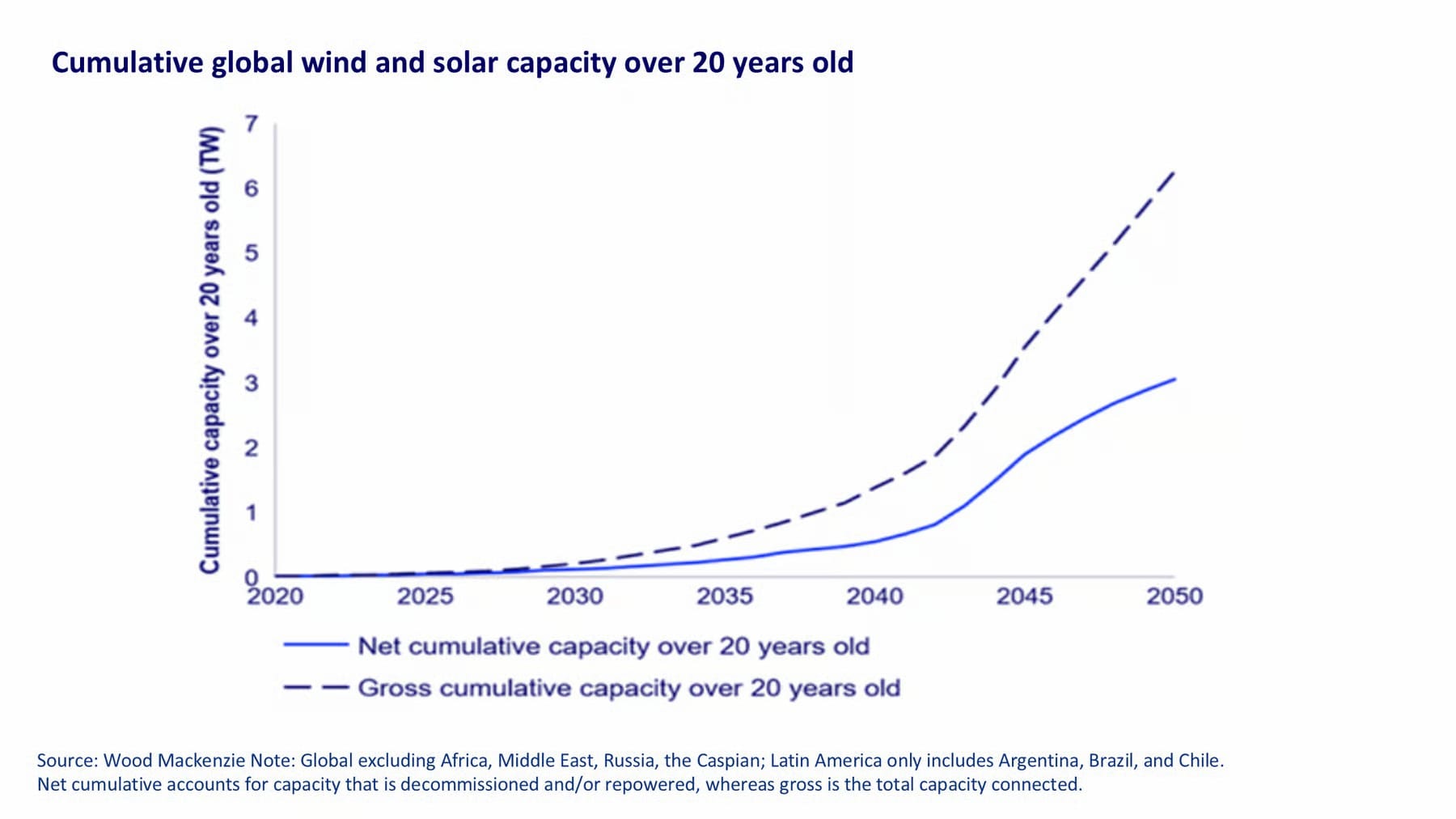
“Ageing wind projects are the most pressing,” they add. “Our latest Horizons report shows that almost 50 GW of wind is now over 20 years old, broadly the design life of these earlier turbines. The number quickly rises to over 230 GW by 2040. And while the rapid deployment of solar PV may have started later, global solar capacity more than 20 years old will overtake wind before 2040.”
And because new wind turbines and solar panels are more powerful, durable, and efficient than older models, upgrading to new technology that lasts longer is attractive.
“The average wind turbine rating has increased fourfold over the past two decades and continues to rise. Meanwhile, the efficiency of solar modules has risen by almost 70% over the same period and average solar sites now require around a third less land for the same capacity,” according to the WoodMac analysts.
“Missing” solar panels and the off-grid solar boom
Solar panels are now so cheap that even households in developing countries can install panels on their rooftops without government subsidies.
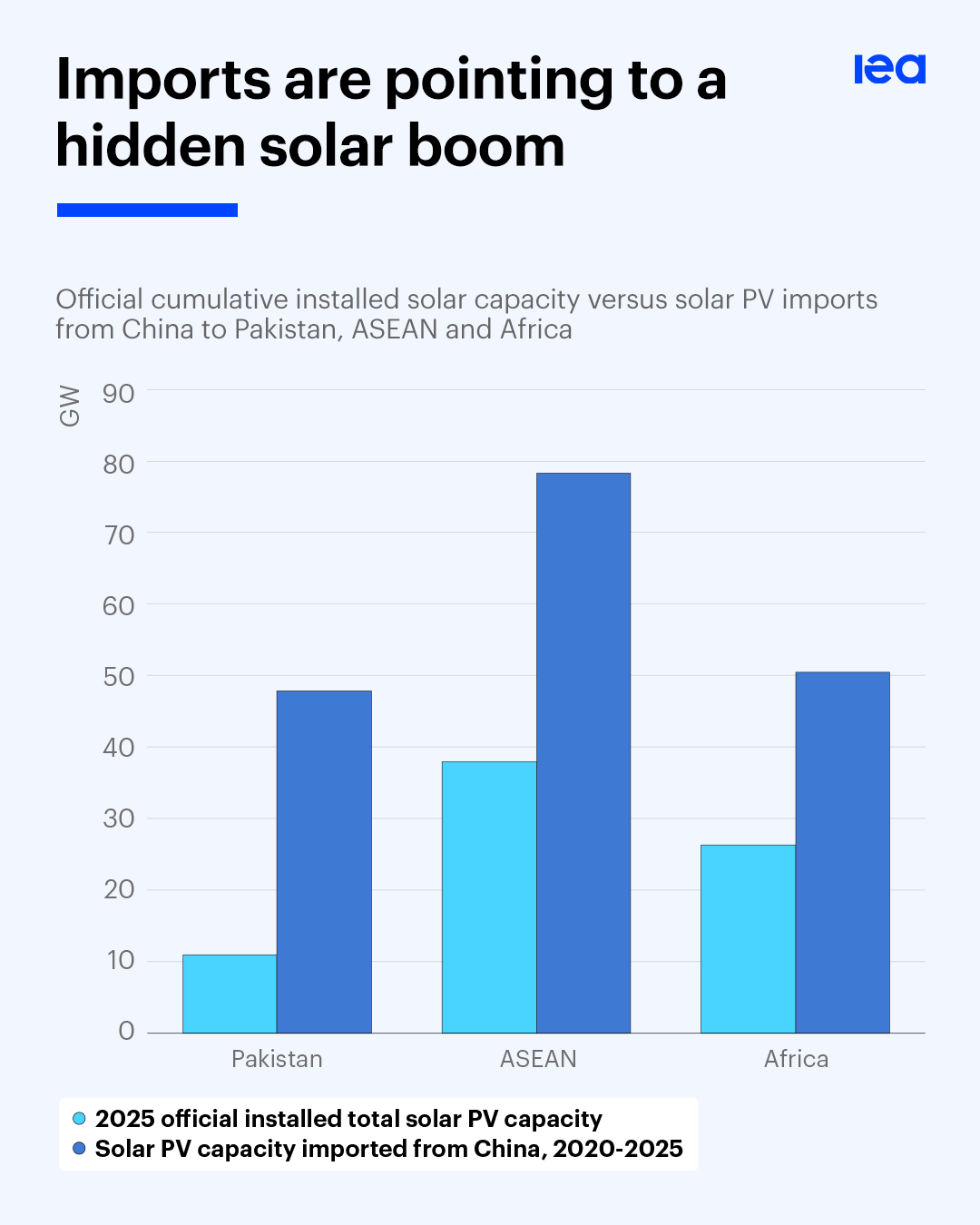
New data from the International Energy Agency (IEA) on what it calls “missing” solar panels illustrates this phenomenon.
“According to official statistics from many developing economies, there is a significant disconnect between the reported level of installed solar PV capacity and the volume of solar panels imported from China, the world’s largest manufacturer,” according to the IEA.
Some of these panels are re-exported to avoid tariffs, notes the IEA, but most are likely being installed domestically, just off grid:
“The fate of these ‘missing’ solar panels may seem like a mystery. But one explanation is that in regions without full access to electricity, or where there are recurrent power outages, consumers are taking the initiative to install small rooftop or garden systems themselves. Because these systems are not typically connected to electricity grids, governments can struggle to keep track of them using traditional methods of data collection.”
According to the IEA, we should expect to see countries across Africa, the Middle East, and Southeast Asia join Pakistan in hosting off-grid solar booms:
“Given current trends, the IEA now forecasts that almost 80 gigawatts of off-grid solar capacity will be installed through 2031 – two and a half times the amount installed in the 2020-2025 period. Outside of Pakistan, which has a dynamic off-grid market, sub-Saharan Africa is set to lead this surge, with more than 21 gigawatts of new capacity installed in the 2026-2031 period – equivalent to all of the region’s installed off-grid solar capacity today. In Southeast Asia, where consumers in the countries most affected by the current energy crisis are turning to off-grid systems to reduce their bills, about 10 gigawatts of additional off-grid capacity is expected to be installed – a tenfold increase from the region’s current capacity.”
China’s zero-carbon industrial parks
China’s massive industrial campuses are getting a “low-carbon makeover,” reports Bloomberg’s Lili Pike.
This week, Pike reported on the Chinese government’s adoption of a goal to build hundreds of zero-carbon industrial parks across the country.
“The first ones sprouted up in China about five years ago, and last year, the growing trend went national, with the central government approving 52 official zero-carbon industrial park pilots,” she writes.
“When Chinese leaders released their five-year plan in March, it included a goal of building 100 by 2030. Together with projects undertaken at the provincial and corporate level, hundreds of these industrial park experiments are slated for development across China.”
Nova Scotia, New England states strengthen their offshore wind partnership
The Trump administration has tried – and so far failed – to stop the construction of five large offshore wind projects on the U.S. East Coast. Earlier this month, the developers behind two of those projects, Revolution Wind and Vineyard Wind, each announced that their projects were fully operational, as Miriam Wasser reported for WBUR.
But the White House’s meddling has chilled the U.S. offshore wind market, freezing future projects. In response, New England states that had been counting on regional offshore wind projects to diversify and decarbonize their grids are looking north to Nova Scotia to make up some of the Trump-induced shortfall.
In my last roundup, I mentioned that Canada’s federal government had committed $100 million ($71 million U.S.) to advance Nova Scotia’s Wind West offshore wind initiative and that the U.S. state of Vermont had signed a deal with Nova Scotia to investigate how to deliver the province's offshore wind power to the New England grid.
Last week, Nova Scotia and Vermont, along with the states of Connecticut, Maine, Massachusetts, and Rhode Island, issued a Request for Information (RFI) to “help the region understand the market’s interest and capacity to develop offshore wind in Nova Scotia and the technical and commercial feasibility of transmission pathways to New England.”
According to the governments, the information request will also “explore opportunities to strengthen the regional offshore wind economy through continued collaboration on supply chains, ports, and workforce development.”
Adding wind lowers the cost of a high-renewables grid
Adding wind to the power mix lowers the cost of a near-100% renewables grid by about 20%, finds a new report from Ember.
“With wind, three-quarters of the world’s electricity demand can have 90% uptime for under $100/MWh. Without it, only half,” write a team of researchers with the energy think tank.
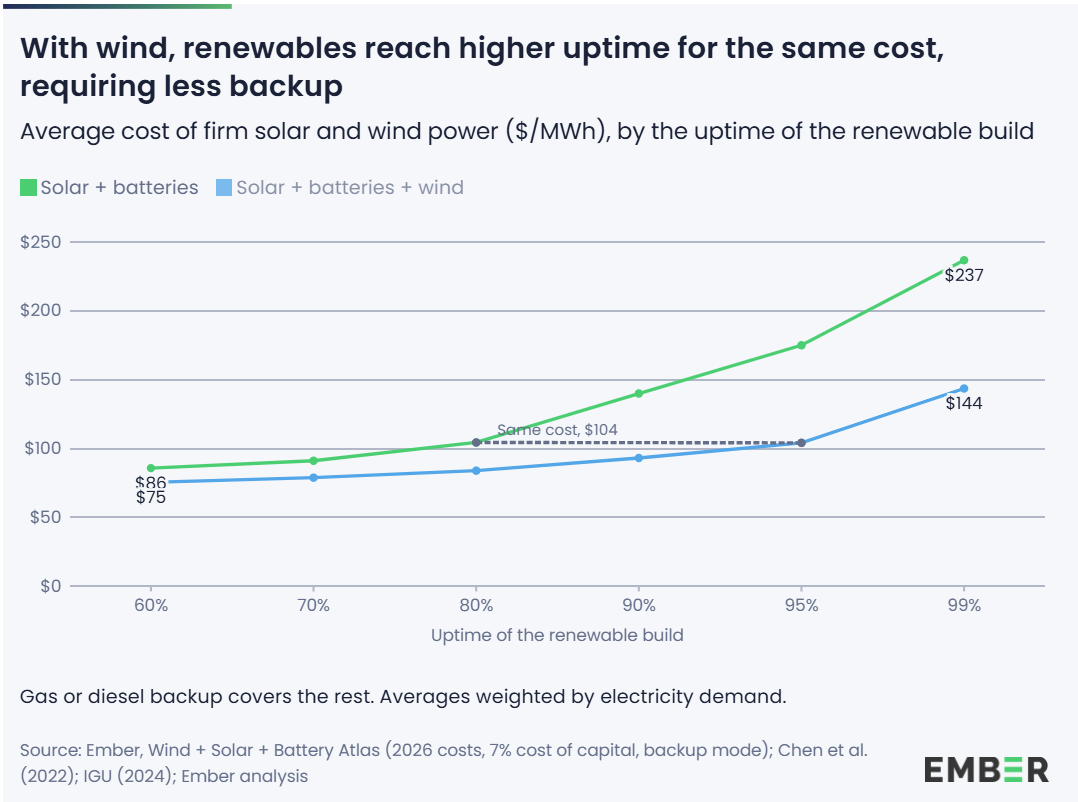
“Adding wind to solar and batteries cuts the median cost of reaching 90% uptime by nearly a fifth, from $105 to $86/MWh,” they add.
The complementary nature of daily and seasonal wind and solar power generation cycles also reduces the need for energy storage or fossil gas backup.
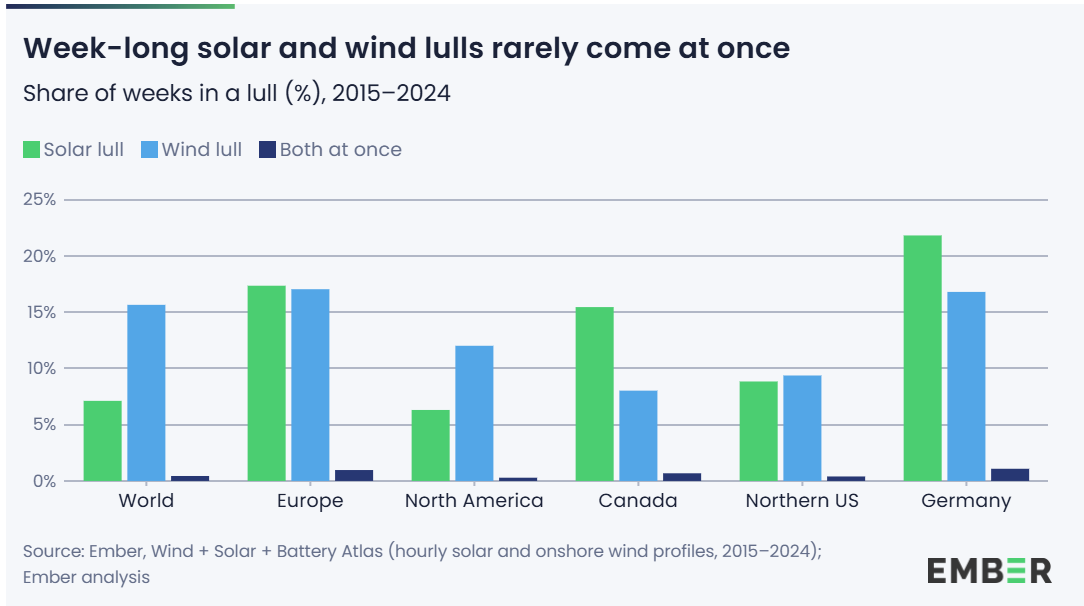
“We already know that solar and wind are cheap. The much more interesting question is how cheaply we can make them reliable. And the answer is increasingly clear: by combining solar, wind and batteries, we can deliver reliable power at remarkably low costs almost everywhere in the world. That’s a pretty fundamental shift in the economics of energy,” writes Ember's Daan Walter.
Let’s take another quick tour of the globe for some recent clean energy deployment records and milestones:
Global EV sales surge continues
- Electric vehicles outsold gas-only cars in Australia for the third consecutive month in October, with EVs accounting for a 23.1% share of the new vehicle market. (Sam Parkinson, Renew Economy)
- October was another record month for EV sales in the UK, with nearly 50,000 battery-electric vehicles (BEVs) registered, a 54% increase over the same month last year. BEVs accounted for 32% of all new car sales in the month, more than gas- or diesel-only and hybrid vehicles. (Michael Holder, BusinessGreen)
- Battery-electric vehicles accounted for a record 37% share of Germany's new car market in October. Slightly more than 94,086 BEVs were sold in the month, an increase of nearly 80% over the same month last year. (Fred Lambert, Electrek) Electric vehicle sales are so strong in Germany that funding for the federal government's €2.7 billion ($2.97 billion) EV subsidy program, which was slated to last until 2029, could be zeroed out by the end of 2027. (Karsten Seibel, Politico)
- Battery-electric vehicles accounted for more than 8% of new passenger vehicle registrations in India in September – up from 4% at the end of 2025. (Shreeyashi Ojha, EV Infrastructure News)
- Battery-electric vehicles now displace 1.2 million barrels of oil per day, 1.2% of global oil consumption and more than five times the amount displaced five years ago. “BEVs make up about 4.2% of the global car fleet but account for a quarter of all new cars sold worldwide.” (Transport and Environment)
The Iran War is driving down emissions
- China's CO2 emissions fell by 3.1% in the third quarter of 2026 – “the largest quarterly reduction since the 2022 Covid lockdowns and means that China’s CO2 emissions have now fallen by an estimated 0.5% in the year to date.” (Lauri Myllyvirta, Carbon Brief)
- Global fossil fuel emissions are on track to fall slightly in 2026, according to data from the Global Carbon Project. “Nations are projected to emit roughly 38.2 billion tons of planet-warming carbon dioxide by burning oil, gas and coal for energy this year. ... That’s roughly 0.4 percent less than in 2025.” (Brad Plumer, New York Times)
Coal-fired power slumps in China
- Coal generation in China fell 7.3% in October, according to the country's National Bureau of Statistics. (Benjamin Storrow, Politico)
U.S. sees rapid energy storage expansion
- U.S. battery energy storage installations are up 20% year-over-year through the first nine months of 2026. U.S. installed battery energy storage capacity now exceeds 200 gigawatt-hours. (SEIA)
Heat pumps becoming standard in California
- Three in four new California homes had heat pumps for both space and water heating in 2026, up from 1% in 2019. (Building Decarbonization Coalition)
One more thing: Support journalism that matters to you
Last week, I marked the 2nd anniversary of this newsletter by urging you to support the independent journalism you read here and everywhere else you find it online.
So I was thrilled to see, a few days before, a crowd of 400 turn out to support Canary Media's clean energy journalism at a live event in downtown Berkeley, California:
It was heartening to see such a big crowd turn out to support @canarymedia.com's journalism last night in Berkeley! This was @leahstokes.bsky.social talking with @jeffstjohn.bsky.social about Gavin Newsom's record on climate and clean energy and the agenda for incoming Governor Xavier Becerra. 🔌💡
— Justin Gerdes (@justingerdes.bsky.social) 2026-11-11T17:05:58.237Z
We should also support journalism with our federal tax dollars. Our friends up north have a template to follow:
Here's something for the new Democratic majorities in Congress to copy: Canada's new federal budget would make a local reporting program permanent and extend a 35% tax credit on newsroom salaries: www.niemanlab.org/2026/11/a-go... via @niemanlab.org's @sarahscire.com
— Justin Gerdes (@justingerdes.bsky.social) 2026-11-12T23:18:07.698Z