What I'm reading: Special research roundup edition
Quitting Carbon checks in on recent energy transition research you might have missed with a special roundup of notable reports and studies.


Quitting Carbon is a 100% subscriber-funded publication. To support my work, please consider becoming a paid subscriber, gifting a paid subscription, or leaving a tip.
I'm back this week with a roundup of notable reports and studies on the energy transition you might have missed. This every-once-in-a-while series is my way of flagging new research that merits your attention.
Expect to hear from me again next Thursday, when I’ll be marking a big milestone for Quitting Carbon.
Before that, for any of you from the San Francisco Bay Area who are attending Canary Media’s live event in downtown Berkeley next Tuesday, I’ll be there as well. Find me and say hello!
Have a great weekend and thanks, as always, for reading.
EVs: Durable batteries, better reliability, and cheaper to operate
With millions of electric vehicles on roads across the globe, we're getting more real-world data on their performance and operating costs.
We're learning, for example, that many EVs retain more than 90% of their battery capacity, even after 93,000 miles.
According to a study by battery diagnostics company AVILOO, “At 150,000 km (93,000 miles), the Mercedes-Benz EQA comes out on top among the 20 models, with a median battery SoH [State of Health] of 94%. The Hyundai IONIQ 5 follows at 93.8%, while the BMW i4 reaches 93.6%,” reports Interesting Engineering's Kaif Shaikh.
“Overall, the results are reassuring for EV owners,” writes Shaikh. “Even the lower-ranked models retain substantial battery capacity after 150,000 km, while the strongest performers remain above 93%.”
High-mileage EVs are more reliable than gas- or diesel-powered vehicles, too, according to data out of the UK.
“Electric vehicles (EVs) with between 90,000 and 120,000 miles on the clock are around 25 per cent less likely to fail an MOT [Ministry of Transport test] than petrol cars with the same age and mileage,” reports BusinessGreen's Stuart Stone.
The findings come from an analysis of 47.4 million tests commissioned by the British Vehicle Rental and Leasing Association, “which today suggested EV failure rates level off at around 60,000 miles, while petrol and diesel numbers continue to climb,” writes Stone.
And in the UK, EVs are now considerably cheaper than fossil fuel-powered cars to drive, according to research from Carbon Brief's Molly Lempriere and Ho Woo Nam.
“The latest surge in fossil-fuel prices means it is now up to nine times cheaper in the UK to drive an electric vehicle (EV) than a petrol or diesel car,” they reported at the end of September.
Countries with growing EV fleets are buffered from those surging fossil fuel prices.
“Electric car fleets have saved oil-importing countries $20 billion since the start of the US-Israel war with Iran,” according to research published last month by the think tank Ember.
“The countries that invested in electric vehicles before this crisis are now better protected and a growing number are following. Every electric car on the road reduces exposure to volatile oil markets, and as fleets grow, so does the protection against future supply shocks,” writes Ember Senior Energy Analyst Euan Graham.
The potential for solar repowering
I've written a few times in this newsletter (see here and here) about the impending opportunity for project developers to repower the first generation of U.S. solar farms. A new report includes some eye-popping statistics that illustrate the market opportunity.
The report, from energy services company Foundry-Logic and clean energy capital platform Crux, “estimates that ‘repowering’ existing solar farms, or replacing old panels with new ones, could unlock about 9.6 gigawatts of solar power by 2030, 29 gigawatts by 2035, and 67 gigawatts by 2040,” reports Heatmap's Emily Pontecorvo.
“Solar is entering its first replacement cycle at this moment when we are seeing a structural increase in demand,” Lisa Hansmann, the director at Foundry-Logic and one of the paper’s authors, told Pontecorvo.
Solar + storage is saving California and Texas billions
So much solar and storage capacity has been added to the California and Texas grids over the past five years it is driving down summertime wholesale electricity prices in the two huge energy markets.
“In summer 2026, America’s two largest states met record high electricity demand at vastly reduced wholesale electricity prices because of new solar and storage,” finds an analysis published last month by the Solar Energy Industries Association.
The research “found that solar and storage saved Texans approximately $3.55 billion and Californians approximately $2.5 billion from June through August 2026, compared with the same period in 2021.”
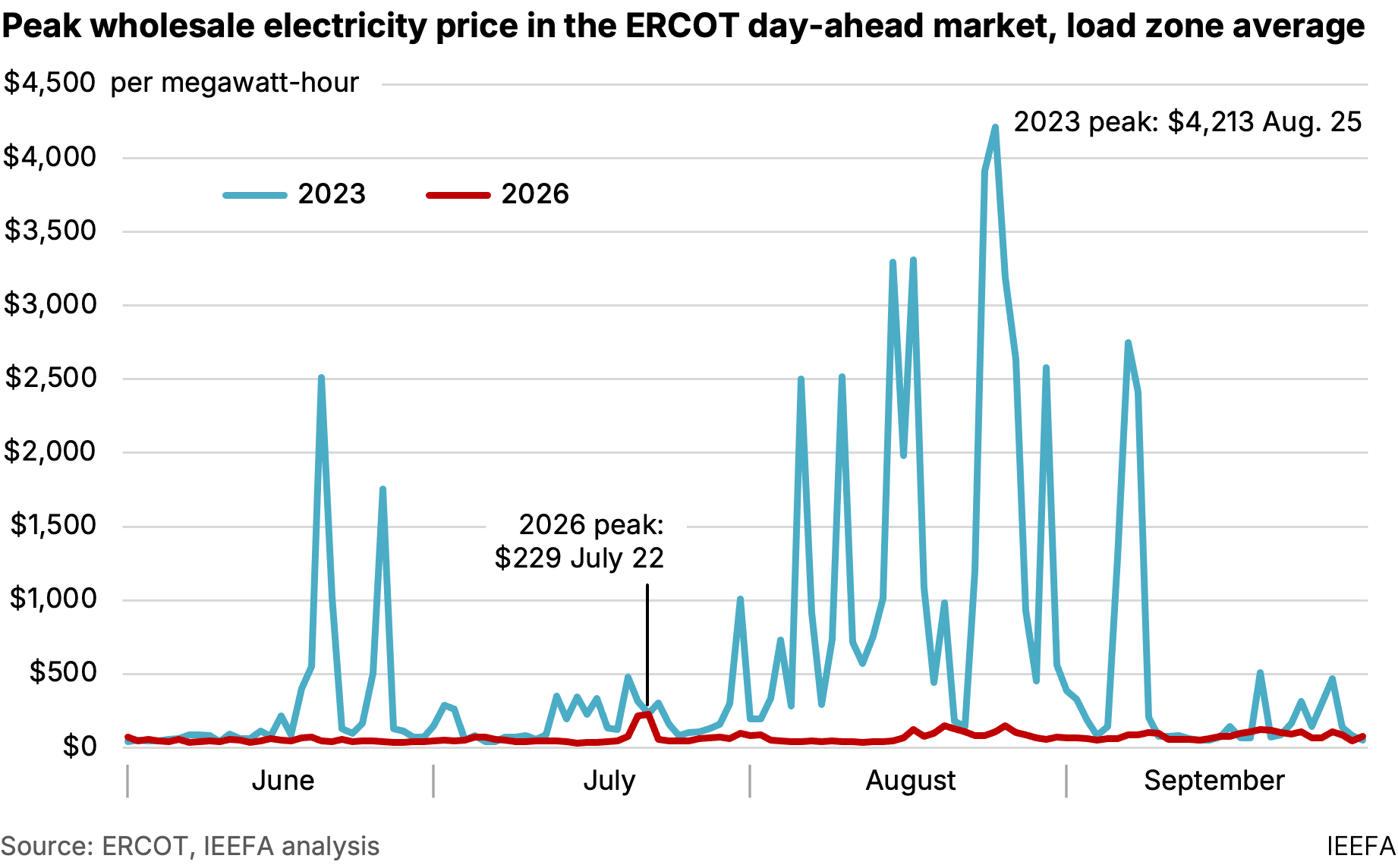
In Texas, the surge in solar and storage capacity helped keep prices stable on the ERCOT (Electric Reliability Council of Texas) grid this summer despite record demand.
“The [ERCOT] system, which supplies about 90% of the state’s electricity demand, set new peaks in July and August, soaring above previous highs from the hot summer of 2023,” write Dennis Wamsted and Seth Feaster, researchers with the Institute for Energy Economics and Financial Analysis (IEEFA).
“However, unlike that year’s large and consistent price spikes, power prices this summer were low and stable – almost boring. The difference: vastly more solar and battery storage in the Lone Star State.”
Renewable energy investors love projects co-located with storage
Global renewable energy investment plateaued in the first half of 2026, after last year's decline, according to data from research provider BloombergNEF.
As the market stabilized early this year, one sector boomed: projects co-located with storage.
“Concerns about curtailment, power price cannibalization, and grid congestion led asset financing to fall in multiple markets – particularly China, Brazil and parts of Europe. Those same challenges drove investors and developers toward projects with co-located storage,” write BloombergNEF analysts.
“Co-located assets received a record $25 billion investment in the first half of the year, nearly double 2H 2025 levels and triple the amount seen in 1H 2025. The US and Australia continue to lead global co-located solar and storage investments in 2026,” they added.
Battery storage is cheaper than gas peakers across the globe
Batteries are now so attractive to investors and project developers because installation and operating costs have fallen precipitously in recent years. Case in point: new data from the consultancy Wood Mackenzie finding that four-hour battery storage is now cheaper than gas peaker plants across the globe.
“In the United States for a 2026 commercial operation date, 4-hour battery storage can be 65% to 75% cheaper than new open-cycle gas turbine gas peakers,” a Wood Mackenzie spokesperson told Utility Dive's Robert Walton.
“Wood Mackenzie calculates four-hour battery storage projects are now less expensive than open-cycle gas turbines in all major markets,” reports BusinessGreen's James Murray.
Deploy batteries at the grid edge for the most value
As for where to deploy batteries, new research prepared for the energy company Base Power by The Brattle Group, a consultancy, finds that batteries installed in homes can deliver more value relative to “transmission-connected batteries.”
The report “finds that distributed batteries could deliver 22% to 66% greater system benefits per kilowatt than comparable transmission-connected batteries.”
“The scale of incremental benefit relative to transmission-connected batteries depends on whether battery deployment is targeted toward areas with distribution grid constraints,” according to a Brattle press release.
“The analysis estimates $95 per kilowatt-year (66%) in additional system benefits for locationally targeted distributed batteries and $32 per kilowatt-year (22%) more value for batteries deployed evenly across a utility’s service territory.”
One more thing: Scenes from Auburn, California
I visited the Gold Country town of Auburn, California, last weekend. Not far from the Old Town – make sure to visit Auburn Alehouse and have the Gravedigger Black IPA, when it's on draft! – is a small gem: School Park Preserve.
Protected by the Placer Land Trust, the open space and woodland is a sanctuary for four species of oaks, including several “heritage oaks” more than 150 years old.


School Park Preserve, Auburn, California. Credit: Justin Gerdes.