
What I'm reading: Special research roundup edition
Quitting Carbon checks in on recent energy transition research you might have missed with a special roundup of notable reports and studies.

Quitting Carbon is a 100% subscriber-funded publication. To support my work, please consider becoming a paid subscriber, gifting a paid subscription, or leaving a tip.
Programming note: I'm working on several stories at the moment, including a few conversations that will be published as Q&As in the coming weeks. Until then, I thought this week I'd share some important recent reports and studies on the energy transition you might have missed.
Have a great long holiday weekend and thanks, as always, for reading.
How to make “green statecraft” durable in 2029 and beyond
“How can the United States build climate policy that lasts?”
That’s the question a group of former Biden administration officials, academics, and policy experts sought to answer in a policy handbook published recently by the Roosevelt Institute.
“This first-of-its-kind, 17-essay collection brings together 19 scholars and practitioners to sketch out what a future governing agenda for climate could look like, post-DOGE,” writes Todd N. Tucker, director of Roosevelt’s industrial policy and trade program.
The collection’s essays are divided into four sections: governing, planning, financing, and producing the next phase of the energy transition.
“Together, they constitute a slice of what a ‘Project 2029’–type effort for climate would look like, including adapting Donald Trump’s means to progressive ends,” writes Tucker.
When it comes to climate impact, it’s almost never too soon to ditch your gas-guzzler
If you’re curious about buying an electric vehicle but have hesitated to make the shift because you wonder whether it’s better for the climate to hold on to your internal combustion engine vehicle (ICEV) just a little bit longer, a new report makes it very clear: ditch it.
The report authors, J. Elliott Campbell and Roland Geyer, researchers at the University of California, Santa Cruz, and UC Santa Barbara, respectively, “conducted life-cycle analyses of different vehicle types and concluded that the energy impact benefits from swapping an EV for an ICEV begin to accrue as early as the first day of the life of the ICEV, and that replacement early in the life cycle consistently provides reductions in greenhouse gas emissions,” writes Jesse Smith, a senior editor at Science.
“Financial considerations will also affect when people choose to make the replacement, of course, but from the perspective of emissions, it is almost never too soon to switch.”
“Although scrapping a functional asset remains economically prohibitive under current market conditions, these results demonstrate a major mitigation potential for policy interventions, such as enhanced scrappage subsidies, to address the emissions of an increasingly durable ICE fleet,” write Campbell and Geyer.
Renewables would save Pacific island nations $700 million annually in avoided fossil fuel costs
“Australia’s Pacific neighbours could save almost $1 billion [$700 million USD] a year by swapping fossil fuel imports for renewable energy – and cover the cost of the transition in just over a decade,” reports Australian Associated Press’ Jennifer Dudley-Nicholson.
Researchers at UNSW Sydney analyzed the costs of fossil fuel imported to operate power plants, generators, boats, and vehicles in 21 Pacific countries in a report published last month.
“Replacing diesel generators in the region would require 2.2 gigawatts of renewable energy generation and 8800 megawatt hours of storage, the report found, and would cost $US650 million per year,” writes Dudley-Nicholson.
“However, the investment could deliver savings of $US700 million a year, which would cover the cost of renewable energy investment in little more than 10 years.”
“We're used to talking about renewable energy in the Pacific as a moral issue, but today’s report shows that the economic case is overwhelming,” said report author Wesley Morgan, a research associate with UNSW’s Institute for Climate Risk & Response, in a press release.
Trucking’s tipping point
The transition to electric trucks is likely to be faster than you think, according to a new report from the Carbon Tracker initiative.
“Heavy-duty transport has long been considered as one of the hardest sectors to electrify. Carbon Tracker’s analysis finds that this assumption is increasingly at odds with the economics of commercial freight,” write the report authors.
“Falling battery costs, manufacturing scale and improving operating economics are bringing battery-electric trucks towards total cost of ownership parity with diesel across major markets, with key tipping points expected by the early 2030s.”
“Once parity is reached,” they add, “adoption is unlikely to proceed gradually.”
The authors cite the example of China.
“Battery-electric trucks accounted for more than 30% of Chinese heavy-duty truck sales in 2025, up from around 1% in 2021, demonstrating how quickly market share can shift once commercial economics become favourable.”
Another record-breaking quarter for U.S. battery energy storage
A record 20.2 gigawatt-hours (GWh) of battery energy storage capacity was installed in the U.S. in the second quarter of the year, according to a report released Tuesday by the Solar Energy Industries Association.
Utility-scale battery energy storage projects accounted for nearly 90% of that new capacity. The total installed capacity of these larger projects has nearly doubled from 88 GWh to 165 GWh over the past 18 months.
According to the report, the pace of new U.S. battery energy storage installations is increasing – momentum reflected in its updated 2030 forecast.
“Demand for energy storage is outpacing expectations, prompting a 11.5% increase in the report’s forecast through 2030 to 683 GWh. The upward revision comes as the industry continues to set deployment records, with more than 10% of all energy storage capacity currently installed in the U.S. coming online in Q2 alone.”
Cheap batteries and the era of “anytime” solar
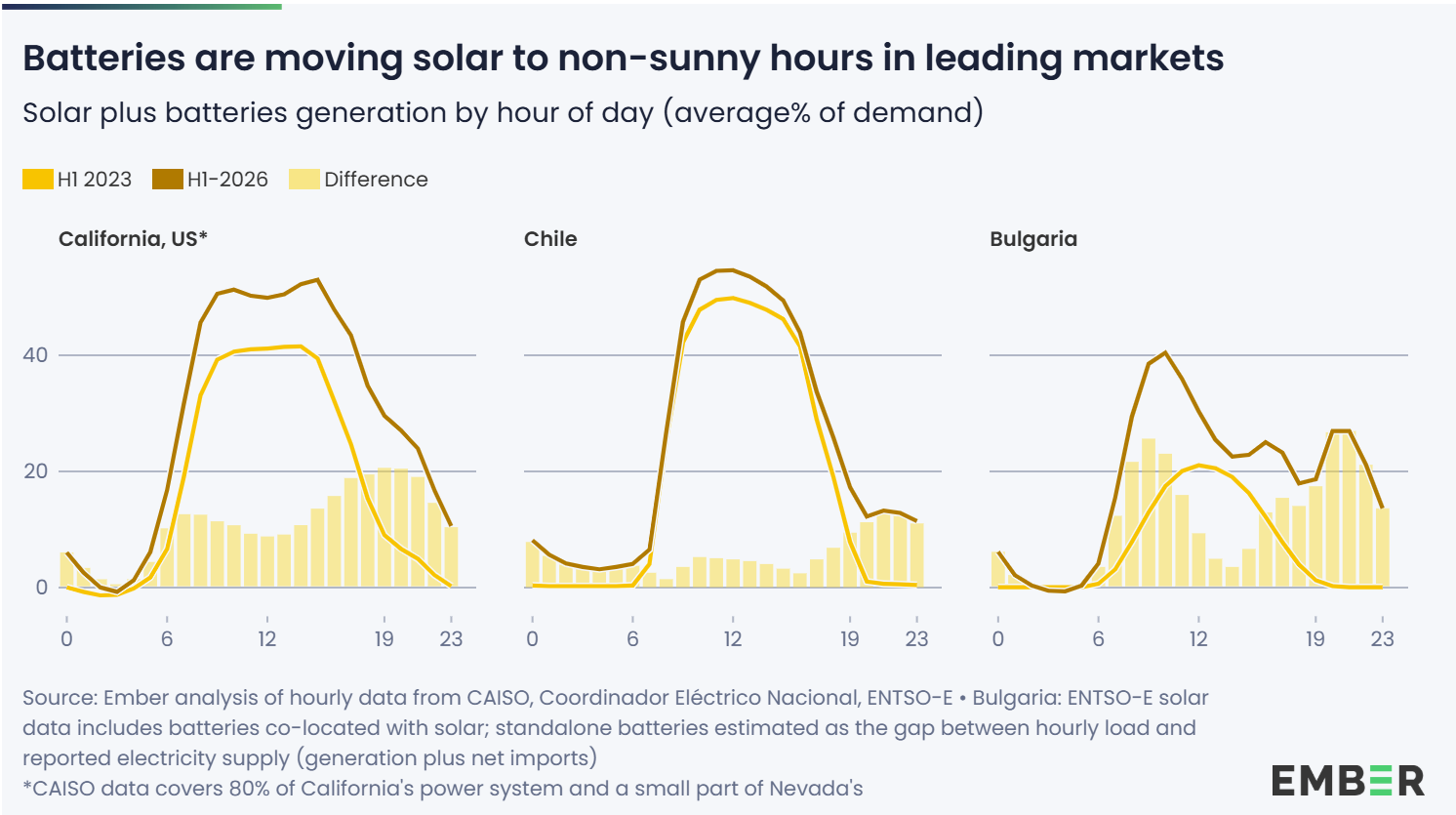
Cheap solar and cheaper batteries are teaming up to unlock the era of “anytime” solar, finds a report published last month by the energy think tank Ember.
“Cheap daytime solar has become the most powerful transformative force reshaping power grids globally, growing faster than any other source of electricity. Now batteries have become cheap and good enough to unlock the next stage of solar growth with anytime solar. Delivering solar in non-sunny hours, the current stronghold of fossil power, changes everything: solar’s role in global power systems can be far bigger than previously thought possible,” writes Kostantsa Rangelova, senior battery analyst, Ember.
According to the report, “batteries deployed in 2026 could shift over a third of new daily solar generation.”
The report notes that in leading markets like Bulgaria and Chile, new battery storage capacity added in 2025 could shift more than three-quarters of the new daily solar generation in the countries. In another leading market, California, “solar plus batteries met over a quarter of electricity demand during the evening peak (7–9pm) on the average day in H1 2026.”
Energy efficiency and demand flexibility can help meet data center loads
Research from the American Council for an Energy-Efficient Economy (ACEEE) underscores the potential to meet expected electricity demand growth – including from data centers – by making homes and other buildings more efficient and responsive to grid needs.
“Amid the growing consensus that data centers should fund their own power generation and grid upgrades, companies and policymakers are discovering that energy efficiency and load shifting in homes and other buildings are a key part of the solution,” write ACEEE’s Mike Specian and Mark Rodeffer.
The pair cite recent examples of business deals and state policies that seek to unlock the potential of these demand-side resources.
Google and Voltus, for example, pledged to together develop a “scalable blueprint” to aggregate distributed energy resources from residential, commercial, and industrial customers across the U.S. Mid-Atlantic region.
And policymakers in New Jersey, Wisconsin, and Kansas have already acted to authorize “large-load customers like data centers to procure energy efficiency and flexible demand, not just new generation, to meet their power needs,” write Specian and Rodeffer. They note that other states, including North Carolina and Illinois, are considering similar measures.
An ACEEE report published earlier this year found that “efficiency and demand flexibility in buildings could together free up 130 to 270 gigawatts over the next 10 to 15 years, more than even the most aggressive projections of total U.S. data center capacity.”
And they could do so at lower cost than fossil-fueled alternatives.
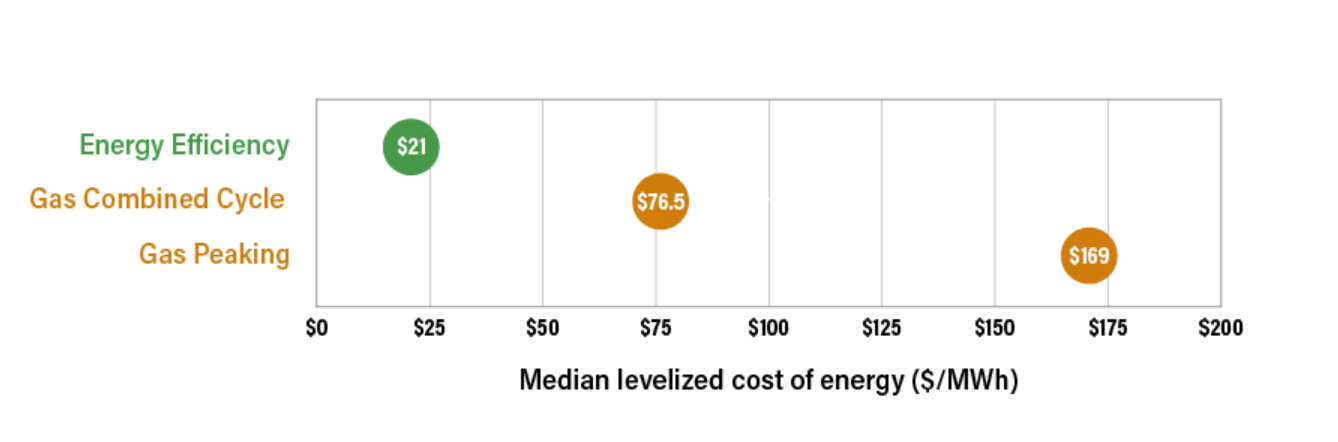
“Programs investing in energy efficiency in homes and buildings, together with demand flexibility, could significantly offset the power needs of new data centers and other drivers of projected load growth at a far lower cost than building new gas plants, both combined-cycle and peaker plants,” finds the report.
Unlocking the flexible load from millions of distributed energy resources across California
A new report outlines how California officials can unlock the potential of millions of customer-owned energy resources located in homes and on driveways across the state to support the state’s grid.
Released last month by GridLab, Kevala, and E3, the report offers “practical recommendations for integrating electric vehicles (EVs), home batteries, smart buildings, and other flexible loads into grid operations to lower electricity costs, strengthen grid reliability, and modernize demand flexibility programs.”
One key finding from the report: “Enrolling just 10% of California's projected EVs in vehicle-to-grid (V2G) programs by 2036 could provide approximately 9 GW of 12-hour storage, representing more than one-third of the state's 2036 long-duration storage procurement target.”
"The next generation of grid infrastructure is already sitting in our driveways, homes, and businesses. The question isn't whether California has the resources – it's whether our programs are designed to unlock their full value,” said Ric O'Connell, executive director of GridLab, in a press release.