What I’m reading: Federal courts chip away at Trump's renewables blockade, Trump wants to kill public transit, Europe's electrification action plan, global energy transition tracker, and more
Quitting Carbon's biweekly roundup of energy transition developments you might have missed.


Quitting Carbon is a 100% subscriber-funded publication. To support my work, please consider becoming a paid subscriber, gifting a paid subscription, or leaving a tip.
Welcome back to another recap of highlights from what I’ve been reading. For all the new readers who have joined us in recent weeks, these every-other-Friday roundups are my way of flagging important energy transition developments you might have missed.
Have a great weekend and thanks, as always, for reading.
Federal courts continue to chip away at Trump's renewables blockade
Court challenges to the Trump administration’s push to kill new wind and solar projects advanced on several fronts over the past week.
On Tuesday, a federal judge in Portland, Oregon, “indicated she was likely to find in favor of a coalition of renewable energy groups and order the Trump administration to resume reviewing wind projects,” reports Courthouse News Service's Monique Merrill.
The clean energy groups sued the Department of Defense at the end of May to force the department to resume wind energy project reviews.
“Near the start of a two-hour hearing,” writes Merrill, “U.S. District Judge Karin Immergut, a Donald Trump appointee, told the parties there was strong evidence the government had violated statutory and regulatory deadlines.”
On Thursday, Judge Immergut ordered the Pentagon to restart the stalled wind project reviews.
The latest in a series of legal claims by clean energy nonprofits was filed in the U.S. Court of Federal Claims in Washington, D.C., against the U.S. Environmental Protection Agency (EPA) challenging its “illegal” termination of grants awarded under the Biden administration’s $7 billion Solar for All program.
“The parties allege the [One Big Beautiful Bill Act] was clear in its direction that the EPA cut only unobligated balances from the Greenhouse Gas Reduction Fund, which was the source of funding for local Solar for All programs across the country,” reports PV Magazine’s Ben Zientara.
The groups say, “the vast majority of the $7 billion in Solar for All funding had already been obligated prior to the passage of the OBBBA, and that the terminations were therefore unlawful,” he adds.
The new claims add to a growing roster of lawsuits challenging EPA’s termination of the Solar for All Program brought by state and local governments, tribes, labor unions, and solar companies.
On a separate legal track, the D.C. Circuit federal appeals court on Tuesday upheld an injunction barring the EPA from terminating $20 billion in grants authorized by the Inflation Reduction Act to establish so-called green banks across the country.
“A federal appeals court on Tuesday barred EPA from clawing back billions of dollars in unspent green energy grants that were awarded to nonprofits under former President Joe Biden’s signature climate law,” reported Politico's Alex Guillén and Jean Chemnick.
“Under the court's order, the recipients could start drawing down funds as soon as next week, when the April 2025 stay that had effectively kept the cash frozen in bank accounts now must be lifted.”
However, the Trump administration is expected to ask the Supreme Court to intervene to prevent that from happening.
All the above affirms what I argued recently: “If you're active in the clean energy economy and the administration has canceled your funding or is blocking your project, it’s an easy decision: Go to court to fight for your interests.”
Trump 2.0's politicization of federal grants
Since publishing a column last month on a Trump administration proposal that would give political appointees across federal agencies the power to kill grants, I’ve continued to track this looming threat.
It turns out that with the proposal the Trump administration is attempting to codify across federal agencies a practice Energy Department lawyers just admitted in court was used to justify canceling billions of dollars in clean energy grants.
“The administration nixed $7.6 billion in clean energy grants last year ‘based solely on the political identity of the grant recipient’s state,’ the U.S Department of Energy said in court documents,” Utility Dive’s Robert Walton reported on July 27.
Here’s how U.S. Rep. Mike Levin (D) responded to the news on Bluesky: “In an Appropriations Committee hearing earlier this year, I questioned Energy Secretary Chris Wright about the billions his department canceled in clean energy grants. He looked me in the eye and told me the decisions were made on the merits and had nothing to do with politics. That was a lie.”
On Monday, two House Democrats referred Wright to the Department of Justice for prosecution for that testimony.
“Secretary Wright lied to the Committee with his statements, which sought to prevent us from learning the truth: that the October award terminations were an act of political retaliation,” Zoe Lofgren and Gabe Amo wrote in a letter addressed to acting Attorney General Todd Blanche.
Senate Democrats responded by calling on the Energy Department to restore the $7.6 billion in terminated grants.
“Now that court documents have confirmed what we knew to be true, we write to demand that you restore previously awarded funding that the Trump administration has weaponized in an attempt to punish perceived political enemies," according to a letter Senate Energy and Natural Resources ranking member Martin Heinrich and Appropriations ranking member Patty Murray sent to DOE with the signatures of 37 of their colleagues.
Meanwhile, last week, Murray reached a deal with her counterpart, Senate Appropriations Chair Susan Collins (R), that would – temporarily – block the Office of Management and Budget proposal pushed by Russell Vought that would give political appointees the power to kill federal grants.
But the deal would only pause implementation of Vought’s OMB proposal for the duration of a continuing resolution to fund the federal government through December 11.
“The proposed rule would systematically politicize federal funding and allow Trump officials to cancel grants at any time for any reason. Enabling this rule would only give Trump the greenlight to take even more federal funding hostage. While Republicans rejected killing the proposed rule outright, I’m going to keep fighting to put a stop to it once and for all, and I will keep pressing my Republican colleagues to do exactly that,” wrote Murray in a statement.
Trump wants to kill public transit, too
The Trump administration isn’t just trying to make it harder to build new wind and solar projects. It’s also refusing to spend billions Congress budgeted for a federal program that helps state and local governments fund new transit projects.
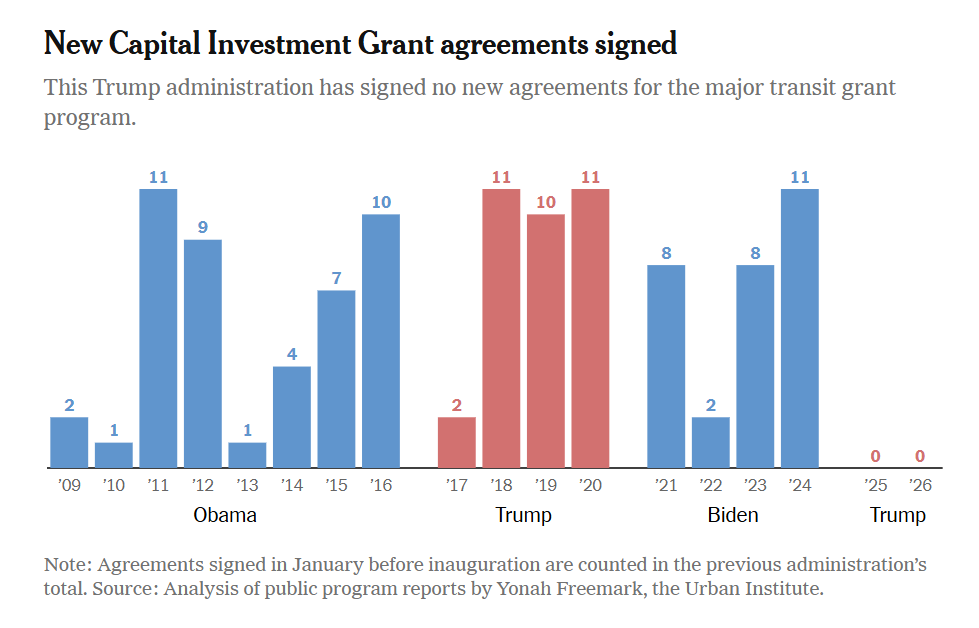
“Since President Trump returned to office, the Federal Transit Administration has not signed a single new agreement under the program, known as Capital Investment Grants. Large projects ready to enter the final phase of the program’s yearslong pipeline have stalled there,” report The New York Times’ Emily Badger and Alicia Parlapiano.
“As the number of pending projects builds up, so has anxiety about the federal government’s support for major transit infrastructure. Money that Congress designated for that purpose is accumulating too: More than $7 billion hasn’t been obligated to any project,” they write.
If Transportation Secretary Sean Duffy had his way, the federal government wouldn’t spend any money on public transit at all.
“Transportation Secretary Sean Duffy proposed eliminating the Highway Trust Fund’s mass transit account, which provides funding for public transportation, in a July 22 letter outlining the administration’s priorities that was sent to six senators serving on committees with influence over the next surface transportation legislation,” Smart Cities Dive’s Dan Zukowski reported last month.
“Duffy also proposed cutting funding for Complete Streets activities that focus on safety for pedestrians and bicyclists, bicycle lanes and grants for electric vehicle charging infrastructure,” he added.
It gets even worse.
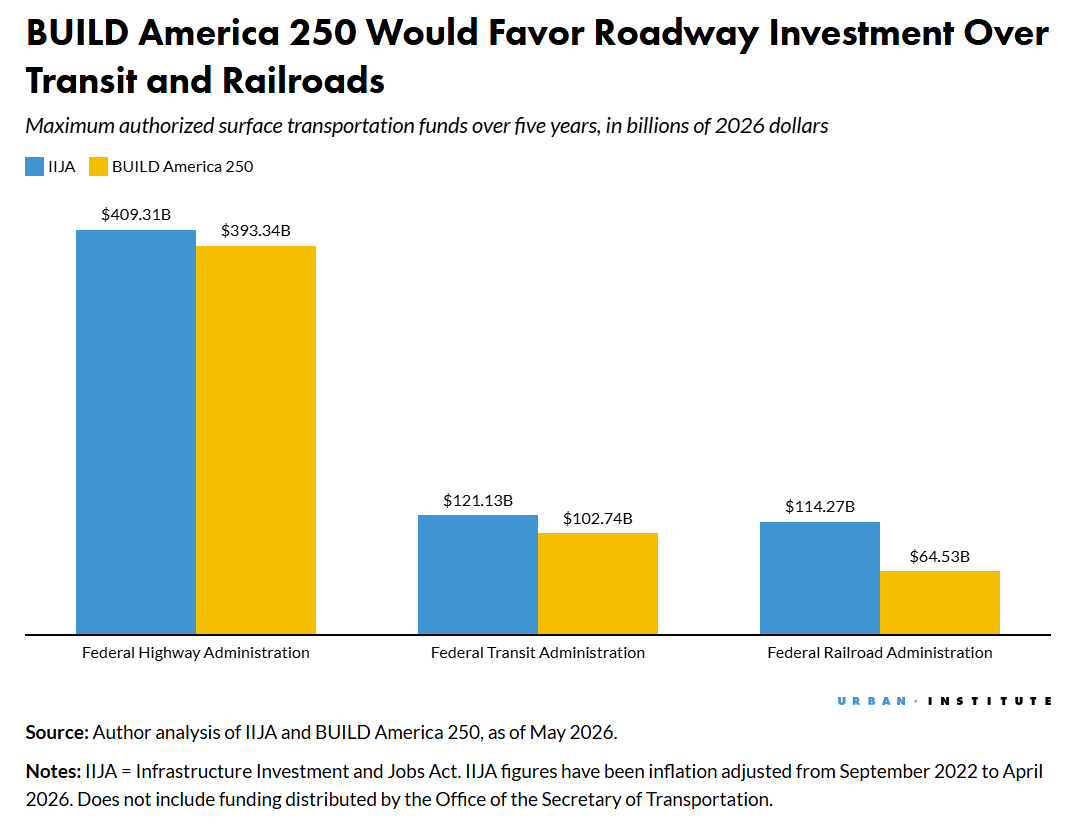
According to Yonah Freemark at the Urban Institute, the federal transportation funding bill now under consideration in Congress, the BUILD America 250 Act, would slash funding for public transit over the next five years.
“If passed, BUILD America 250 would dramatically reduce federal support for new transit and intercity rail lines compared with the previous five-year federal transportation law, the Infrastructure Investment and Jobs Act (IIJA),” he wrote in a recent blog post.
“Adjusted for inflation,” he added, “the bill would reduce potential overall transit funding by 15 percent compared with IIJA, including by making a 45 percent cut to programs designed to fund new transit and rail projects. Instead, the bill would direct a much greater share of funding to highways while eliminating all guaranteed funding for new rail or transit projects.” (emphasis in original)
EU action plan “defines electrification as the destination”
It didn’t get much press here in the U.S. but it’s worth noting that last month the European Commission released an Electrification Action Plan that aims “to make Europe the first electro-continent.”
The goal is “to increase electrification from today's 23% of energy use to 46% by 2040. By reaching this goal, the EU could save €260 billion per year in fossil fuel imports,” according to the Commission.
Measures in the plan include:
Future-proofing electricity bills in the EU by empowering EU countries to reduce network charges for certain consumer groups and taxes for energy-intensive businesses
Encouraging faster deployment of smart meters, which will make it easier for consumers to save on their energy bills.
Lowering upfront costs of electrification technologies across key demand sectors. This will be achieved by mobilising tools such as social leasing schemes, the Emissions Trading System (ETS) financial instrument and the Social Climate Fund.
Speeding up the deployment of European electricity grids through the grids package; accelerating the uptake of innovative electrification solutions.
Investing in skills and jobs in electrification, with the potential of creating hundreds of thousands of quality jobs.
The plan also includes more ambitious targets for energy storage deployment.
“It recognises that energy storage is an essential element to optimise the functioning of the EU energy system, and that 200GW will be needed by 2030 and 500GW by 2050. That is up from 55GW in 2026,” reports Energy Storage News’ Cameron Murray.
“There's a lot to welcome, and the framing is right,” observed Louise Sunderland, Europe director at the Regulatory Assistance Project, about the action plan.
“To me the most important thing is that the action plan steps away from the technology neutrality approach favoured by policy makers. It defines electrification as the destination, and names the key technologies, the specific barriers and introduces targeted measures.”
Let’s take a quick tour of the globe for some recent clean energy deployment records and milestones:
- Renewables accounted for 58% of Germany’s electricity consumption in the first half of 2026 – up three percentage points over the same period last year and a new record for the first six months of the year. (Julian Wettengel, Clean Energy Wire)
- This comes after data confirmed that wind and solar power overtook fossil fuels on Germany's grid for the first time ever in 2025. (Ho Woo Nam and Josh Gabbatiss, Carbon Brief)
- Solar generated a record 14.4% of the UK’s electricity in July – a jump from the previous monthly record of 12.4% set in May. (Stuart Stone, BusinessGreen)
- Wind turbines have generated more electricity than fossil gas plants in the UK in every month over the past year through July – the first consecutive 12-month period with more wind than gas generation in the country’s history. (Nicolas Fulghum, Ember)
- More than half (51%) of California’s electricity generation in May came from solar power – a “a world-first solar milestone” for a major economy. (Nicolas Fulghum, Ember)
- China’s exports of low-carbon technologies jumped by a third from January to June, with shipments of lithium batteries and wind turbines increasing by 38% and 36%, respectively. (Bloomberg News)
- Quarterly EV sales records were set in 50 countries during the first half of 2026, according to the International Energy Agency. (Stuart Stone, BusinessGreen) “In five major markets — Australia, Brazil, India, Korea, and Vietnam — sales have roughly doubled since the start of the energy crisis, compared to the same period last year.” (Nahal Toosi, Politico)
One more thing: Sponsored by Big Oil
Recent editions of two of the most popular U.S. energy newsletters, Axios Future of Energy and Semafor Energy, happen to share a lead sponsor.
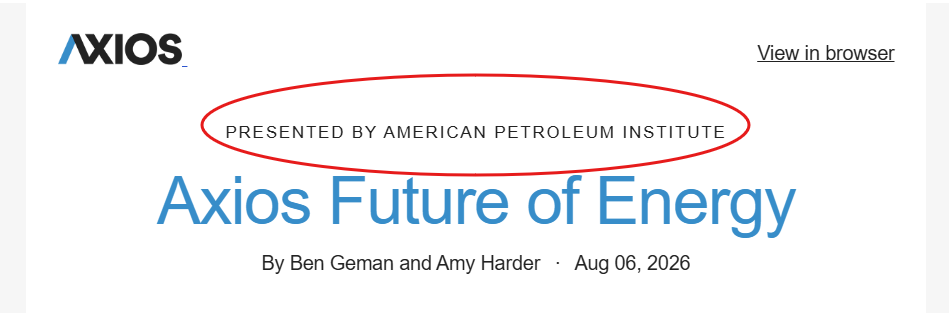

There are no fossil fuel ads here at Quitting Carbon. Instead, we are entirely funded by readers like you. Remember, you can support the newsletter anytime by becoming a paid subscriber, gifting a paid subscription, or leaving a tip. Thank you!