Could "sophisticated miniature modular plants" slash the energy consumption and emissions resulting from processing raw materials?
"Manufacturing without addresses" can slash the time, money, and energy required to transport and process raw materials around the globe, says ARPA-E Program Director Cory Phillips.

Quitting Carbon is a 100% subscriber-funded publication. To support my work, please consider becoming a paid subscriber, gifting a paid subscription, or leaving a tip.
Strangely, this is a story Donald Trump's Energy Department didn't want told.
In April, I attended the annual Energy Innovation Summit hosted by DOE's moonshots incubator, the Advanced Research Projects Agency-Energy (ARPA-E). By far the best programming at the summits each year are the eight-minute presentations delivered by ARPA-E fellows and program directors during themed "Fast Pitch" sessions.
Befitting an agency tasked with advancing "high-potential, high-impact energy technologies," the "Fast Pitch" presentations are a way for ARPA-E's experts to float new ideas, highlight a promising new path of scientific inquiry, or solicit feedback on a new concept from the hundreds of researchers and entrepreneurs in the room.
At this year's summit, the "Fast Pitch" presentation that had me excitedly scribbling in my notebook was titled "Manufacturing Without Addresses: Factories that Refuse to Sit Still" by Dr. Cory Phillips, a chemical engineer who leads two programs at ARPA-E, including ROSIE (Revolutionizing Ore to Steel to Impact Energy), which is focused on decarbonizing the steel industry.
There's some irony in the fact that we journalists read all day, all the time hoping we come across something we've never read before.
Listening to Phillips, and reading his slides, was such a moment.
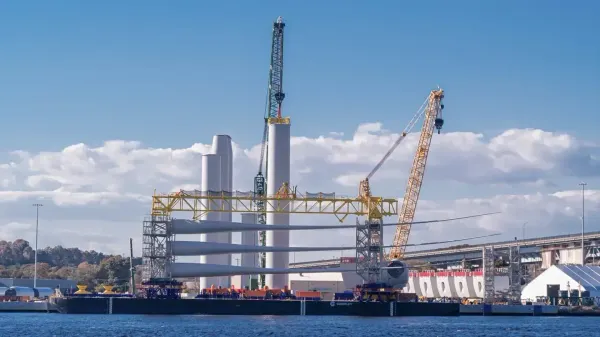
His epiphany: it's possible to save time, energy, and money – and slash emissions – by using mobile, modular factories to begin processing the 16 billion tons of raw material that's moved around the globe each year in transit.
"We spend a lot of time, energy, and money moving raw materials on assets that could probably do more, instead of just letting the raw materials sit there and wait idle until it reaches a centralized processing facility," he said during his pitch session.
That 16 billion tons of raw material – think coal and biomass, petroleum and metal ore – is transported around the globe on tankers, rail cars, and trucks thanks to an enormous investment in energy and money. According to Phillips, the tally comes to more than 20 quadrillion BTUs of energy and $2.4 trillion dollars a year.
With such massive sums, even tweaks on the margins could yield huge savings.
"Even if you improve 1%," he said, "you get maybe tens of billions of dollars in cost savings and tens of trillions of BTUs in energy savings, but that's impact by optimization."
"What I'm talking about today is impact by transformation."
Sidetracked by Trump's DOE
My interest piqued, I reached out to Phillips and ARPA-E after the summit to request an interview for a Q&A.
As I've written previously in this newsletter, the request was sent to DOE headquarters, where, weeks later, staff rejected both my interview request and my request that the agency share Phillips' presentation slides. No reason was given for the denials.
Perhaps it had something to do with the column I published – Why does Chris Wright insist on being so wrong on the energy transition? – as I waited to hear if my interview request had been cleared?
But we journalists don't give up so easily.
It took months of waiting, but ARPA-E recently posted videos from the summit at its YouTube channel, including Phillips' "Fast Pitch" session (his talk runs from 16:30-25:45).
So, thanks to the video workaround, you can now learn about Phillips' pitch, too.
Streamlining a "convoluted and inefficient" journey to market
Raw nickel, a critical material used in lithium-ion batteries, specifically cathode-active materials, must be smelted down into ferro nickel alloys, nickel sulfates, and other precursors as it is iteratively refined down to the product used in batteries.
Phillips framed his pitch concept by recounting the example of the months-long journey nickel makes from extraction in a wet clay mine in Indonesia to processing stops spread across Southeast Asia and the Pacific and then on to a fabrication facility in the U.S.
It is "quite convoluted and inefficient," said Phillips. "It requires a lot of energy, it requires a lot of costs. In fact, it's probably greater than 80 days on the ocean. Not quite Jules Verne, but half our way around the world."
His insight: What if a "sophisticated miniature modular plant" was used to begin converting the nickel ore on the haul truck from the mine and on tankers at sea?
He cited ROSIE projects at the DOE's Argonne National Laboratory and the University of Illinois in which researchers put plasma discharges on rotary kilns to convert iron ore to iron.
For nickel, "we can have what we call a plasma mechanical chemical device that allows you to do the drying, the sieving, and the grinding simultaneously with plasma smelting."
This breakthrough alone would shave 70% off the time for the first leg of the journey to convert nickel into a battery-grade product.
The process would continue at sea.
A miniature modular plant could be used to convert nickel alloy into nickel sulfate salt, or with high-temperature electrochemical molten electrolysis, reduce iron oxide to iron.
At this step, a sulfur source is needed, which could come from the exhaust from the bunker fuel burned to power the tanker.
"So, now you do a few things: you're valorizing [i.e. increasing the beneficial reuse of] the amount of metals that are available to you on board, but you're also cleaning up the exhaust, and you're also creating other opportunities with metals that exist in the precursors," said Phillips.
The climate payoff
Phillips estimated that introducing raw material processing during transit could reduce the overall mine-to-market trip for nickel from 80 to just 30 days.
He also posited that you could apply the same technology to metals other than nickel or iron, to critical minerals, to oil and gas for fuels, or to biomass.
Truncate, or even eliminate, some of the steps required to process raw materials for end uses globally and you could significantly reduce emissions from the sector.
Freight transport accounts for 8% of global greenhouse gas emissions. And without aggressive action, the sector's share of global emissions will surge by mid-century.
"Growing economies in Asia, Africa and Latin America are expected to triple global demand for freight by 2050, which will double freight’s greenhouse gas emissions," writes Suzanne Greene, the program manager of the Sustainable Supply Chains initiative at the MIT Center for Transportation & Logistics.
"Even as other energy sectors reduce their fossil fuel use, nearly all freight transportation runs on oil and gas. If we continue with business as usual, freight will become the highest emitting sector by 2050," she adds.
ARPA-E was created to accelerate the adoption of energy technologies that disrupt business as usual. Phillips' "manufacturing without address" concept has the potential to upend business as usual in one of the world's biggest industries.
It's a shame, then, that the Trump administration didn't want you to know about it.