What I’m reading: Surging electric truck sales, France's clean tech social leasing success, and global energy transition tracker
Quitting Carbon's biweekly roundup of energy transition developments you might have missed.


Quitting Carbon is a 100% subscriber-funded publication. To support my work, please consider becoming a paid subscriber, gifting a paid subscription, or leaving a tip.
Welcome back to another recap of highlights from what I’ve been reading. These every-other-Friday roundups are my way of flagging important energy transition developments you might have missed.
I was off last week relaxing in Bend, Oregon, (read to the end for some photos!), hence the belated arrival of this roundup.
Have a great weekend and thanks, as always, for reading.
With diesel prices soaring and battery technology maturing, electric trucks sales are surging across the globe
Trucks have lagged passenger vehicles in transitioning to battery-powered models. But with diesel prices soaring across the globe and batteries more capable than ever of powering even heavy-duty trucks, the disparity between the two segments will close.
“Worldwide, sales of medium- and heavy-duty electric trucks hit a record high in the first half of this year, according to research firm BloombergNEF. Nearly 160,000 e-trucks were sold in that time period, up by around 75% from the first half of 2025,” reports Canary Media’s Ysabelle Kempe.
In major European markets like France and Germany, electric trucks are already cheaper to operate than their diesel counterparts.
A report published last month by the campaign group Transport & Environment (T&E) finds that electric trucks deliver a lower total cost of ownership in six out of nine major EU markets. The six markets (Belgium, Denmark, France, Germany, the Netherlands, and Sweden) together account for 46% of all new heavy trucks sold in the EU.
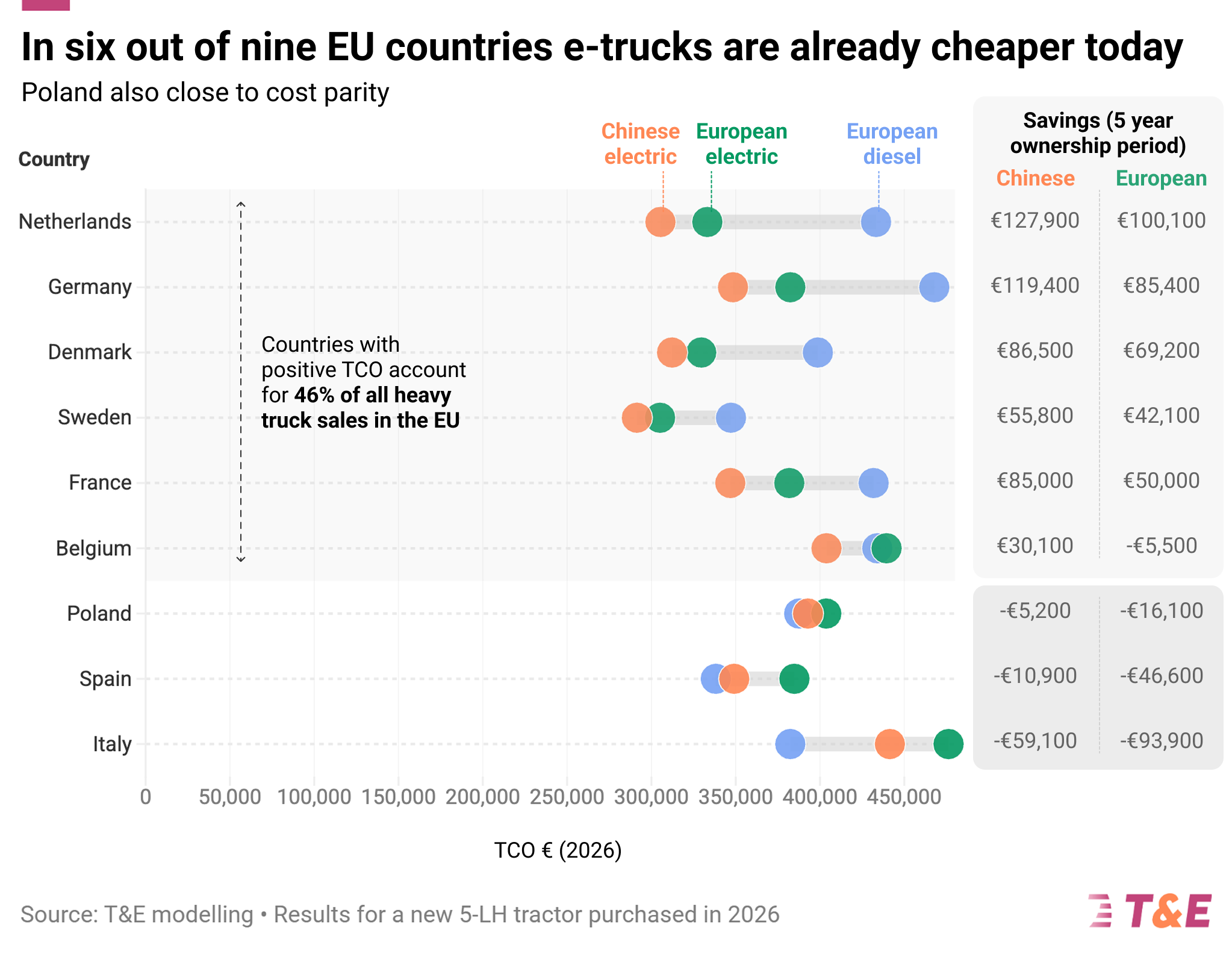
“In the Netherlands and Germany, savings can go up to €100,000 and €85,000 respectively over five years, with electric trucks reaching their payback time after only two years. With current high diesel prices, savings could rise to €123,000 and €106,000 respectively,” according to a T&E press release.
With battery electric trucks cheaper to operate than diesel models in more markets, shipping giants are adding electric trucks to their fleets.
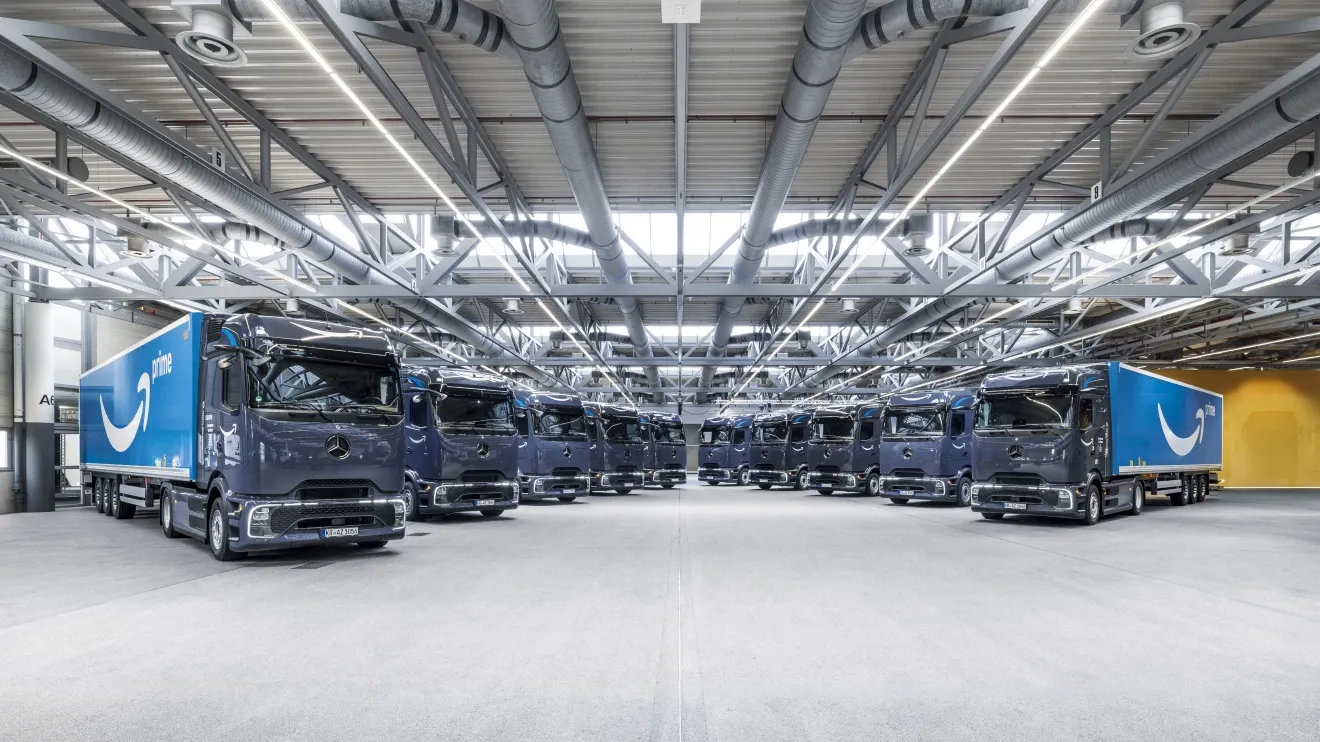
Last month, in Germany, Mercedes-Benz Trucks delivered the first 27 models from Amazon's largest-ever order of electric trucks. By the end of 2026, Amazon will be operating more than 50 of the Mercedes-Benz eActros 600 battery electric trucks on German roads.
Just last week, FedEx placed an order with California-based electric truck manufacturer Harbinger for 2,000 all-electric box trucks – a transaction “believed to be one of the largest binding orders for electric medium or heavy-duty trucks in history,” according to Harbinger.
The e-trucks are to be delivered by the end of 2027 and rolled out across the U.S. and Canada. The total order is valued at more than $300 million, but Harbinger estimates the 2,000 electric trucks can generate $800 million in diesel fuel savings.
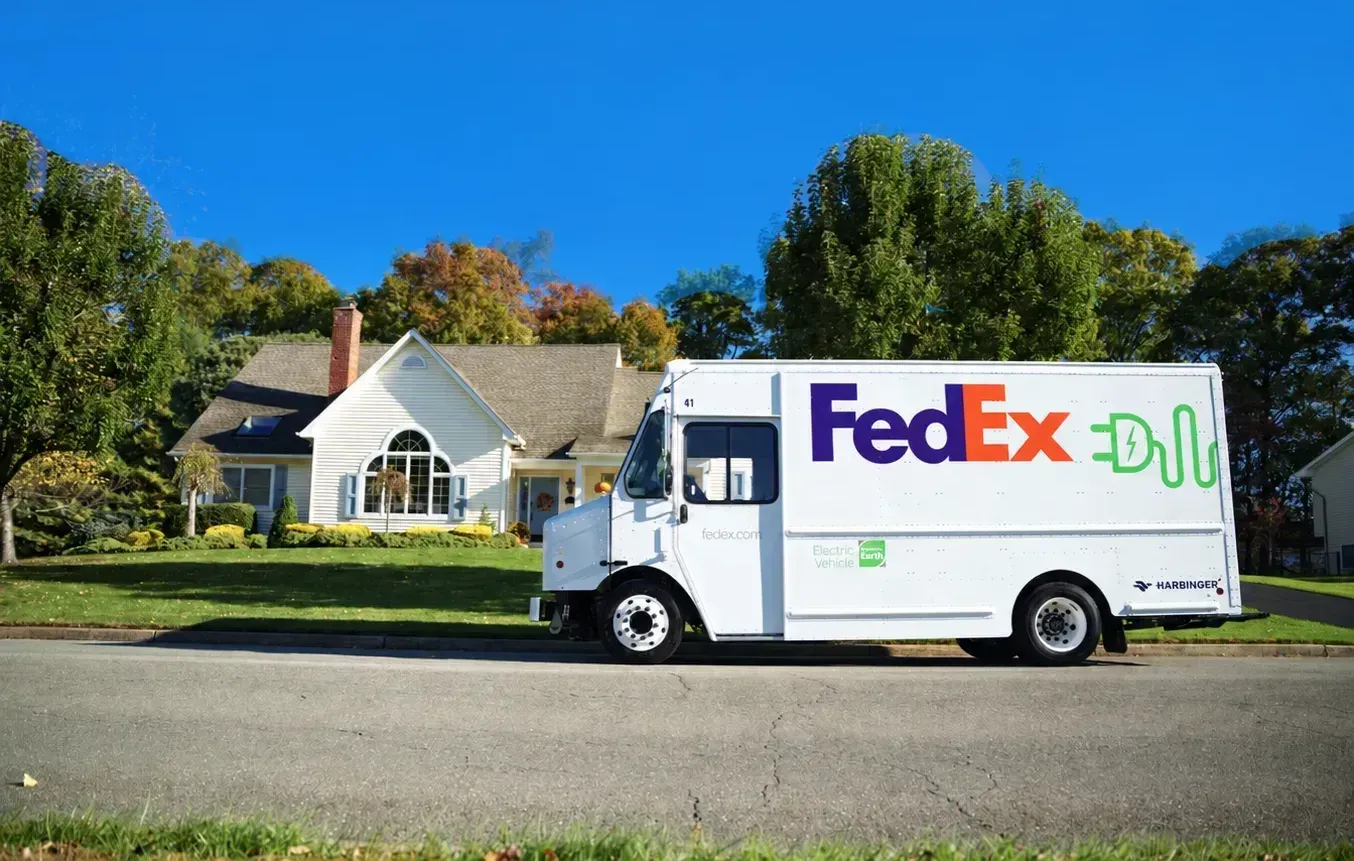
Deals like the Amazon and FedEx deployments will become increasingly common because manufacturers keep improving the business case for electric trucks by boosting their range and shortening charging times.
Consider some recent examples.
Swedish truck manufacturer Scania added two batteries behind the cab in its electric long-haul trucks, boosting the range to up to 720 kilometers (447 miles). Another Swedish truck maker, Volvo, recently unveiled a new 80-ton electric truck and began commercial production of the FH Aero Electric, a truck with a range of 700 kilometers (435 miles).
Chinese electric automaker BYD unveiled a new heavy-duty truck with range up to 600 kilometers (373 miles) and a 1.5-megawatt charging system. And Chinese battery giant CATL announced a next-generation commercial truck battery with a range up to 1,000 kilometers (621 miles) and the ability to switch between charging or battery swapping.
Tesla recently opened its first pre-assembled Semi Megacharger site, with each stall providing up to 1.2 MW of charging power.
San Francisco-based startup Revoy offers a detachable “dolly” that can turn a conventional diesel truck into a hybrid electric vehicle. The dolly, a unit containing a battery pack, electric motor, and drive axle that bolts between the cab and cargo trailer, can reduce diesel consumption by up to 95% and tailpipe emissions by 85%.
France finds “social leasing” unlocks the market for EVs
French policymakers might have struck upon a solution to one stumbling block of the energy transition: the upfront cost for climate solutions like electric vehicles and heat pumps.
Under a novel le leasing social (social leasing) program, low-income French households can drive an EV without a down payment.
Here’s how it works, as reported by Politico’s Zia Weise and Nicolas Camut.
“Allow low-income households to lease an EV for less than €200 a month over three years, without a deposit. The government subsidizes a large share of the cost in cooperation with carmakers. Drivers can return the car when the lease ends, or buy it.”
“Since 2024,” they write, “social leasing has helped finance 100,000 cars, and 36,000 people have already applied for the 50,000 EVs on offer since the latest funding round kicked off in July – a figure the French government said proves the program’s success.”
Just this week, French officials launched a similar program with a goal to finance 55,000 heat pumps over the next two years.
Social leasing is proving so popular that policymakers across Europe are pushing to adopt the concept:
European policymakers are starting to pay attention. In July, the European Commission advised governments to consider adopting social leasing schemes for EVs, heat pumps, batteries and solar panels.
The center-left Socialists & Democrats, the second-largest faction in the European Parliament, called this spring for a continent-wide social leasing scheme in response to sky-high energy costs stemming from the Iran war.
“It’s a very effective measure when it comes to lowering the demand for gasoline and petrol, because we see that the prices are rising, and creating alternatives in the short run for people with a low income or middle income is very needed,” said Mohammed Chahim, vice chair of the Socialists & Democrats.
The Dutch government said earlier this year that research into duplicating the French program is underway. Italy announced a pilot leasing scheme in July for low-emissions cars and EVs. Sweden will use the revenues from a new EU carbon price to fund EV leasing for low-income households.
I’d love to see social leasing programs for clean energy technologies piloted by local and state governments here in the U.S. as a proof of concept ahead of inclusion in an IRA 2.0 package to be introduced in a future session of Congress.
Now a regular feature of these roundups, let’s take another quick tour of the globe for some recent clean energy deployment records and milestones:
Renewables records
- On a Saturday afternoon last month, renewables net more than 80% of demand on Australia's main grid for the first time. (Giles Parkinson, Renew Economy) Over the month of September, large-scale solar generation hit new record highs in three states (New South Wales, Queensland, and Victoria), while fossil gas generation hit a new low. (Sophie Vorrath, Renew Economy)
- Renewables covered a record 61% of Germany's electricity consumption during the first three quarters of 2026, a 4% increase over the same period last year. (Carolina Kyllmann, Clean Energy Wire)
- Germany generated as much solar electricity by the end of September as it did all of last year. (Carolina Kyllmann, Clean Energy Wire)
- The UK recorded more solar installations during the first half of 2026 than in any previous year. (Michael Holder, BusinessGreen)
Clean energy slashes energy bills
- The UK's clean energy auction scheduled for this autumn could deliver more than £11 billion ($13.2 billion) in savings for consumers through 2050, according to energy transition consultancy LCP Delta. (James Murray, BusinessGreen)
Fossil fuel and energy transition plans
- Germany presented a plan to kick fossil fuels by 2045, becoming just the third country, after France and the Netherlands, to publish such a plan. (Julian Wettengel, Clean Energy Wire)
- This week, South Korea announced a $747 billion energy transition and decarbonization plan calling for 100 GW of renewable energy capacity by 2030 and for electric and hydrogen vehicles to exceed 70% of new vehicle sales by 2035. The plan also includes targeted decarbonization plans for high-emitting sectors such as steel, cement, and semiconductors. (ESG News)
China's emissions-slashing exports
- China's clean tech exports prevented 374 million metric tons of CO2 last year, more than the annual emissions of the UK, according to the Centre for Research on Energy and Clean Air. (Lewis Jackson, Reuters)
Heat pumps sales jump in Europe
- In the first six months of 2026, sales of residential heat pumps increased by 11% in a dozen European countries. Slightly more than 1.16 million heat pumps were sold in Austria, Belgium, Denmark, Finland, France, Germany, Italy, Netherlands, Norway, Portugal, Sweden, and Switzerland – up from the 1.04 million units sold in the first half of 2025. (European Heat Pump Association)
EV sales surge continues
- EV sales hit a new record in the UK in September, grabbing a 28% share of the overall market with almost 100,000 fully electric vehicles sold. (Michael Holder, BusinessGreen)
- Fully electric vehicles accounted for at least 50% of new passenger vehicle registrations in six European countries in September. In Denmark, battery EV registrations hit a record 88.8% share, and gas-only vehicles dipped below 50% of the overall passenger vehicle fleet for the first time (49.98%). (Joshua S. Hill, The Driven)
- Gas-only cars dipped below 50% of global new car sales for the first time in the first half of 2026. Gas-only cars accounted for 49% of global new car sales over the period, down from 73% in 2021, according to Mobility Global data first reported by Nikkei. (Fred Lambert, Electrek)
One more thing: Scenes from Bend and Crater Lake National Park, Oregon
As promised, here are some scenes from last week's stay in Bend and visit to Crater Lake National Park on the drive home.
One of my favorite things to do in Bend is to simply walk along the Deschutes River in Drake Park at sunset. Mirror Pond is just steps from the downtown.