Why does Chris Wright insist on being so wrong on the energy transition?
Under Energy Secretary Chris Wright's leadership, the U.S. is doubling down on fossil fuels even as the rest of the world is embracing clean energy.


Quitting Carbon is a 100% subscriber-funded publication. To support my work, please consider becoming a paid subscriber or making a one-time donation.
If you care about facts and are clear-eyed about the true state of the global energy transition, it can be surreal to listen to Chris Wright speak for the U.S. government at an energy conference.
Earlier this month, I listened as Wright, the secretary of the U.S. Department of Energy, addressed a crowd of hundreds of researchers and entrepreneurs at the Advanced Research Projects Agency-Energy (ARPA-E) annual Energy Innovation Summit in San Diego.
Among those in the audience were scientists at the nation’s top research universities and the Energy Department’s own national laboratories, as well as leaders from many of the country’s most important energy companies. In other words, people who know what is actually going in global energy markets and policy.
And yet, Wright filled his keynote address with easily debunked statements.
“Energy, the last five or 10 years, got way off track,” he said. “Energy got politicized. It got swept up in climate alarmism. That we need to change the global energy system immediately. In fact, we need to reduce global energy consumption as soon as possible. This is alarmism.”
First, “energy got politicized” is a bit much coming from the man whose orders that uneconomic coal-fired power plants operate past their scheduled retirements – against the wishes of their owners and absent requests from grid operators – have already cost ratepayers hundreds of millions of dollars.
And surely Wright knows that most activists are pushing to reduce global fossil energy consumption as soon as possible, not trying to deny people access to energy.
For Wright, energy abundance is paramount.
“Energy is life,” he said. “The absence of energy is poverty, despair, reduced opportunities, and ultimately death. Energy is the most important industry in the world – ever. And it will always be because energy is foundational.”
By Wright’s reckoning, coal, oil, fossil gas, and nuclear can be relied upon to support life. Most renewables, especially wind and solar, cannot.
“The result has been 10 or 20 years of just massive investment in energy that wasn’t helpful in better energizing the world. It wasn’t helpful in lifting people out of poverty. It wasn’t helpful in expanding access to energy. In fact, I believe it will go down as the greatest malinvestment in history,” he said.
“We’ve spent $10 trillion dollars, where we’ve taken dollars and turned them into quarters or dimes or nickels – and in some cases, negative value. We can’t do that as a society. That’s not the way forward.”
Under Wright’s way forward, fossil fuels, including coal, are predominant.
Speaking before the Senate Energy and Natural Resources Committee last week, Wright said, “I'm pretty confident coal will lead the world in global electricity production when I die.”
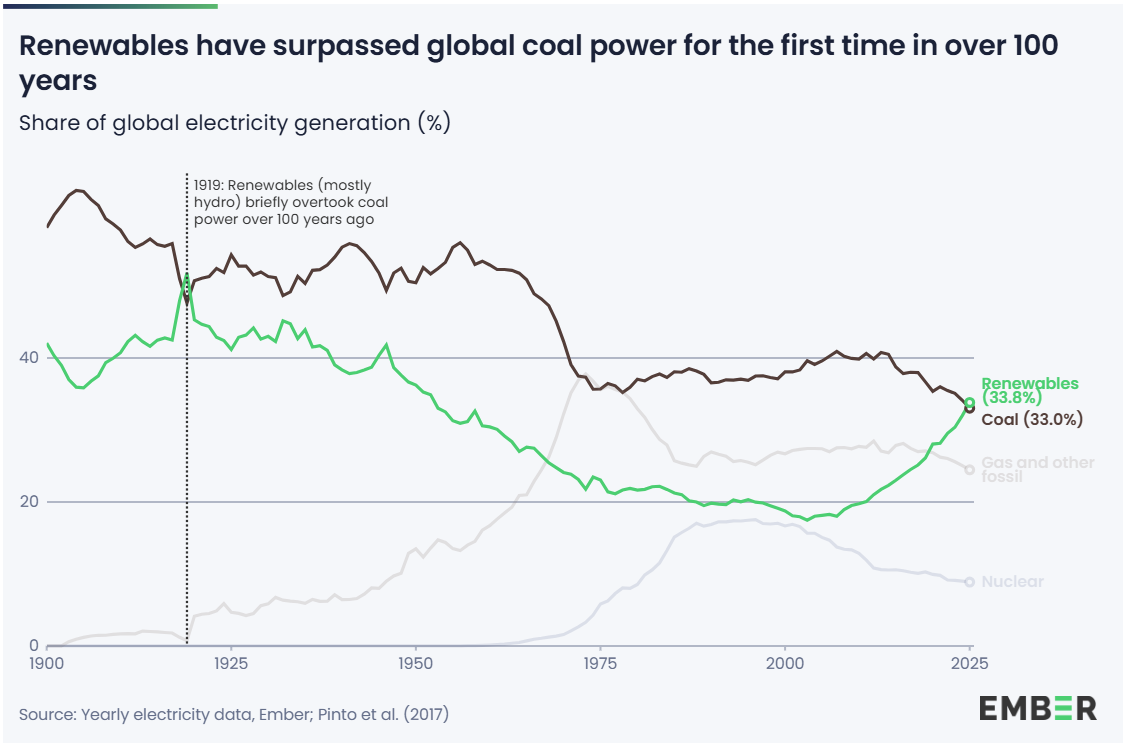
But renewables already overtook coal as the globe’s largest source of electricity last year, according to research from the think tank Ember.
And as Carbon Brief’s Simon Evans notes, “solar is set to overtake coal in the early 2030s – and wind soon after,” according to the International Energy Agency.
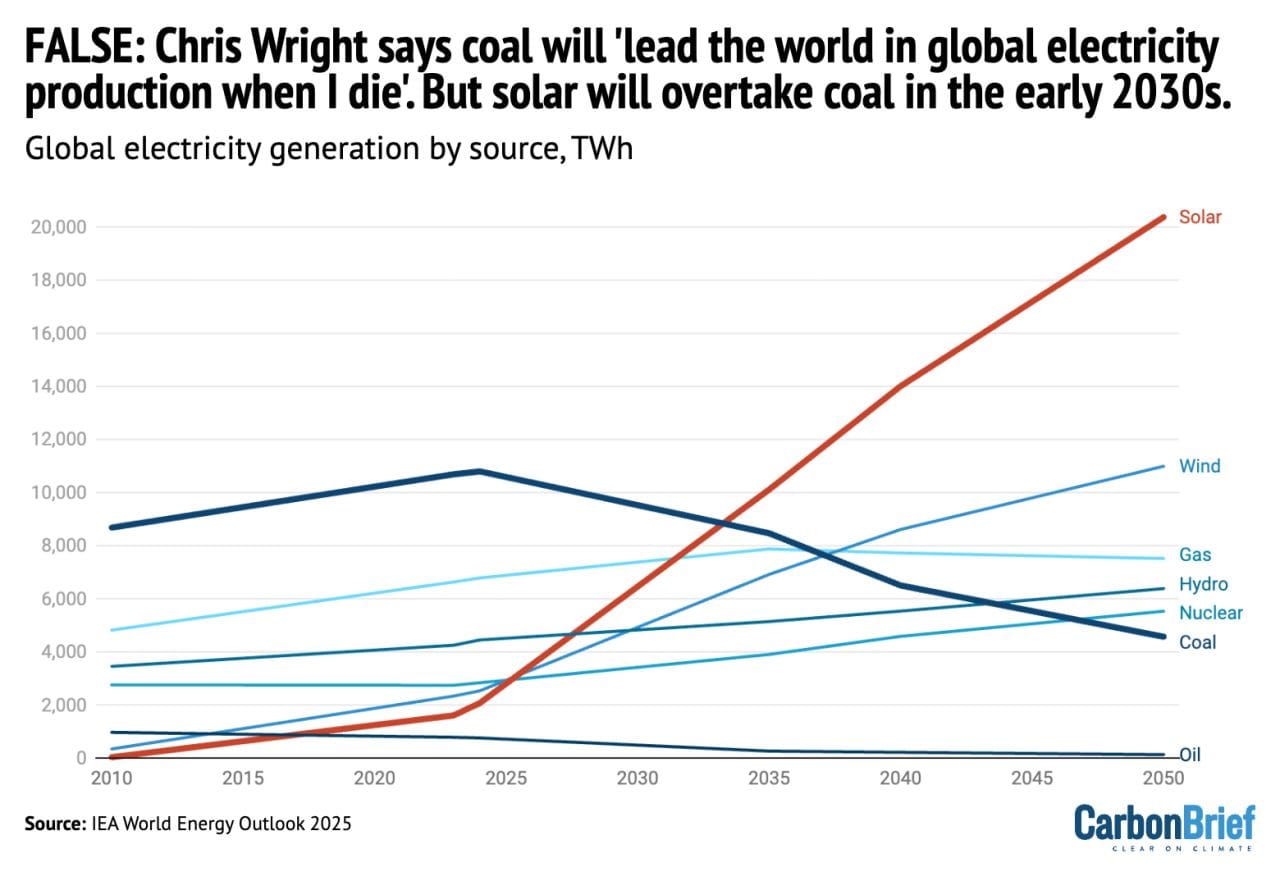
Wright is 61 years old. He might want to reconsider his prediction.
Hypocrisy on the national labs
The perplexing thing about all this is there are plenty of experts working for Wright who could set him straight. He oversees one of the world’s leading sources of energy information as well as the globe’s preeminent network of national energy R&D laboratories.
At the ARPA-E summit, Wright even said he supported the labs.
“Most innovation, and certainly commercial application of innovation, is driven by business. It’s not driven by government – although our national labs are true gems and massive, massive players in scientific innovation and AI innovation,” he said during a conversation with AMD Chair and CEO Lisa Su and ARPA-E Director Conner Prochaska.
“One of my proudest titles,” he added, “is to be the lead cheerleader for our 17 national labs that have just been massive drivers of innovation.”
But actions speak louder than words.
And it should not surprise you to learn that the lab most adversely affected by decisions made by Wright and White House budget director Russell Vought is the National Renewable Energy Laboratory in Colorado.
Wright purged “renewable” from the facility’s name by rechristening it the “National Laboratory of the Rockies.”
It gets worse.
There have been two rounds of layoffs at the lab during Trump 2.0, with nearly 250 researchers and scientists losing their jobs. The lab is also planning to remove wind turbines installed at its Flatiron Campus testing facility, Colorado Public Radio’s Sam Brasch reported earlier this month.
And then there are the budget cuts proposed by Vought.
The Trump administration wants “sweeping cuts” at the national labs, PV Tech’s Will Norman reported on April 13.
“The DOE issued its Budget Justification proposal for the financial year (FY) 2027 last week, which included a roughly $264 million cut to the National Laboratory of the Rockies’ budget, representing a 52% reduction in its overall funding. It also proposed cuts to the Lawrence Berkeley National Laboratory of roughly 20%, and similar cuts to the Oak Ridge, Pacific Northwest and Argonne National Laboratories,” he writes.
Across Wright’s department, “The portion of the budget not related to defense would be reduced 16.5 percent, to $12.5 billion, with major cuts to funding for renewable energy research,” writes Inside Climate News’ Gabriel Matias Castilho.
Why does Chris Wright insist on being so wrong about the energy transition?
Why is he allowing his department, including the “true gems,” the national labs, to be dismantled before his eyes? Why is he and the rest of the Trump administration waging a war against wind and solar power?
Perhaps it's as simple as Wright showing loyalty to the oil and gas industry he worked in for decades and the administration doing the bidding of some of its biggest fossil fuel donors.
Whatever the reason, at a time when Trump's Iran war is driving politicians and consumers to embrace clean energy, the U.S. has never seemed so isolated and adrift.
Wright thinks the clean energy transition is the “the greatest malinvestment in history.” The rest of the world is coming to see it as the future.