What I’m reading: Trump's Iran war and the energy transition, getting more out of the existing grid, research roundup, and more
Quitting Carbon's biweekly roundup of energy transition developments you might have missed.


Quitting Carbon is a 100% reader-supported publication. Support independent energy journalism by becoming a paid subscriber or making a one-time donation.
Trump’s Iran war and the clean energy transition
In the column I published last week, I wrote: “The irony will be lost on Donald Trump, but the fallout from his calamitous war of choice in Iran could be what pushes many world leaders and households to turn against fossil fuels for good.”
Let’s check in on how that prediction looks.
Australia set an electric vehicles sales record in March, as did the UK. In Germany, EVs overtook petrol models in new car registrations last month.
The EV sales surge is set to continue.
In Australia, evidence of momentum building includes “a more than doubling in interest in online searches, a doubling in queries about leasing and insurance, a surge in second hand sales, and what appears to be a record backlog of EV orders,” writes Renew Economy’s Giles Parkinson.
Back in Europe, “the rapid increase in fossil fuel prices in Germany and many other countries due to the war against Iran has pushed the cost advantage of driving electric vehicles over combustion engine cars to a record high,” writes Clean Energy Wire’s Benjamin Wehrmann.
In response to rising energy prices, “a majority of Germans want the country to accelerate a path that makes it less dependent on energy imports and supports the expansion of renewables as a crucial measure, several surveys from the energy industry have shown,” reports Wehrmann’s colleague Julian Wettengel.
Such a path is exactly what French Prime Minister Sébastien Lecornu outlined in a national electrification plan announced last week.
“The plan centres on expanding domestic electricity use, drawing on France’s nuclear fleet and scaling up renewables,” reports Euractiv’s Florent Servia.
“Housing is a central pillar of the plan,” he adds. “A ban on gas boilers in new buildings will take effect at the end of 2026, as the government pushes to make electric heating the default.”
“As economies in Asia and Europe reel, leaders make plans to replace imported oil and gas with homegrown energy,” the Washington Post’s Evan Halper reported last week.
Such plans are music to the ears of China’s leaders.
“The ongoing global energy crisis has highlighted the risks of heavy dependence on fossil fuel imports, prompting an urgent need for countries to rethink their energy security strategies and accelerate the transition to renewable energy,” Liu Zhenmin, China's special envoy for climate change, said during a recent interview with Xinhua, the country’s state news agency.
As the world’s dominant supplier of solar panels, EVs, and batteries, China happens to be ideally positioned to meet other countries’ demand for clean energy technologies. In the wake of Trump’s war in Iran, its battery exports are soaring.
As the author and activist Bill McKibben put it: “Donald Trump has managed to break the two-century-old grip of fossil fuel on the human imagination.”
Getting more out of the existing grid
Virginia Democrats were primed to pass legislation to advance their energy and climate priorities once the party won control of the General Assembly and the governor’s mansion in the November 2025 election.
The state’s Democratic trifecta has led to the passage of a flurry of such bills, including a “first-in-the nation” law (HB 434) that will require the state’s investor-owned utilities to take steps to get more out of the existing power grid.
The so-called “grid utilization” law “will require the state’s two major vertically integrated utilities to provide detailed distribution grid utilization data to state regulators this year and propose initiatives to use more existing capacity,” reports Utility Dive’s Brian Martucci.
Colorado lawmakers sent a similar piece of legislation (HB 26-1081) to the desk of Governor Jared Polis (D) on Tuesday.
According to Martucci’s colleague, Ethan Howland, “As of March 3, 16 states had some form of advanced transmission technology requirements and two were considering them.”
“Improving grid utilization to get more out of the grid we already have is a low-cost, near-term way to expand available supply, meet growing demand, spread fixed costs across more electricity sales, and put downward pressure on bills for households and businesses,” said Jeff Dennis, executive director of the Electricity Customer Alliance, in a statement.
Here’s another roundup of noteworthy reports and studies you might have missed:
“The new twin fossil shock”
How does the fallout from Russia’s invasion of Ukraine and the shutdown of the Strait of Hormuz, as triggered by the U.S.-Israel war with Iran, compare with the oil shocks of the 1970s? And will these more recent oil shocks permanently alter the trajectory of the global energy transition?
“The parallels with the 1970s oil shocks are striking. But so too is the difference,” write researchers from the energy think tank Ember in a report published Tuesday.
“For the first time, there are scalable, cost-competitive alternatives. Solar, wind, batteries, EVs and other electrotech offer a permanent route out of fossil dependence,” they add. “The shock has jolted the electric age forward. But the response is a choice: lean into local, electric security, or reach back to the old fossil playbook.”
Solar and wind growth prevent a surge in fossil power generation post-Hormuz closure
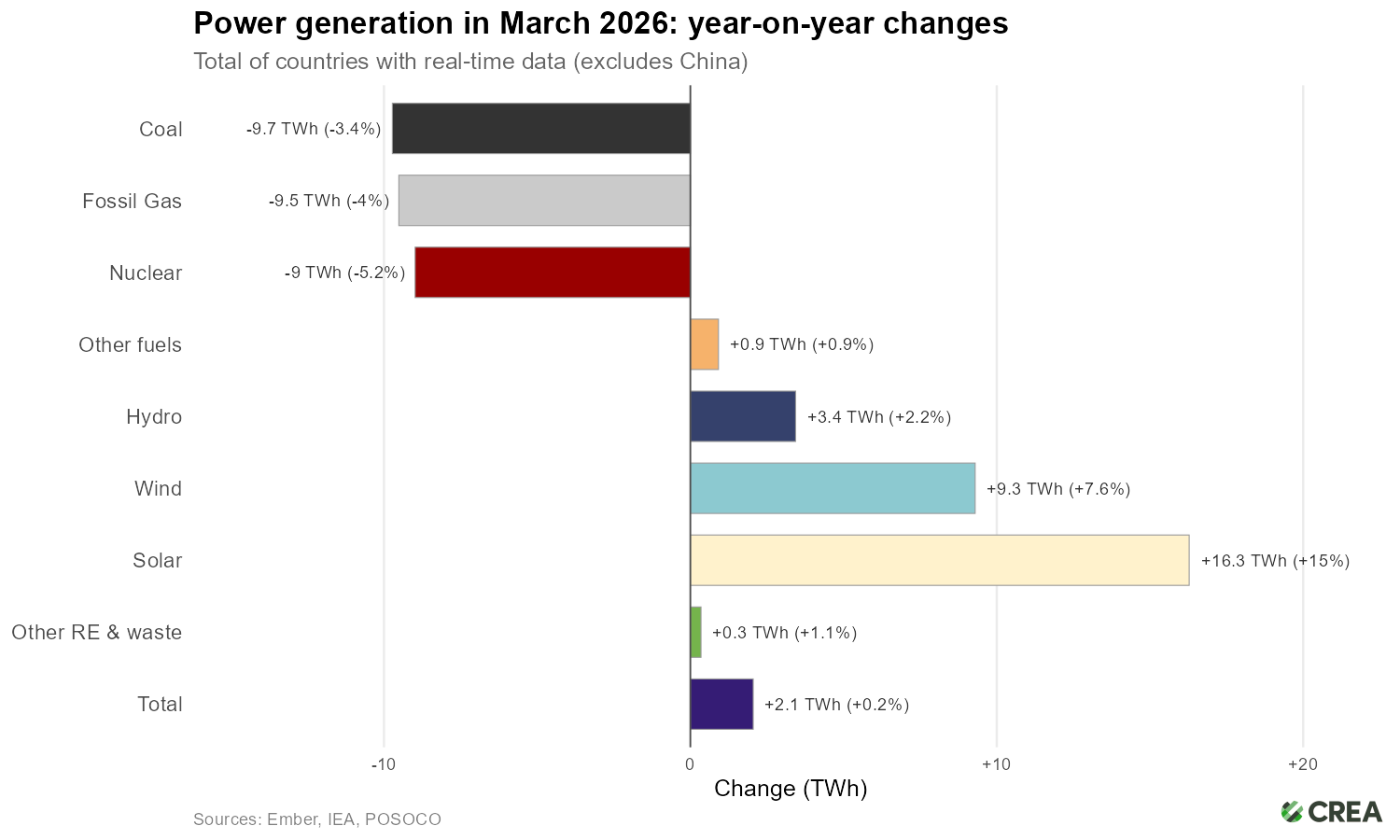
Contrary to much speculation by energy industry analysts, the closure of the Strait of Hormuz has not yet caused a surge in global fossil fuel power generation, according to research published Tuesday by Lauri Myllyvirta, lead analyst, Centre for Research on Energy and Clean Air.
“Global power generation from fossil fuels fell in the first month since the start of the Hormuz closure, with the fall in gas-fired generation offset by large increases in solar and wind power, rather than coal,” he writes. “Total power generation from fossil fuels in countries with near-real-time data fell 1% year-on-year, with coal-fired generation flat and gas-fired generation falling 4%.”
“The largest and most direct impact of the high fossil fuel prices will be accelerated sales of clean energy technologies such as solar, EVs, and heat pumps directly to consumers, bypassing slower-moving government and utility decision-making,” concludes Myllyvirta.
Solar power is slashing Europe’s gas imports bill
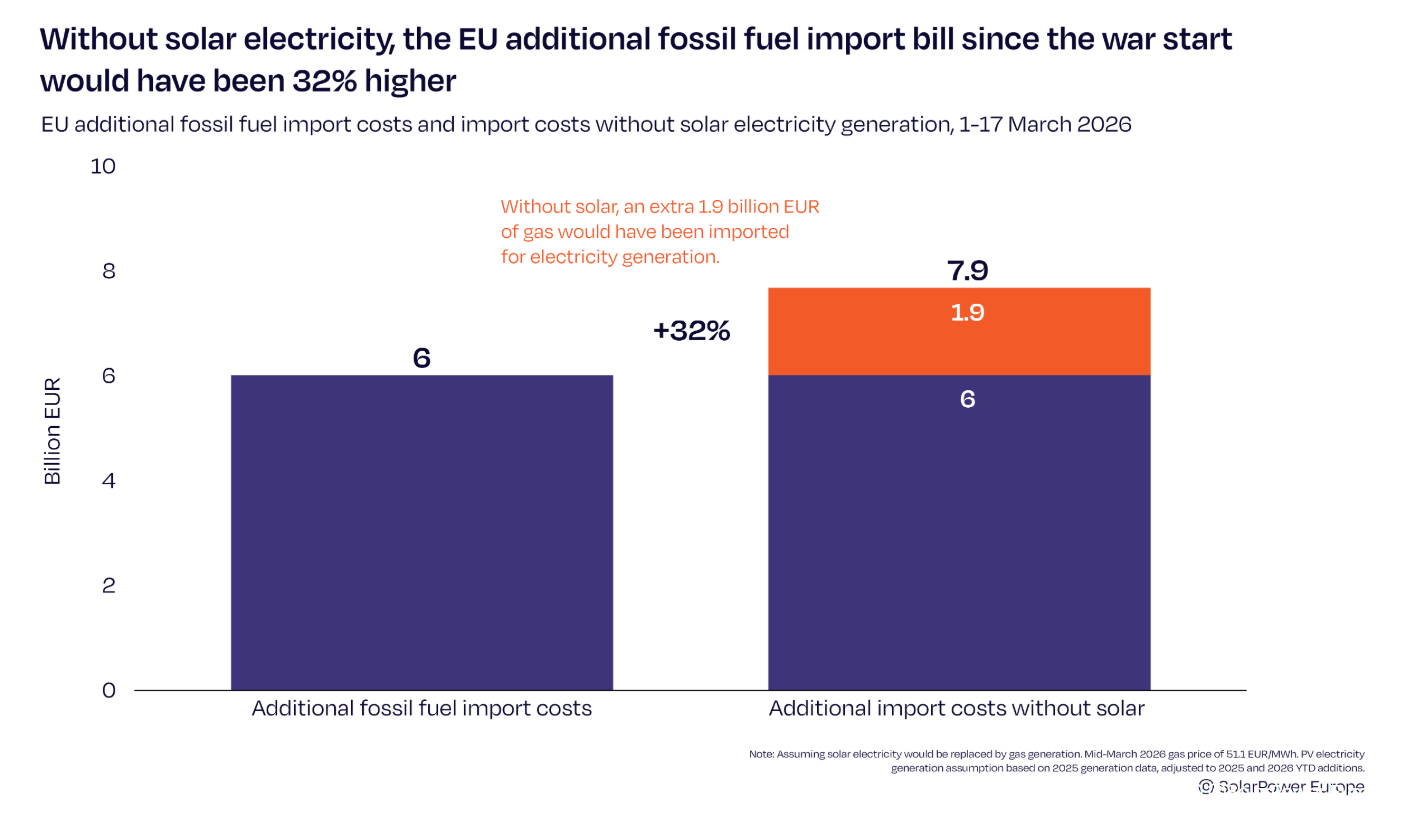
The solar deployed in Europe is already saving the continent more than €110 million ($129.7 million) daily in avoided fossil gas imports during the war in Iran, according to SolarPower Europe.
“The EU saved 111.7 million EUR every day in the first 17 days of the Middle East conflict,” according to research published by the trade association on April 1. “In the same period, solar has reduced the overall gas import bill by 32%.”
SolarPower Europe finds the total savings from solar in March came to €3.77 billion and could reach nearly €67 billion for the year if gas prices surge.
Grid bottlenecks threaten renewables growth in Europe
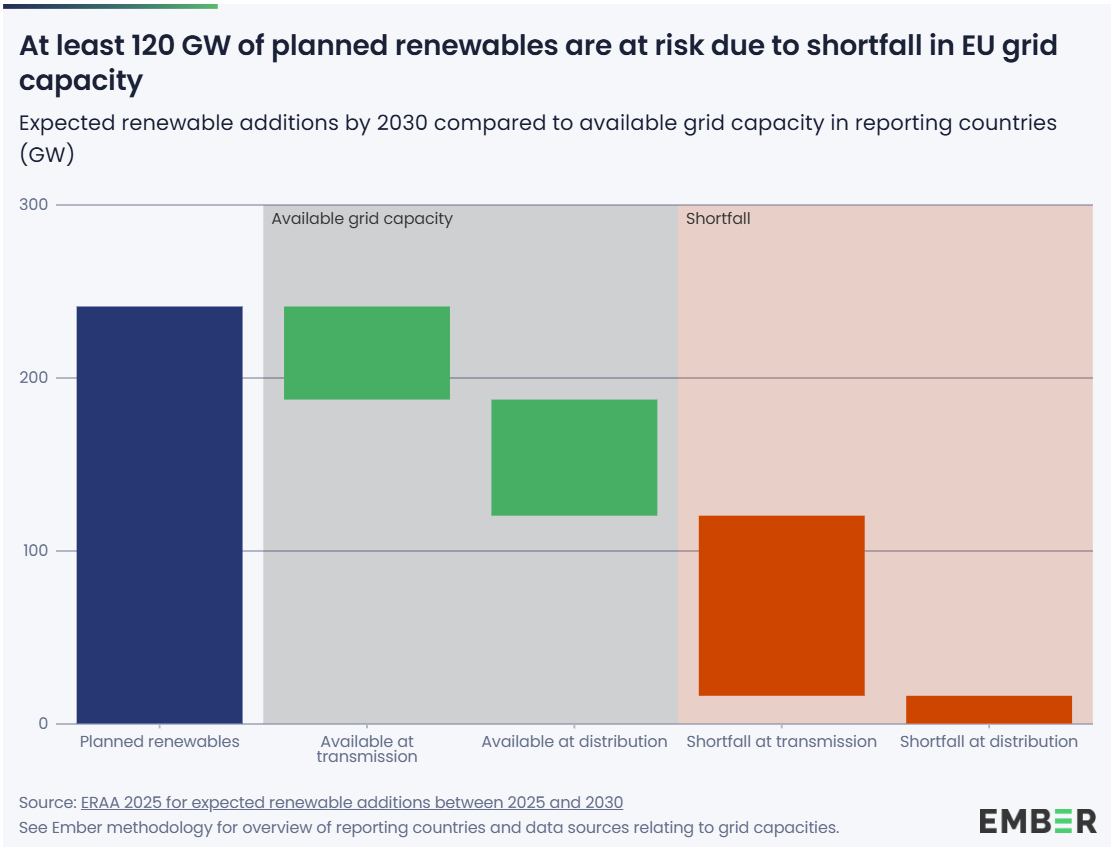
The next wave of solar and wind deployment in Europe could be at risk, however, unless grid constraints are cleared, finds a new Ember report.
“Grid bottlenecks put at risk over 120 GW of anticipated renewables across 20 EU countries,” according to the think tank. “As Europe faces its second fossil price shock in four years, barriers to rapid renewable rollout are a matter of urgency. One in every two grid operators has insufficient grid capacity to connect planned new wind and solar.”
“Grids will determine the success of Europe’s mission to wean itself off imported fuels and expand its industrial base. Grid readiness is now an indicator of economic readiness, not a technical afterthought. Ambitions alone cannot move electrons,” says Elisabeth Cremona, senior energy analyst, Europe, Ember.
Heat pumps provide big savings for electric-resistance homes
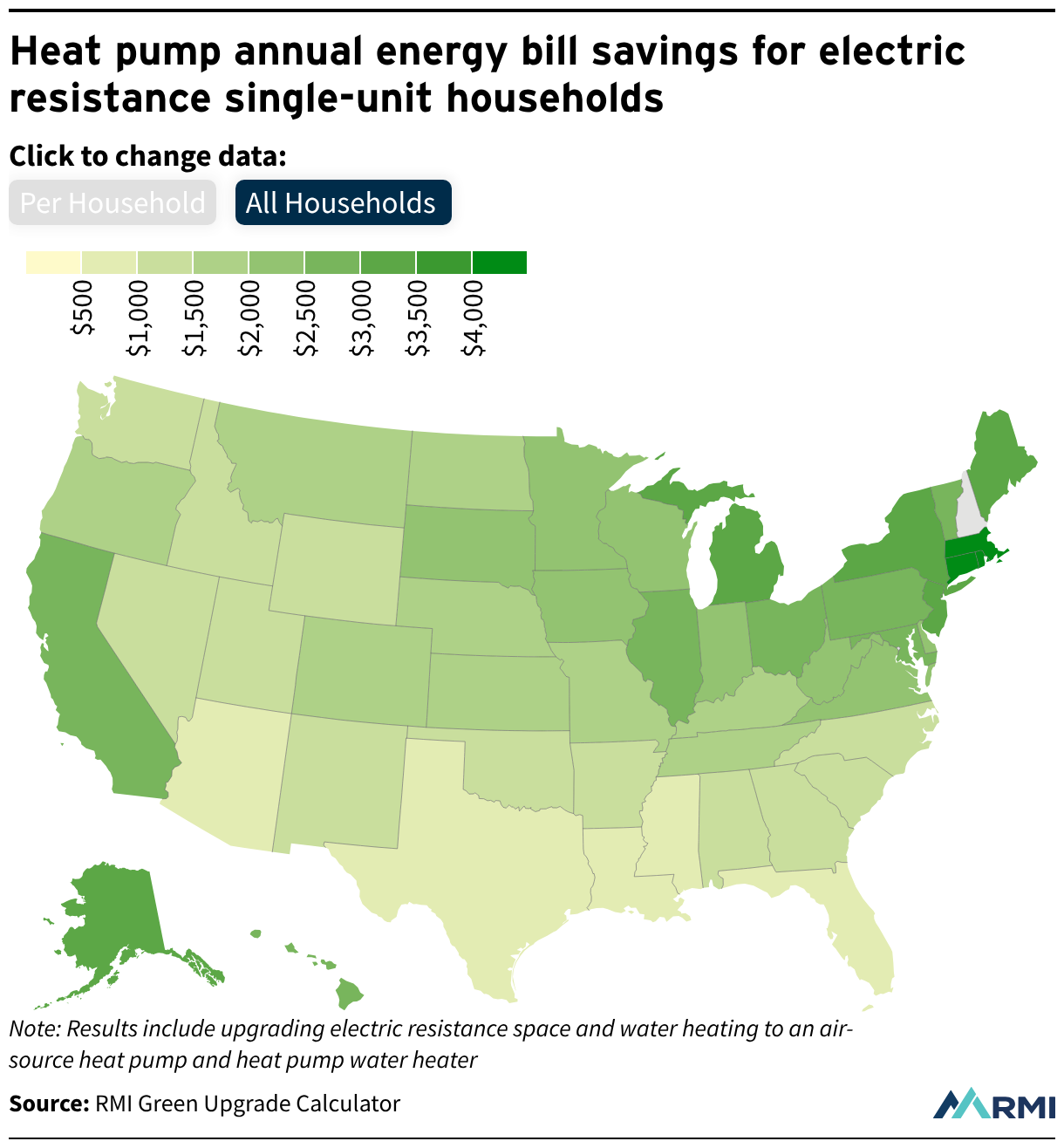
Tens of millions of U.S. households still heat their homes or water with electric resistance technologies when much more efficient heat pumps could do the job better at lower cost.
“Today’s modern heat pumps for space and water heating are roughly three times more efficient than resistance heating, delivering immediate bill savings for households while reducing peak demand on the grid and cutting carbon pollution,” write Ryan Shea and Rachel Golden, researchers with the Carbon-Free Buildings team at the RMI think tank.
“Using RMI’s Green Upgrade Calculator,” they write, “we found that single-family electric resistance households in the United States could save an average of $1,530 per year – and nearly $23,000 over the equipment’s fifteen year lifetime – by upgrading to heat pumps for space and water heating.”
Gas utility bills are rising faster than electric bills
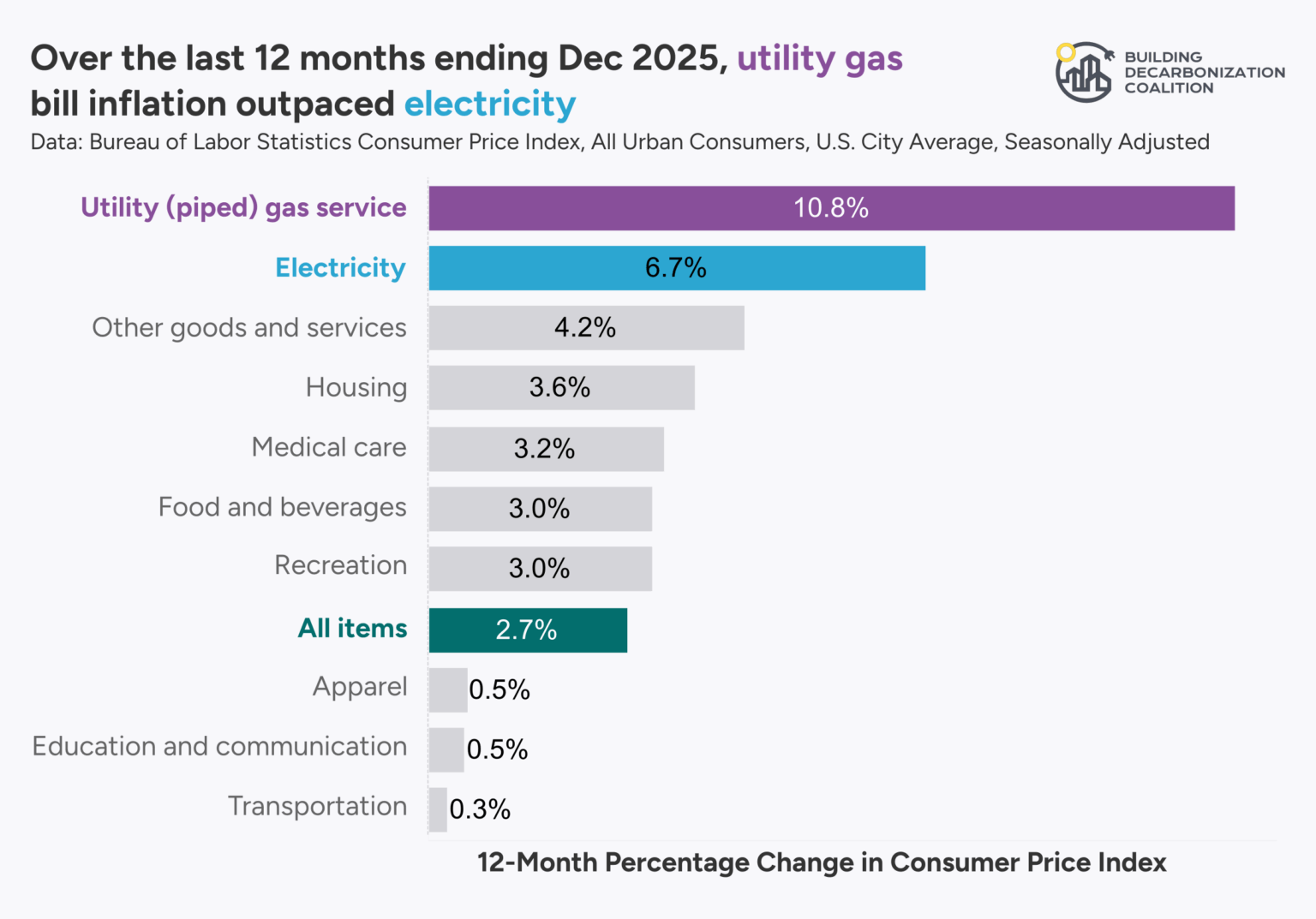
The impact of surging electricity rates on bills garners significantly more media coverage but a new report finds that fossil gas utility bills are rising even faster and “are a hidden driver behind America’s energy affordability crisis.”
The Building Decarbonization Coalition (BDC) report finds that:
- In 2025, gas bills rose 60% faster than electric bills and four times faster than inflation.
- About two-thirds of a typical household’s gas bill now goes toward pipeline replacements and other distribution infrastructure investments, rather than the gas itself.
- Gas utility spending on distribution infrastructure has more than tripled since 2010, and if utilities had not accelerated this spending, their customers would have saved $130 billion ($1,723 per gas household).
- Each year of accelerated gas utility spending adds at least $40 billion in excess lifetime costs for ratepayers.
“The tens of billions of dollars that utilities spend each year on gas pipeline replacements and other infrastructure investments, not volatile gas prices, are the main reason why gas utility bills rose much faster than inflation in 2025,” said Kristin George Bagdanov, associate director of research at BDC, in a statement.
Utilities plan to spend $1.4 trillion on the grid through 2030
As I’ve written here at Quitting Carbon, soaring electricity rates threaten climate action. Households may balk at joining the energy transition unless policymakers act to rein in electricity rate increases.
Under current trends, households won’t find relief anytime soon.
In a report published Tuesday, PowerLines, a nonpartisan consumer education nonprofit organization, “found that investor-owned utilities are planning to spend at least $1.4 trillion over the next five years through 2030 on capital expenditures (CapEx) – a more than 21% increase over the $1.1 trillion over a five-year period outlined last year.”
“Investor-owned utilities are signaling a record-breaking wave of capital spending, and history shows that those plans are often a leading indicator of future utility rate increase requests,” said Charles Hua, founder and executive director, PowerLines, said in a statement.
“Our century-old utility regulatory system has accelerated the size of the pie of utility capital spending, even when more cost-effective solutions that could lower consumers’ utility bills are available yet underdeployed.”
Bonus: Watching my Padres at Petco Park
In my last roundup, I mentioned I would be flying down to San Diego to attend the ARPA-E Energy Innovation Summit – watch for coverage of the conference in the coming weeks.
After the summit concluded, I stayed on for a few days to watch my beloved Padres play at Petco Park – and was rewarded with back-to-back walk-off victories!
Petco is not the most beautiful ballpark in Major League Baseball – that honor goes to PNC Park in Pittsburgh – but it is close. Embedded in a walkable downtown neighborhood, surrounded by great restaurants and breweries (don't miss East Village Brewing!), you can't beat the setting.

Whenever I visit Petco, I always take a moment to pay tribute to the franchise's all-time great, the Hall of Famer and my favorite baseball player, the late Tony Gwynn.