Russell Vought wants complete control over the $1.1 trillion in federal grants handed out each year
Local and state governments, scientists, and research institutions are alarmed by a Trump administration proposal that would give political appointees across federal agencies the power to kill grants – including funding for clean energy.

Quitting Carbon is a 100% subscriber-funded publication. To support my work, please consider becoming a paid subscriber, making a one-time donation, or gifting a paid subscription.
The litany of scandals, the grift and the graft, emanating from the White House each day is so unrelenting it can be hard to calibrate one’s outrage and sense of alarm. Is the latest revelation really worthy of your indignation?
I’m sorry, but I’m adding to your Yes, be concerned about this list.
On May 29, Russell Vought’s Office of Management and Budget (OMB) – the executive branch’s nerve center – released a sweeping proposal that would upend the way the federal government administers grants.
If the update to the 2013 Uniform Guidance for Federal Financial Assistance is approved as written, political appointees at more than 40 federal agencies would be empowered to overrule peer review panels to kill grants, and grants could be terminated for running afoul of the administration’s goals or priorities.
At stake is the fate of more than $1.1 trillion – 17% of total federal spending – the federal government sends to local and state governments, tribes, universities, nonprofits, research institutions, and other beneficiaries each year.
“Key provisions introduce mandatory pre-issuance reviews of all discretionary awards by political appointees to ensure alignment with administration policy priorities. Additionally, the proposal expands agency discretion to terminate existing awards and restricts funding for collaborations with specific foreign entities,” Christopher Steven Marcum and Abigail Haddad wrote at Tech Policy Press on July 13.
Federal grantees are justifiably alarmed by the Trump administration’s incipient power grab.
“Make no mistake, this is the most threatening and harmful proposal regarding federal government assistance to cities that we have seen in probably over three decades, or ever. It is that significant in scope,” Dave Gatton, director of the U.S. Conference of Mayors Council on Metro Economies and the New American City, said during a June 17 webinar hosted by the National Association of Counties and other government associations.
“The proposed rule would centralize and standardize federal grant processing while giving agencies significantly broader authority to terminate grants mid-award for reasons beyond noncompliance, including political and agency priority misalignment, Matthew Hanson, managing director, government advisory services for the crisis-management firm Witt O’Brien’s, said during the webinar,” according to Smart Cities Dive’s Vicky Uhland.
Grantees mobilize against the proposal
Federal grant recipients, including scientists and researchers represented by the American Physical Society, American Geophysical Union, and Stand Up for Science, among many other organizations, quickly mobilized against the OMB proposal.
Federal grantees did not have much time to prepare comments in response to the more than 400-page proposal. The 45-day comment period expired on July 13.
By the deadline, individuals and organizations had submitted nearly 500,000 comments.
“Phase one of our fight against the OMB rule is complete and you all showed up!!! Half a million comments is wild. We absolutely exceeded our goal of 100,000! So, what happens next??? Welcome to phase two: Pressure and preparation!,” Colette Delawalla, Stand Up for Science's Founder and CEO, wrote on Bluesky on July 14.
Comments overwhelmingly oppose the OMB proposal
An analysis conducted by researchers at the University of North Carolina at Chapel Hill, in partnership with the newsroom STAT, found that 95% of the comments opposed the new OMB rule; just 1% supported the proposal.
The researchers used a large language model by Open AI to classify, and to identify themes mentioned in, the more than 52,000 comments that had been posted online by the July 13 deadline, according to STAT’s Anil Oza and J. Emory Parker.
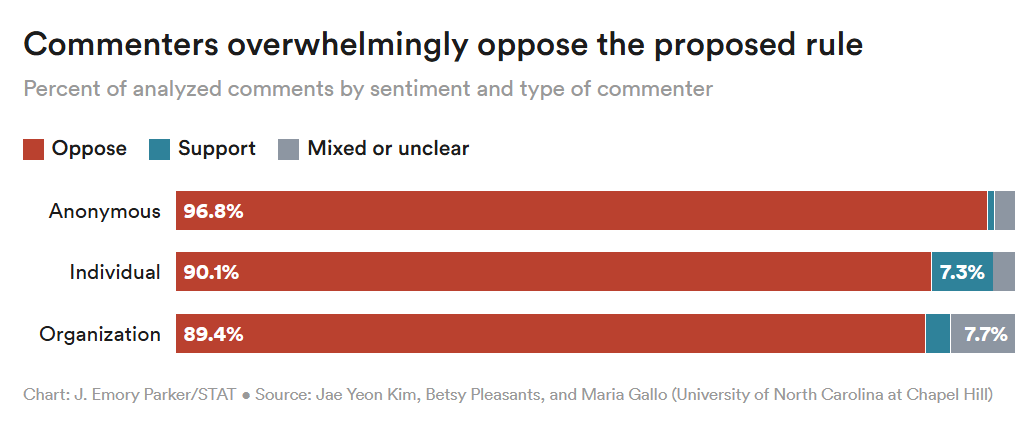
“Around 60% of commenters of those opposed to the rule directly mentioned political control of grants, while about a third mentioned opposition to peer review no longer being binding,” they write.
To get a sense of how the clean energy industry feels about the proposed rule, I used the simple search bar at Regulations.gov to identify commenters from the sector.
“I strongly oppose the proposed changes to put political appointees in positions of authority over science and research funding. Science and research, and thus the strength of America, thrive when developed and advanced independent of political whims and agendas. History supports this view,” wrote a commenter representing the Pacific Marine Energy Center, a research consortium comprising Oregon State University, the University of Washington, and the University of Alaska Fairbanks (emphasis in original).
Kurt Zwally, the director of commercial development with the solar developer Sustainable Energy Systems, wrote: “For someone in renewable energy, the concrete concern is this: NIH, NSF, DOE, and EPA all fund research on clean energy technology, grid modernization, air quality, climate-related health impacts, and extreme weather – every one of those grant applications must now pass a political screen before it can be awarded, regardless of what peer reviewers say about its scientific merit.”
“The grant application process has already gone off the rails, and the scientists I work for are worried about uncertain funding,” wrote Alex Siemer, a (very brave!) intern with the National Laboratory of the Rockies (the lab formerly known as the National Renewable Energy Laboratory).
“Section 200.205 of the rule change would give political appointees way more power to block funding for renewable production projects like the ones my seniors are working on.”
“This new regulation would drastically affect my lab's ability to obtain funding, especially now that climate change has been politicized and the current admin has no interest in investing in renewables,” wrote Alexis Glaudin, a Ph.D. candidate in physical chemistry at the University of Washington.
“Science is already under-funded, and this will exacerbate the problem,” she added. “New funding proposals should be reviewed by scientists who understand emerging fields and are not motivated to approve/disapprove science projects based on how profitable it would be to the country.”
What’s next
OMB intends to enact the new rule by October 1, the beginning of the federal government’s fiscal year. To meet that deadline, it would have to publish the final rule in the Federal Register by September 1.
It’s an exceedingly ambitious deadline – especially if OMB follows the law.
“The administration is required to respond to substantive public comments, according to the Administrative Procedures Act. But it does not need to amend the rule based on that feedback,” write STAT’s Oza and Parker.
“OMB is legally mandated to review *and* respond to EVERY substantive public comment,” (emphasis in original) Stand Up for Science's Delawalla noted on Bluesky. “This matters for several reasons: OMB said they will enact the rule by 10/1, there are 100’s of thousands of comments that aren’t logged yet, and failure to do this step lets up serious litigation.”
As Delawalla suggests, federal grantees are already preparing to sue the Trump administration if the final rule looks anything like the proposal released in May.
But the force behind the proposal, OMB’s Vought, won’t be persuaded by the commenters near-universal rejection of his power grab. Instead, he’ll view the lopsided result as affirmation, a rebuke engineered by “woke” radicals on the left.
The proposal to overhaul federal government grantmaking is just the latest step in Vought's quest to wrest control of spending from Congress and hand it permanently to the president. That’s a potential outcome that should alarm us all.