What I’m reading: Offshore wind advances in Canada and New Zealand, Desertec 2.0, electrification bills advance in California, Trump's assault on energy efficiency, and more
Quitting Carbon's biweekly roundup of energy transition developments you might have missed.


Quitting Carbon is a 100% subscriber-funded publication. To support my work, please consider becoming a paid subscriber, making a one-time donation, or gifting a paid subscription.
Welcome back to another recap of highlights from what I’ve been reading. Have a great weekend. And thanks, as always, for reading.
Offshore wind advances in Canada, New Zealand
Donald Trump is doing everything he can to kill the U.S. offshore wind industry – despite federal judges repeatedly ruling to block his administration’s anti-wind campaign.
Meanwhile, policymakers are working to stand up offshore wind industries in two new global markets.
In Nova Scotia, leaders want to position the province as an offshore wind “superpower” capable of exporting electricity west to some of Canada’s largest cities and south, across the border, to New England.
Under the Wind West plan, wind farms offshore Nova Scotia could generate enough electricity to meet about a quarter of Canada's power needs.
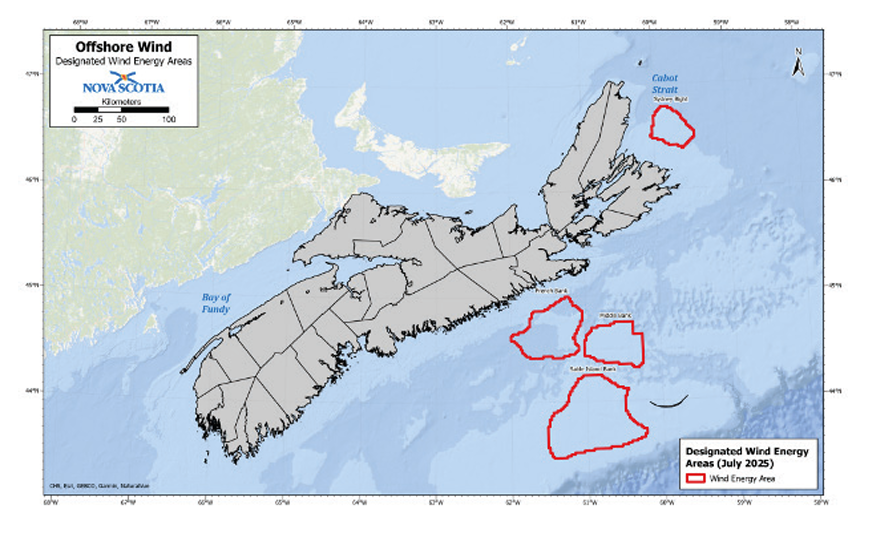
In early February, the province signed an agreement with the U.S. state of Massachusetts to partner on offshore wind development. The next month, the utility Hydro-Quebec issued a Request for Information to assess options to connect wind farms offshore Nova Scotia to its transmission network.
Last month, Nova Scotia’s offshore energy regulator identified the companies that qualified to bid later this year on seabed licenses to develop projects that could supply as much as 5 gigawatts of offshore wind capacity by 2033. The qualified bidders include China-based Ming Yang Smart Energy Group, Toronto-based Northland Power, and Ireland-based Simply Blue Energy.
Meanwhile, on the other side of the globe, last week New Zealand lawmakers passed the Offshore Renewable Energy Bill, legislation to support the development of offshore renewable energy projects, including offshore wind farms.
“This legislative decision establishes the framework the industry has been waiting for. A clear ‘two-step’ permitting regime gives developers greater confidence to investigate and invest in New Zealand’s exceptional offshore wind energy resources,” said New Zealand Wind Energy Association CEO Kevin Hart in a press release.
“Now that the bill has passed, officials will advise when the first tender round for permits can proceed. I expect this to occur in the coming months,” said Energy Minister Simeon Brown in a press release.
Desertec 2.0
Remember Desertec?
If you’ve been active in the energy space for long, you'll likely remember this initiative, launched in 2009, which aimed to export solar power from North Africa via undersea cables to Europe. Desertec 1.0 ultimately failed.
But might it work today? The European Union is ready to try again.
“The European Union is betting that the future of its energy system lies under the North African sun,” reports Politico’s Elena Giordano.
Last month, the European Commission pledged €5 billion ($5.7 billion) to renewables projects in North Africa and the Middle East, which could export electricity to Europe’s grid, under the new Trans-Mediterranean Renewable Energy and Clean Tech Cooperation (T-MED) initiative.
“The Commission hopes the EU funding will lure private money to co-invest, mobilizing up to €25 billion of investment in solar, wind, hydrogen, electricity grids and other clean technologies by 2035,” writes Giordano.
The Commission believes the T-MED initiative could contribute to the development of up to 15 gigawatts of new renewable energy capacity across the Mediterranean by 2035.
“The Mediterranean region holds vast untapped renewable potential – 2,300 GW, representing over twice the EU's current capacity – with solar and wind costs 30-40% lower than in Europe. … At a time of geopolitical uncertainty, growing energy demand and increasing climate pressures, unlocking this potential is in the shared interest of both the EU and its southern Mediterranean partners,” said Dubravka Šuica, EU Commissioner for the Mediterranean, in a press release.
EVs are beginning to displace global oil consumption
I’ve written in this newsletter that Donald Trump’s catastrophic war with Iran is prompting political leaders and households around the world to seek the security and certainty offered by clean energy technologies, including electric vehicles.
We’re beginning to see how adding EVs to the global vehicle fleet is starting to displace oil demand.
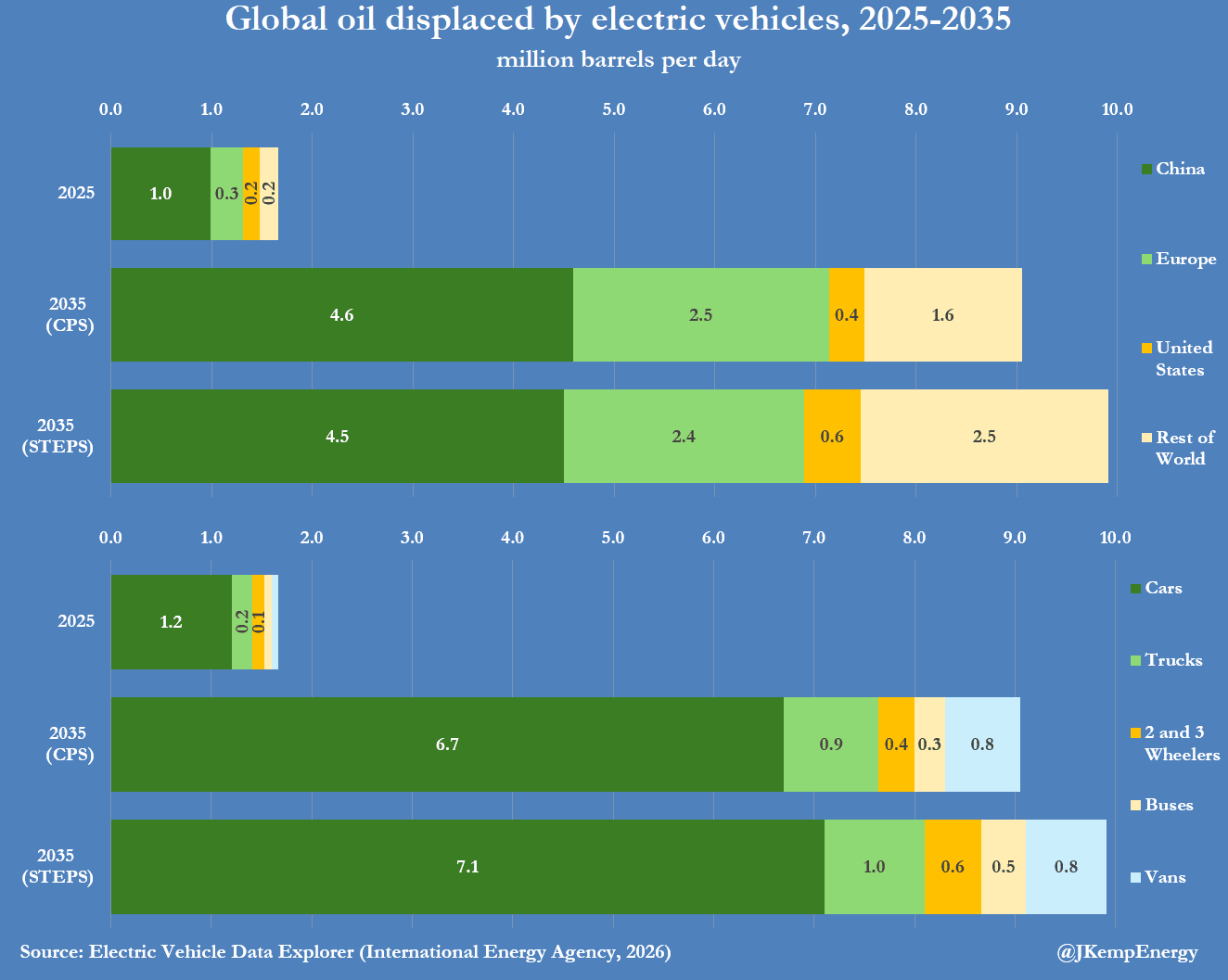
“Electric vehicle adoption is beginning to displace a modest but meaningful amount of oil demand, and the effect is expected to grow sharply by the mid-2030s,” writes UK-based energy analyst John Kemp.
“According to the International Energy Agency, EVs displaced about 1.7 million barrels per day of oil consumption in 2025, up from 0.4 million barrels per day in 2020,” he adds. “By 2035, that displacement is projected to rise more than fivefold, reaching 9 million barrels per day under the agency’s current policies scenario and 10 million barrels per day under its stated policies scenario.”
California lawmakers advance key electrification bills
California lawmakers have voted to advance two bills aimed at making it much easier to fully electrify buildings in the state.
Last week, legislation from state Senator Scott Wiener (D) to streamline heat pump permitting (SB 222), which already passed out of the Senate, was voted out of a second policy committee in the Assembly and is now headed to the Appropriations Committee ahead of a final floor vote.
Also last week, a bill authored by Assemblymember Marc Berman (D) that would give homeowners the option to electrify their homes with money that would otherwise be spent to upgrade or replace fossil gas service lines (AB 2313) passed unanimously out of the Senate Energy, Utilities, and Communications Committee.
The legislation, which already passed out of the Assembly, now heads to the Senate Appropriations Committee.
The Trump administration wants to make it harder to build and sell more energy efficient buildings and appliances
The Trump administration really wants you to pay more to power your home and all the appliances in it.
Last month, the U.S. Department of Energy (DOE) released an analysis finding that nationwide adoption of the 2024 International Energy Conservation Code (IECC) would increase residential construction costs by more than $9.2 billion annually. According to DOE, “construction costs for a typical single-family home could increase by as much as $14,000” for homes built to the code.
“American families should not be forced to pay more for a home because of nonsensical energy-related mandates. For too long, climate activists have pushed regulations that increase housing costs, reduce consumer choice, and make it harder for Americans to build and own a home,” said Energy Secretary Chris Wright in a press release.
As I’ve written in this newsletter, many U.S. states adopt the IECC as their energy code for small residential buildings, so it would be quite a big deal if the cost of adopting the code was so onerous for homeowners.
But the Energy Department under Donald Trump, including Wright himself, has a troubling track record of misleading the public about the cost and performance of clean energy technologies.
And Canary Media’s Alison F. Takemura calls them out for it in her reporting this week on DOE’s 2024 IECC analysis.
“Energy-efficiency standards can make it more expensive to construct new buildings, but they save money for residents in the long run. In a new analysis,” she notes, “the Trump administration ignored the second half of that equation – a move that energy experts fear could undermine efficiency efforts nationwide.”
The findings in the DOE analysis are “a break with decades of DOE analysis, spanning Republican and Democratic administrations, which has reported significant energy and financial savings under each iteration of the code,” she adds.
“The Energy Department is completely contradicting its own findings. The DOE’s new methodology is a deep mystery,” Donna Stanley, vice president of communications at the nonprofit International Code Council, which develops the IECC, told Takemura.
Takemura cites a report published by DOE’s Pacific Northwest National Laboratory last year finding that “the 2024 model code generates an average life-cycle cost savings of nearly $3,000 per residence over the 2021 code … though in specific regions that could rise to almost $9,500.”
Last week – you might have missed the announcement just before the Fourth of July holiday weekend – DOE announced a proposed rule that would create hurdles to update the efficiency standards for appliances and other equipment.
“The proposal will update the Department’s Process Rule used to establish energy conservation standards for household appliances and equipment, including air conditioning units, gas stoves, washing and drying machines, water heaters, refrigerators, and other products Americans rely on every day,” according to DOE.
“For too long, the American people paid the price for mandates that restricted consumer choice and drove up costs. President Trump promised to end this nonsense and that is exactly what we are doing. This proposed rule will preserve the American people’s ability to choose home appliances and equipment that actually work – at prices they can afford,” said Wright in a press release.
It should not surprise you that energy efficiency advocates contest these claims.
“Efficiency standards are a proven policy for lowering Americans’ energy bills, but this would create hurdles designed to make updating them more difficult,” said Andrew deLaski, executive director of the Appliance Standards Awareness Project (ASAP), in a press release.
“This obstacle course of restrictions would hinder the department from carrying out its congressional mandate to protect consumers. We have products that keep getting more efficient and we need to embrace these technology advances, not reject them, especially as data centers strain our electric grid,” he added
A recent ASAP analysis estimates that the next scheduled round of updates to federal efficiency standards for appliances and equipment could:
Save U.S. households an average of about $160 annually on their utility bills over two decades (2030–2050); businesses could collectively save almost $15 billion annually.
Save 4.2 trillion gallons of water cumulatively through 2050.
Reduce summer peak demand by about 34 gigawatts (GW) in 2040 and 56 GW in 2050.
Cut cumulative carbon dioxide emissions by more than 800 million metric tons through 2050.
Because the proposed rule could be reversed under a future Democratic president, as the Biden administration did with similar process changes adopted during the first Trump term, “the industry’s hope is for Congress to amend the underlying Energy Policy and Conservation act to ‘lock these reforms into statute,’” Kelly Mariotti, president and CEO of the Association of Home Appliance Manufacturers, told Heatmap’s Emily Pontecorvo.
Bonus: The sky ablaze before the fireworks came
This was the scene at sunset as the crowd waited for the annual July 4th fireworks show to begin in Concord, California, last Saturday.