What I’m reading: Energy transition milestones in China, global EVs sales surge, Trump 2.0 and climate tech startups, and more
Quitting Carbon's biweekly roundup of energy transition developments you might have missed.


Quitting Carbon is a 100% reader-supported publication. Support independent energy journalism by becoming a paid subscriber or making a one-time donation.
Welcome back to another roundup of highlights from what I’ve been reading. I'll be back in your inbox next week. Thanks, as always, for reading.
Energy transition milestones in China
It can be hard to wrap one’s mind around the speed and scale of energy innovation in China.
Consider Sam Parkinson’s recent dispatch from the Beijing Auto Show.
“I just spent two days at the 2026 Beijing Auto Show (Auto China 2026), and I need to tell you something: the future of the auto industry is electric and Chinese. I’m not being dramatic. Just realistic,” he writes at The Driven.
“In a single hall at the show,” he adds, “there were more EV models on display than there are available ones in the entire United States. There are 17 halls at this show. Seventeen. And they all have more EVs than the US market.”
At the same show, Parkinson visited the booth for a hybrid driverless electric truck solution called “Kargo One” developed by KargoBot.
“One human-driven ‘pilot’ truck leads a convoy of 2 to 6 fully automated L4 trucks,” he writes. “The idea is that the human lead handles the most complex ‘long-tail’ manoeuvres (like navigating a chaotic toll booth or a messy construction site), while the autonomous followers mimic the lead’s path. KargoBot says this reduces labour costs by up to 80%, and cuts energy consumption by 5-10% due to reduced wind resistance.”
And then there are the seemingly never-ending series of “world’s biggest” or “world’s first” announcements coming out of China.
“The world’s largest purely electric container ship has officially begun commercial operations in China,” reports Parkinson’s colleague Joshua S. Hill.
“China’s state news agency Xinhua reported last week that the Ning Yuan Dian Kun, built by Jiangxi Jiangxin Shipbuilding, began commercial operations with an inaugural run between the Ningbo-Zhoushan and Jiaxing ports in China’s eastern Zhejiang Province,” he adds.
Last week, Chinese battery maker CATL unveiled a new battery promising a staggering 932 miles (1,500 kilometers) of range.
“If true, the vast distance is another data point that underscores China's strength in EV tech — and EVs' growing capacity to offer conveniences of gas-powered cars,” writes Axios’ Ben Geman. “On that note, CATL also reportedly unveiled a separate battery, an update of its Shenxing battery that can charge in six minutes, per reports from its presentation.”
China also just set a new record for solar panels sent overseas.
“According to new analysis from Ember, based on data from the Chinese customs authority, solar exports equivalent to Spain’s entire installed capacity were dispatched from China over the month of March, surpassing the previous record set in August 2025 by 49%,” writes Renew Economy’s Sophie Vorrath.
And lest there be doubt about China’s commitment to meet its climate and clean energy targets, the country’s leadership just announced a new initiative that ties local officials' promotions to action on climate.
“China will begin a major campaign aimed at accelerating climate action by local authorities, warning regional officials that they will be held accountable for failing to make progress toward President Xi Jinping’s green targets,” writes Bloomberg’s Lili Pike.
“Starting this year, provinces will be graded on efforts to ensure China’s carbon dioxide emissions peak before 2030, and on objectives to lift clean energy consumption and to limit the use of coal and oil, according to an official document published Thursday by the Xinhua News Agency.”
With the Strait of Hormuz closed, EV sales surge across the globe
We’ll soon have data for April, but it’s clear based on data through March that more car buyers are opting for electric vehicles in response to the soaring fuel prices and uncertainty triggered by Donald Trump’s war in Iran.
“New data from New Automotive and E-Mobility Europe released today shows the number of EV registrations across 15 key EU and EFTA markets rose 51 per cent year-on-year during March to over 224,000 electric passenger cars,” BusinessGreen’s James Murray reported last week.
On Tuesday, Bloomberg’s Kyle Stock and Lili Pike reported on the global EV buying spree:
“The war in Iran and the turmoil it has set off in global oil markets is fueling a surge in electric car sales in much of the world. In March, the first four weeks since the bombing began, consumers in France, Germany and the UK drove off in 206,200 EVs, a 44% increase over the year-earlier period. In South Korea, electric car transactions more than doubled. In Italy, where the path to electrification has been slow, 16,000 battery-powered vehicles left dealerships last month, a 67% increase.”
In the U.S., too, surging gas prices have drivers eyeing EVs and hybrids.
“A Cars.com in-market shopper survey found that more than half of car shoppers – 52% – said rising gas prices have led them to consider a full EV or plug-in hybrid vehicle (PHEV). Breaking it down further, 33% said they are more likely to consider a PHEV, while 19% are more inclined to look at a fully battery-electric vehicle,” reports Yahoo Finance’s Pras Subramanian.
Demand for used EVs might even be outpacing that for new models.
“Octopus Electric Vehicles has reported a huge surge in demand for second-hand electric cars through its leasing service,” BusinessGreen’s Stuart Stone reported last week. The UK car leasing company said demand for leasing its used EVs increased by 177% in March compared to the same month last year.
France publishes a fossil fuel exit plan
This week, nearly 60 countries gathered in Santa Marta, Colombia, for the inaugural Conference on Transitioning Away from Fossil Fuels.
“Countries attending a first-of-its-kind summit have walked away with plans to develop national roadmaps away from fossil fuels, along with new tools to address harmful subsidies and carbon-intensive trade,” writes Carbon Brief’s Daisy Dunne in a briefing on the key takeaways from the summit.
One concrete takeaway was a roadmap published by France for transitioning away from fossil fuels.
The plan “sets end-of-consumption targets for coal by 2030, oil by 2045 and fossil gas by 2050 for energy purposes.”
Tuvalu and Ireland will co-host the second Conference on Transitioning Away from Fossil Fuels in Tuvalu next year.
“The vase is broken”
Fatih Birol, the executive director of the International Energy Agency, is a circumspect operator, so I took notice when reading his analysis of the fallout of Donald Trump's war in Iran in a remarkable interview published by the Guardian last Friday.
“Speaking exclusively to the Guardian," writes Fiona Harvey, “Birol said a key effect of the US-Israel war on Iran was that countries would lose trust in fossil fuels and demand for them would reduce.”
Birol told Harvey:
“Their perception of risk and reliability will change. Governments will review their energy strategies. There will be a significant boost to renewables and nuclear power and a further shift towards a more electrified future. And this will cut into the main markets for oil.”
“The vase is broken, the damage is done – it will be very difficult to put the pieces back together. This will have permanent consequences for the global energy markets for years to come.”
Trump 2.0 alters plans for climate tech startups
How disruptive has the Trump administration’s campaign to kill what it calls the “Green New Scam” been for startups?
Last week, during a San Francisco Climate Week panel hosted by Heatmap News, Mitch Rubin, a managing director at Elemental Impact, talked about how the new administration’s priorities are impacting emerging companies. Elemental is a nonprofit investor in climate tech companies.
Every year, Elemental evaluates the health of its portfolio companies by conducting a 75-question survey that analyzes “how climate companies are adjusting to changes in the policy, environment, and market dynamics,” Corina Standiford, Elemental’s chief communications officer, told me in an email.
More than one year into the second Trump administration, Elemental’s 160 portfolio companies are feeling the whiplash of changing policy.
“90% reported altering expansion plans, fundraising, or operations due to the evolving federal landscape,” said Standiford.
The companies also reported a total of $659 million in government grants, financing, or incentives that were rescinded, cancelled, or paused.
“It’s real. It’s very real,” said Rubin during the panel.
“There are companies that sit at this nexus of priorities for the existing administration around AI, energy infrastructure, critical minerals. And we’re seeing some accelerate through the public funding,” he added.
“There are so many amazing technologies and businesses that are going to be forced to go into hibernation mode. Some might shut down altogether, which is an absolute shame because we need these moonshots to be developed as a society.”
Bonus: SF Climate Week on the historic Klamath ferry
It will be hard to top the venue for the Heatmap News event I attended last week.
Heatmap hosted an afternoon of panels for San Francisco Climate Week in a conference room aboard the Klamath, a ferry that plied San Francisco Bay in the first half of the 20th Century.
Now permanently docked at Pier 9 just off the Embarcadero in San Francisco, the Klamath affords stunning views of San Francisco Bay, the western span of the San Francisco-Oakland Bay Bridge, and the Financial District skyline.
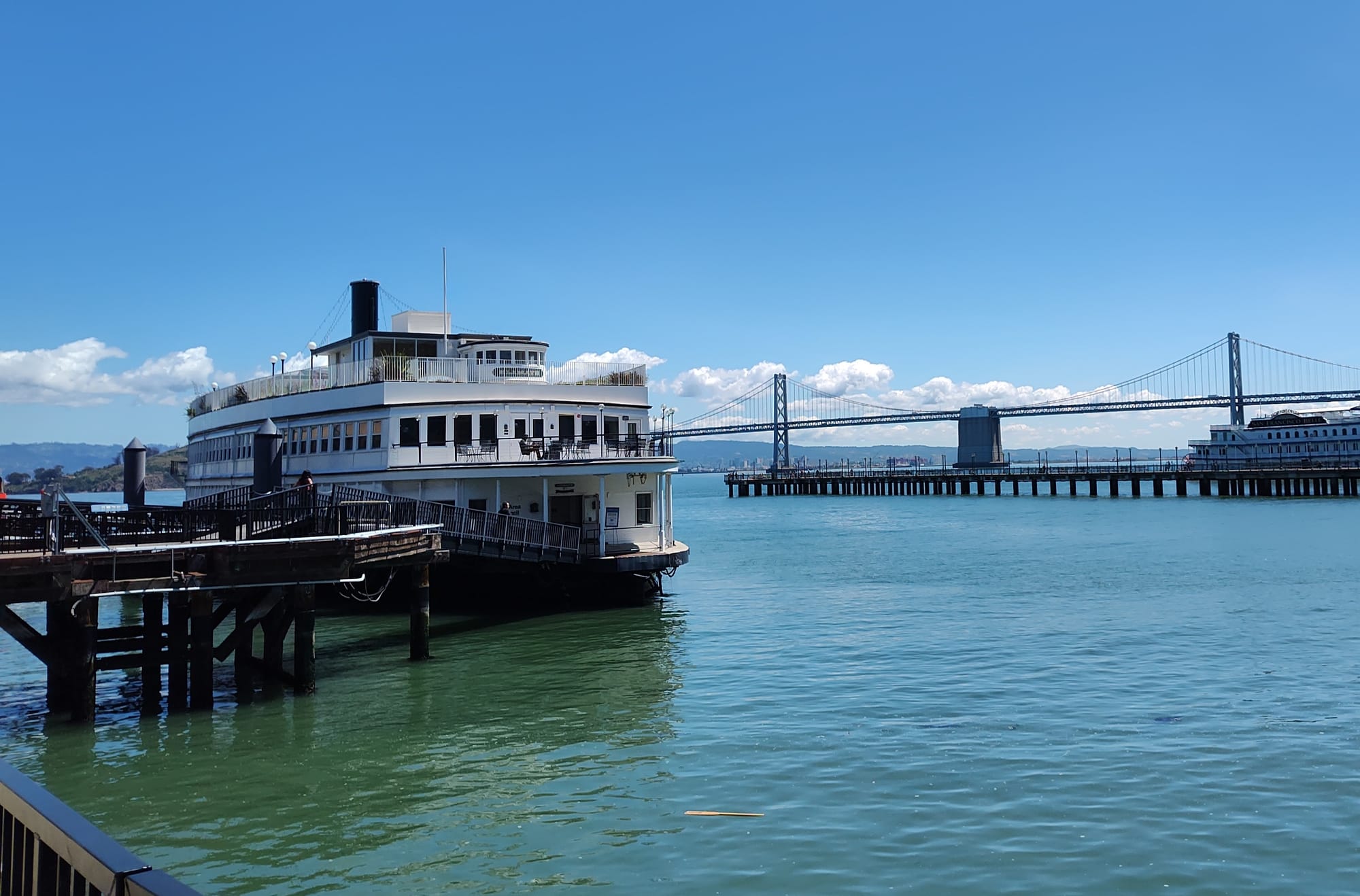

The historic Klamath ferry docked at Pier 9 and the Financial District, San Francisco, California. Credit: Justin Gerdes.