What I’m reading: Germany notches tall turbine and big battery milestones, electrification is coming for big ships and planes, making it easier for EV drivers to charge, global energy transition tracker, and more
Quitting Carbon's biweekly roundup of energy transition developments you might have missed.


Quitting Carbon is a 100% subscriber-funded publication. To support my work, please consider becoming a paid subscriber, gifting a paid subscription, or leaving a tip.
Welcome back to another recap of highlights from what I’ve been reading. For all the new readers who have joined us in recent weeks, these every-other-Friday roundups are my way of flagging important energy transition developments you might have missed.
Have a great weekend and thanks, as always, for reading.
Germany notches tall turbine and big battery milestones
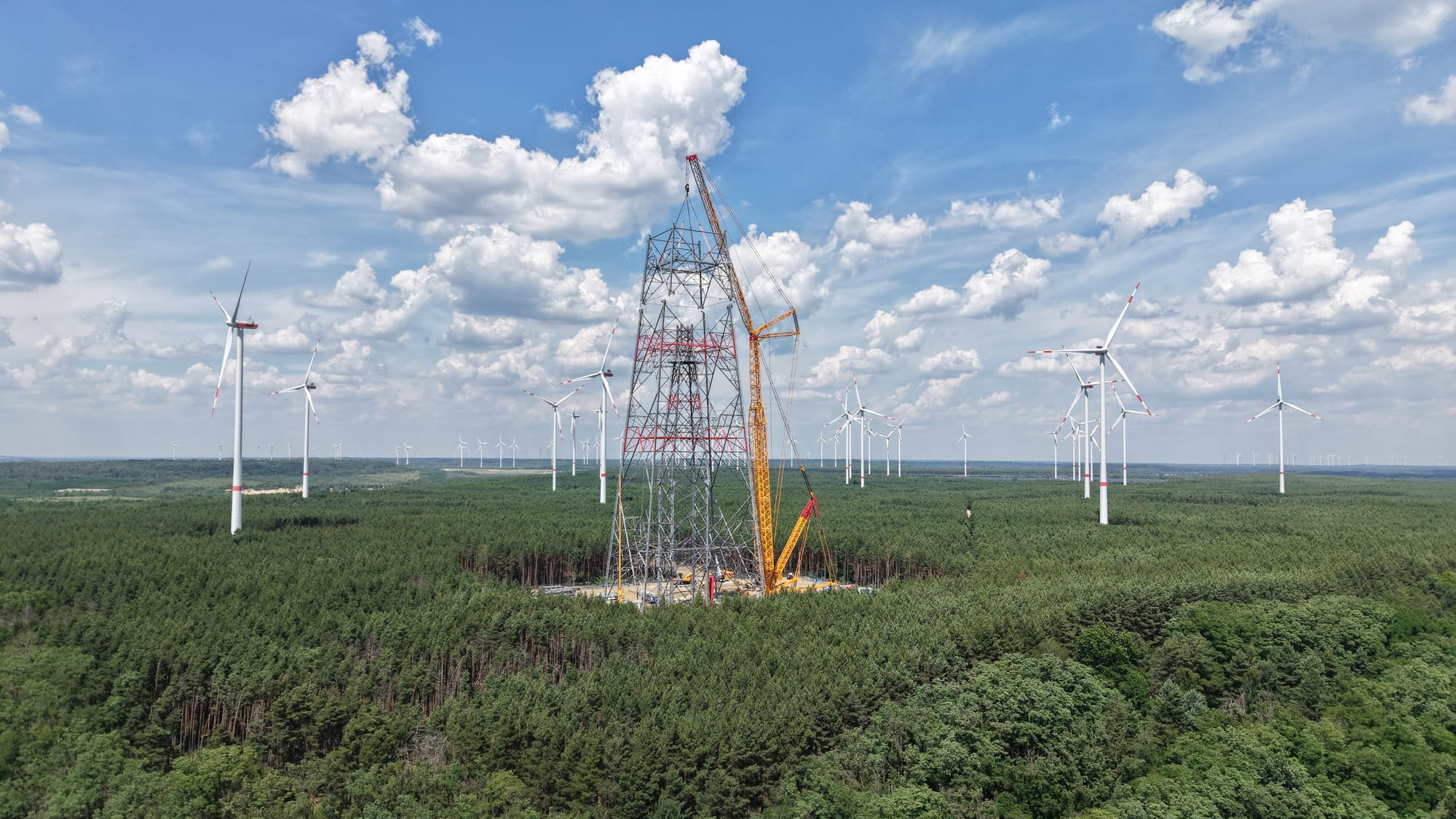
Near the town of Schipkau, between Berlin and Dresden, in Germany, the project developer Gicon is erecting what it calls the world’s largest onshore wind turbine.
On Sunday, a hydraulic lift will hoist the turbine’s assembled nacelle, hub, and rotor blades from a platform at 165 meters to their final position at 300 meters (984 feet) on a “telescopic onshore lattice tower.”
“Including the blades, the wind turbine in Schipkau, in the eastern state of Brandenburg, is set to be 365 metres tall, almost exactly the same height as Berlin’s iconic TV tower,” writes Clean Energy Wire’s Sören Amelang.
According to Gicon, “the high-altitude wind tower will be able to produce more than twice as much energy as a comparable conventional onshore wind turbine once operational.”
In the northern German state of Schleswig-Holstein, Swedish energy giant Vattenfall recently decided to proceed with construction on a 254-megawatt/1,000-megawatt-hour battery energy storage system.
The project, which will be built at the site of the Brunsbüttel nuclear power plant, will be “one of the country’s and Europe’s largest battery energy storage system (BESS) projects,” reports Energy Storage News’ Andy Colthorpe.
The project is one in a wave of big battery projects in the pipeline in Germany.
“The Vattenfall project, if completed today, would be Germany’s biggest operational BESS, but others are already in construction that will dwarf it,” notes Colthorpe.
“BESS owner-operator BW ESS recently broke ground on the 1,000MW/5,700MWh Klostermansfeld BESS in Saxony-Anhalt, and utility LEAG is currently building the 1GW/4GWh GigaBattery Jänschwalde 1000 as well as the 400MW/1.6GWh GigaBattery Boxberg 400 project,” he adds.
Vattenfall's Brunsbüttel battery is scheduled to come online by the end of 2028.
Electrification is coming for big ships and planes, too
In a recent roundup, I wrote about the impending launch of what is billed as “the world’s largest battery-electric ship,” a ferry built by the Tasmanian shipbuilder Incat destined for duty in South America.
The ship’s deployment was delayed by the fallout of the war in Iran (the heavy lift vessel slated to carry the electric ferry to its destination had been stuck in the Persian Gulf, unable to pass through the Strait of Hormuz). But the ferry just arrived in South America and will soon enter service.
“The vessel will now be commissioned before entering regular ferry service on the River Plate between Buenos Aires, Argentina, and Colonia, Uruguay,” reports Renew Economy’s Joshua S. Hill.
“Another three similar electric ferries are now being built by Incat in Tasmania, this time for European ferry operators, which will also be the biggest of their type in the EU.”
Meanwhile, the first test flight of what is billed as “the largest battery-electric aircraft ever flown” took place last month in upstate New York.
The X1, a full-scale demonstrator of Heart Aerospace’s ES-30 production aircraft, took to the skies from Plattsburgh International Airport for a 27-minute flight as part of the plane’s FAA certification process.
The ES-30, a 30-seat hybrid-electric regional airliner, has secured customer commitments from United Airlines, Air Canada, and JSX.

“With the first flight of X1, Heart Aerospace has demonstrated electric flight at the scale of a commercial airliner,” said Anders Forslund, founder and CEO of Heart Aerospace, in a press release.
“Electric commercial aircraft have the potential to fundamentally reshape airline economics and, ultimately, lower the cost of air travel for passengers. This is at the heart of our vision for abundant air travel, with electrification enabling more affordable, frequent, and cleaner air service to and from airports closer to home,” he added.
Heart Aerospace expects the ES-30 to begin commercial service in 2031, and “to reduce aircraft operating costs by more than 40% compared with legacy regional aircraft.”
Making it easier for EV drivers to charge
Most electric vehicle charging is done at home but for EVs to become mainstream everywhere, and across vehicle classes, plugs need to be more accessible in more places. Towards that end, here are models that are expanding the access to EV charging in urban areas, for shoppers on the go, and for heavy-duty trucks hauling freight.
On Tuesday, the City of New York announced a deal with startup it’s electric to increase the number of curbside charge points in the city to around 700 by 2030.
“To put in perspective how important this is, London and New York City have similar populations. But London has around 27,000 curbside EV chargers while New York City has just 88 so this is a major opportunity for expansion,” Tiya Gordon, it’s electric’s co-founder and COO, told Heatmap’s Trisha Gupta.
The city will select neighborhoods where a greater concentration of rideshare drivers live to install the 150 new curbside charging stations. It’s electric’s model streamlines the utility interconnection and permitting process by selecting curbside sites adjacent to buildings with spare electricity capacity.
“The charging stations meter and pay for their own electricity use, and in exchange for the building’s surplus power, it’s electric shares its revenue with building owners,” writes Gupta.
EV drivers looking to top off their batteries away from home can visit Walmart’s expanding network of company-owned and operated fast-chargers. The mega-retailer recently opened its 100th fast-charging site at a store in Colorado.
“The milestone brings Walmart’s charging network to 100 stores across 20 states,” reports the IESNA newsletter.
“Most Walmart EV charging locations feature between 8 and 16 fast charging stalls capable of delivering up to 400 kilowatts (kW) of power, with both CCS and NACS connectors to support the majority of EVs currently on the road.”
In Germany, the country’s federal transport minister said the government is starting to build the first of what will be a network of 4,200 fast-charging points at around 350 locations along motorways for heavy-duty electric trucks.
Writing at Clean Energy Wire, Sören Amelang notes that “Half of [Germany's] logistics companies said in a poll published in February that a lack of public charging points is a reason why they have not yet bought electric trucks.”
“Around one third of hauliers said they plan to use electric trucks by 2030, while 77 percent assumed that electric trucks will be standard or at least widely in use by that year, according to the survey from think tank Öko-Institut.”
Back by popular demand, let’s take another quick tour of the globe for some recent clean energy deployment records and milestones:
EV sales surge in August
- In Australia, EVs accounted for a record 24.9% of the new car market, more than conventional petrol or diesel models. (Giles Parkinson, Renew Economy)
- EVs captured a new record share of the car market in the UK, too, at 30% and “became the [country]'s biggest selling fuel type for the first time.” (Michael Holder, BusinessGreen)
- Sales records were also set across Europe, with EVs accounting for 98.7% and 85.9% in Norway and Denmark, respectively. (Joshua S. Hill, The Driven)
- In China, EVs and hybrids accounted for 65% of total passenger car sales in the month, and the government published a new plan calling for EVs and hybrids to reach a 70% market share for passenger cars by 2030. (James Murray, BusinessGreen)
Renewables milestones and records
- Germany nearly halved its use of fossil fuel use for electricity between 2018 and 2026, falling from 174.6 billion kilowatt-hours (kWh) to 94.2 billion kWh. (Benjamin Wehrmann, Clean Energy Wire)
- Solar power hit a record high in the UK over summer 2026, and by the end of August the country's total solar generation was 17 terawatt-hours – 13% higher than the same point in 2025. (Molly Lempriere and Ho Woo Nam, Carbon Brief)
- China notched multiple solar milestones this summer: solar generation increased by 15.5% year-over-year in the first seven months of 2026, and solar generating capacity hit 1,286 gigawatts by the end of July, 31.5% of total installed power generation. “Solar panels are now China’s top source of power capacity, surpassing coal in a key milestone for the country’s green-energy boom.” (Felix Tam, Bloomberg)
Electrification advances in China
- Rapid electrification of transport is beginning to slash fossil fuel use and reduce carbon emissions in China. “China's carbon dioxide emissions shrank by 1% year-on-year in the second quarter of 2026, driven by a 9% decrease in oil consumption as consumers chose cleaner and cheaper ways to get around, according to a Centre for Research on Energy and Clean Air (CREA) analysis for Carbon Brief.” (Colleen Howe, Reuters)
- Economywide electrification and accelerating renewables deployment has pushed fossil fuels to a plateau in China. “Coal generation has stopped growing in 17 out of 26 Chinese provinces and regions, and fossil fuel use is reaching its peak in eight out of 11 industrial sectors, according to a new report by energy think tank Ember.” (Eugenia Perozo, Semafor)
- “Power generation from coal and gas fell 4% in China in August, as solar and wind covered all electricity demand growth and hydropower and nuclear grew as well. Cement production fell 12%, crude steel 4% and oil refinery output 7%, indicating emission reductions across the board.” (Lauri Myllyvirta, CREA, via Bluesky)
Bending the curve on emissions
- A clean energy surge has kept India's power sector emissions flat from the first half of 2024 through the first half of 2026. “This is the first time in more than 50 years that there has been no growth in India’s coal power over a two-year period, even as electricity demand grew overall.” (Lauri Myllyvirta and Anubha Aggarwal, CREA, Carbon Brief)
- Global fossil-fuel emissions are set to fall by around 0.5% in 2026 amid the fallout from the war in Iran and the Strait of Hormuz closure, according to a new Carbon Brief analysis. (Simon Evans, Carbon Brief)
One more thing: A stunning Concord sunset
It would make for a better story if I had snapped this photo deep in the wilderness, on a trail miles from the nearest road. But no, I captured this scene not far from my home in Concord, California, in the parking lot of a favorite taphouse. Even in the most mundane urban setting, the Earth's majesty is never far away.