California is investing a half-billion dollars to decarbonize homes for low-income households
California is installing zero-emission electric appliances and energy-saving upgrades at no cost to low-income households across the state under the Equitable Building Decarbonization Program.

Quitting Carbon is a 100% subscriber-funded publication. To support my work, please consider becoming a paid subscriber, making a one-time donation, or gifting a paid subscription.
Low-income households across California will soon have electric heat pumps, induction cooktops, and other energy upgrades installed in their homes for free thanks to a program funded by the Golden State's carbon market.
State officials recently celebrated the first retrofit project completed under the program at McKinney Manor, a low-income senior housing complex in San Diego, California.
Under the Equitable Building Decarbonization Program, California will spend close to a half-billion dollars to swap fossil fuel-burning appliances for electric models, and to install energy-savings upgrades, in single-family, muti-family, and manufactured homes.
“The Equitable Building Decarbonization Program demonstrates that climate action and affordability can go hand in hand. By replacing outdated, polluting appliances with modern electric technologies at no cost to residents, California is advancing its climate goals while ensuring healthier, safer, and more comfortable homes for communities that have too often been left behind,” said California Energy Commissioner Andrew McAllister in a press release.
I recently spoke with McAllister, who leads the California Energy Commission's (CEC) work on energy efficiency and building decarbonization, and his colleague, Diana Maneta, the CEC's equitable building decarbonization lead, to learn more about the program.
Ending onsite fossil fuel combustion
California will not achieve its 2045 carbon neutrality target without eliminating onsite combustion of fossil fuels in buildings. Nearly 90% of residences, and almost all commercial buildings, have fossil gas connections in California.
“Buildings account for about 25% of California’s greenhouse gas emissions, so decarbonizing buildings – by replacing gas appliances with efficient electric appliances – is a key part of California’s climate strategy,” according to the CEC.
Half of those emissions come from burning fossil fuels in buildings, and the other half come from the electricity used by buildings. Just two end uses – space and water heating – account for about 80% of onsite building emissions in California.
And so, in 2022, California lawmakers passed and Governor Gavin Newsom (D) signed legislation (AB 209) establishing the Equitable Building Decarbonization Program. The program is run by the CEC and is funded largely with revenue from the Greenhouse Gas Reduction Fund, the repository for the proceeds from California's cap-and-invest system.
California has budgeted $432.5 million for the Equitable Building Decarbonization program.
Nearly $340 million of that total supports the Statewide Direct Install Program, the retrofit projects like the one at McKinney Manor that will install energy- and carbon-saving upgrades in homes at no cost to residents. Add to this $154.25 million in supplemental funding from the federal Home Efficiency Rebates (HOMES) Program, and the expected budget for the direct install program is $493.5 million.
The direct install program for California's tribal communities should be up and running by the middle of next year.
“The motivation was to ask the energy commission to give the state some additional tools and resources to figure out how we were going to taper those emissions. Electrification is the path that's really the backbone of how we're going to decarbonize our building sector,” says McAllister.
“This program, or another like it,” he says, “needs to be with us for the next at least two decades in order to get to the buildings that don't have [owners with] the disposable income or the savings to pay for these retrofits.”
The first “rapid start” projects
Three regional administrators – Los Angeles County in Southern California, the Center for Sustainable Energy in Central California, and the Association for Energy Affordability in Northern California – were selected to administer the direct install program and are charged with reaching out to potential participants.
“In this first phase,” says McAllister, “we just want to really focus on places where delivery is going to be efficient, the savings would be clear, and the buildings are really ripe for these upgrades.”
McKinney Manor in San Diego was one of three so-called “rapid start” retrofit projects identified by the CEC and its partners.
For these low-hanging-fruit retrofit opportunities, the regional administrators and their local partners focused on projects that were already in the pipeline of similar programs.
For example, McKinney Manor was in the pipeline of the SoCalREN multi-family program, which is also administered by Los Angeles County. And in Northern California, “rapid start” projects in the cities of Gilroy and Morgan Hill were in the pipeline for Silicon Valley Clean Energy's multi-family retrofits program.
“So, in both cases, it was a great fit for the Equitable Building Decarbonization Program,” says Diana Maneta.
The retrofits pipeline
Community-based organizations will lead the outreach to potential participants in the initial focus areas identified by the CEC.
The three regional administrators will have information on their websites for interested households to check their eligibility. And households that live within the initial focus areas can put themselves forward as candidates for retrofits.
But much of the outreach work will be done by local organizations with deep roots in the focus communities.
For example, near my home in Concord is a focus area called the Contra Costa Refinery Corridor. A local organization, Spark Point Contra Costa, is one of the partner organizations that will help with outreach for the Association for Energy Affordability.
“From there,” says Maneta, “there's a process of matching up the participants with a contractor, and scoping them, coming up with the right package of measures.”
“If the household is interested, and if they're income-eligible,” she goes on, "they'll receive a home assessment to identify the measures that are the best fit for the household.”
In addition to the income-eligibility criteria, participating homes must use gas, propane, or another fossil fuel as the primary fuel for space or water heating.
According to the CEC, “all homes served receive a heat pump for space heating and cooling, or a heat pump water heater, or both.”
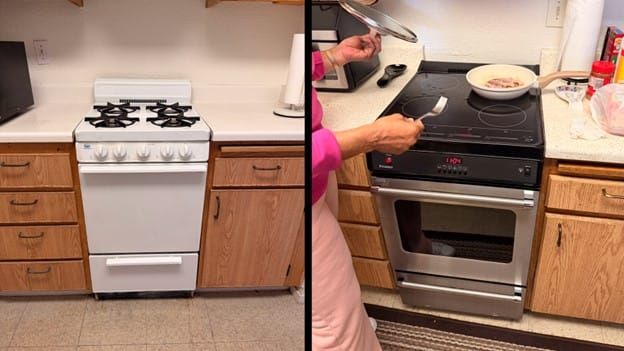
Energy upgrades can also include induction stoves and electric clothes dryers as well as energy-saving improvements such as duct sealing, a smart thermostat, insulation, and LED lighting.
“Energy modeling is done to evaluate the likely energy savings and bill impacts associated with that, so that the potential participant can make an informed decision about moving forward with the project, and then contractors are brought in to actually perform the retrofit,” says Maneta.
“At the conclusion of the retrofit, at least two of the following four end uses must be electric: space heating, water heating, cooking, and clothes drying,” according to the CEC.
The path to 2045
“We have a near-term trajectory that has solid funding, and then the idea is to show success and continue a dialog with the governor and Legislature through time to keep the program funded and tailor it to the current needs at each juncture,” says McAllister.
The CEC estimates that 12,000 to 15,000 low-income households could receive no-cost energy upgrades under the Equitable Building Decarbonization Program.
But a lot depends on what happens with the costs for equipment and labor.
“We are in a high cost period,” says McAllister. “Things have really gone up the last few years.”
“Hopefully we can create some economies and some synergies and work with the contractors to get ever-improved pricing,” he adds.
After conversations with the Legislature, the CEC and lawmakers landed on not putting a finite timeline on the program.
“Everybody acknowledged it would depend on continual allocations of funds if it was going to be a long-term program,” McAllister says.
“We have a half-billion dollars. It sounds like a lot of money, in historical terms, for a program like this,” he goes on. “But if you do the math of how much investment is needed in buildings that are going to need some kind of help to do these retrofits ... the numbers are a couple orders of magnitude bigger than that.”
“We had to figure out how to channel these resources to places where they could make the most difference.”