What I’m reading: Global EV and heat pump sales surge, people won't forget the Iran war disruption, research roundup, and more
Quitting Carbon's biweekly roundup of energy transition developments you might have missed.


Quitting Carbon is a 100% reader-supported publication. Support independent energy journalism by becoming a paid subscriber or making a one-time donation.
Welcome back to another roundup of highlights from what I’ve been reading.
A quick update on what’s coming up – and a story delayed, for now – here at Quitting Carbon.
I’ll be in Long Beach, California, early next week for Offshore Wind California's Pacific Offshore Wind Summit. Quitting Carbon is excited to be a media partner for this year's summit. If you'll be there, too, find me to say hello or grab coffee.
I had planned by now to have written more about the ARPA-E Energy Innovation Summit I attended recently in San Diego. I left the summit with one story at the top of my to-do list: a Q&A with Dr. Cory Phillips, a program director at ARPA-E, about the topic of his fast-pitch session titled “Manufacturing without Addresses: Factories that Refuse to Sit Still.”
I had thought my interview request would be a formality. Instead, an ARPA-E press contact said it would have to cleared at the Department of Energy (DOE) headquarters, and asked if I could share questions in advance. I asked, in the meantime, if ARPA-E would share Phillips’ presentation slides – slides for a public talk, based on taxpayer-funded research, already presented to a crowd of hundreds at the summit – to help me prepare for the interview.
No, the slides couldn't be shared without clearance from DOE HQ, I was told.
Two weeks after my initial interview request, I got my answer: “I’m afraid the request was denied, and we can’t share the slides.” No reason was given for the denials.
Might the denials have something to do with the column I published – Why does Chris Wright insist on being so wrong on the energy transition? – as I waited to hear about my interview request from DOE HQ?
I'll try to find another way to bring you that story!
Now, on to this week's roundup. And thanks, as always, for reading.
With oil and gas markets constrained, EV and heat pump sales are surging
Oil and gas prices are unlikely to return to pre-Iran war levels until next year – even if Israel, the U.S., and Iran agreed to a permanent ceasefire tomorrow. With so much lingering uncertainty, consumers in much of the world are avoiding fossil-fueled models when shopping for cars and for systems to heat and cool their homes.
“Electric vehicle sales in Latin America, Africa and much of Asia – a grouping that includes billions of people but that analysts often refer to as ‘rest of world’ – soared 79% in March compared with a year earlier, according to Benchmark Mineral Intelligence, a research firm. For all of 2025, sales of electric cars in these countries jumped 48%,” writes the New York Times’ Jack Ewing.
Those “rest of world” markets are increasingly served by China’s dominant EV industry. China’s car industry hit a milestone last month by exporting more EVs than conventional gas or diesel cars for the first time.
“China exported 769,000 automobiles in April, with new-energy vehicles accounting for 52.7% of total exports,” reports The Wall Street Journal’s Jiahui Huang.
In Australia, EV sales accounted for a record 16.46% share of new vehicle sales in April, The Driven’s Riz Akhtar reported last week. In Europe, EV sales in April increased by 27% compared to the same month last year, the Times' Ewing reported this week.
As for electric heat pumps, “Over the first three months of the year, about 575,000 heat pumps were sold in 11 large European countries, up 17 percent from a year earlier, the European Heat Pump Association said. The increases were particularly large in France, Germany and Poland,” reports the Times’ Eshe Nelson.
“Households are now seeing that they are only one Trump-ignited war away from very expensive tank refueling or heating bills,” Elisabetta Cornago, an energy and climate policy expert at the Center for European Reform, told Nelson.
Trump’s Iran war: “We have passed the point of people forgetting”
Regular readers of this newsletter know, as the section above demonstrates, I’m firmly in the camp of those advocating that the world will never be the same in the wake of the Israeli-U.S. war against Iran.
Renewables are just too competitive. Countries and households can choose zero-carbon options without hesitation or regret.
As Jigar Shah, the director of the Department of Energy's Loan Programs Office during the Biden administration, argued on the April 30 episode of the “Open Circuit” podcast (lightly edited for clarity):
“We have passed the point of people forgetting. People will never forget. I mean, to the extent that things get rebuilt in the Middle East, there will be a premium for that forever. People will be suggesting a security premium for the rest of time. And I think that that is important because the single biggest problem that clean energy has had is not the lack of McKinsey cost curves or NDC [Nationally Determined Contributions] reports or net-zero reports. It has been inertia. People have said, We get it, we see the analysis, but we are used to doing things this way. We need a lot of pushing to think about doing things in a new way. And I think that the amount of pushing here is not a two-year thing.”
“The amount of time it’s going to take to get any sort of normalcy out of the supply chain will be much longer than two years. And in that time period, I think the amount of inertia is going to go down by so much that you will see countries out competing each other around how to localize their supply chains and to achieve energy sovereignty. No one wants to import molecules ever again. They’re forced to, don’t get me wrong, we will have a robust LNG trade and oil trade, but every single day, the energy minister in that country is going to be like, ‘How do I make that number smaller?’ And that will be persistent for the next 20 years.”
Enjoying Quitting Carbon? The best way to support this newsletter is with a paid subscription.
Here’s another roundup of noteworthy reports and studies you might have missed:
Record-breaking global wind power deployment in 2025
The Trump administration is doing everything it can to snuff out the U.S. wind industry, but globally the industry is still setting deployment records.
The global wind industry installed a record-breaking 165 gigawatts (GW) of new wind capacity in 2025 – up 40% on the previous year, according to new data from the Global Wind Energy Council (GWEC).
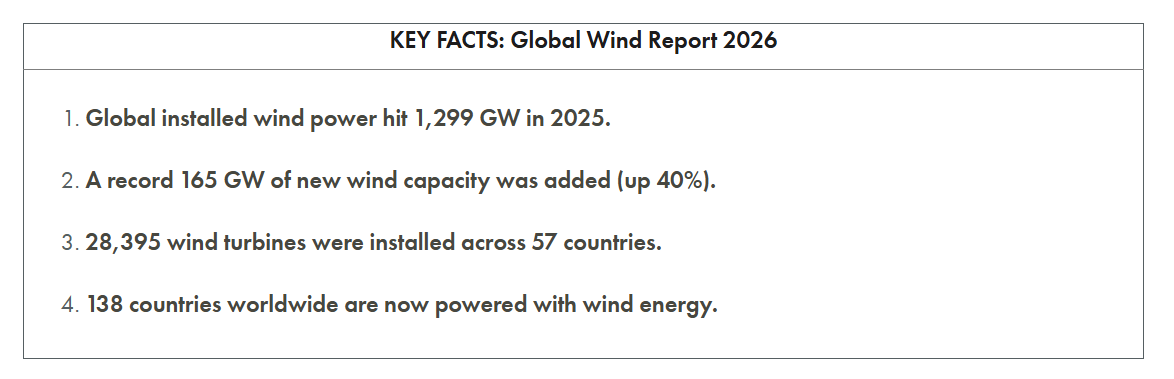
The trade association believes the industry is capable of even faster growth.
“Even as the wind industry growth is accelerating, there is no escaping that global growth remains uneven, and the world is still not on track to triple renewables by 2030,” Ben Backwell, CEO of GWEC, said in a statement.
“Bureaucratic red tape and slow roll-out of grids is stopping badly needed projects from being built in many areas of the world. However, by acting decisively to address the blockages, policymakers can quickly access a huge pipeline of ready to invest projects.”
An easy way for the industry to get more capacity out of the sites it has already developed, as I wrote here last week, is to repower existing wind farms.
Why is rooftop solar so cheap Down Under?
Why is rooftop solar so much more expensive in the U.S. than in Australia?
A new report from GridLab, Advanced Energy United, and RMI puts forward some definitive answers.
Based on a study trip to Australia by U.S. state utility regulators, the report finds that “Australia’s approach to permitting and installation are key to rooftop solar’s low costs,” writes PV Magazine’s William Driscoll.
Take just one example.
“In the state of South Australia,” writes Driscoll, “residential customers may install a large rooftop solar system with no need for interconnection approval, in exchange for accepting flexible export limits, which modeling has shown would allow export of full generation more than 98% of the time in most areas.”
“That approach has helped rooftop solar and other renewables to now provide close to 75% of South Australia’s electricity consumed, said Bryn Williams, principal at Energy Horizons, on a webinar accompanying the report.”
According to Driscoll, the Australia study tour participants brought home four lessons: “Act and react: an action-first, adaptive culture; get the ‘plumbing’ right: standards first, solutions follow; consumer energy resources: put customers front and center; and regulator be nimble: high-level incentives create room to move.”
Yes, industry can electrify, too
“There is still a perception that industry is too hard to abate, so we can worry about it later,” Oxford University’s Jan Rosenow told Canary Media’s Alison F. Takemura.
Not so, according to a new report published by Rosenow and Oxford colleague Cassandra Etter-Wenzel.
Rosenow and Etter-Wenzel analyzed detailed technical studies as well as more than 1,600 global decarbonization scenarios to determine how much industrial energy demand could be electrified.
“Both datasets led to the same conclusion: Roughly 85% of industrial energy demand could be electrified by 2050 – and upwards of 90% in the long term – with existing and emerging electric tech,” writes Takemura.
“Near complete electrification is technically possible,” said Rosenow.
“Homegrown energy” could lower costs for nearly all U.S. households
Rewiring America published a report last week “outlining how states can lower energy costs, meet rising electricity demand, and deliver direct benefits to households by investing in American homes.”
“With the right policies, whole-home electrification, rooftop solar, and battery storage could become affordable for 96 percent of eligible US households, up from roughly 9 percent today, delivering about $26,000 in lifetime savings per home and $1.5 trillion in total savings nationwide,” according to a press release.
The policy blueprint identifies “six interlocking policies that align energy system investment with household savings”: reducing permitting and soft costs; requiring large new energy users to invest in distributed resources; scaling virtual power plants; enabling inclusive utility investment; modernizing electric rate design; and redirecting gas infrastructure investment.
Wind and solar are pushing fossil gas off the UK grid, lowering the country’s gas imports bill
The UK has added so much wind and solar power it was able to eliminate coal-fired power from its grid. Now, plentiful wind and solar are pushing fossil gas power off the grid, too.
“The UK came within a whisker of operating a fully zero carbon grid on Wednesday afternoon, as gas power generation hit a record low and solar output surged to a record high,” BusinessGreen’s James Murray reported on April 24.
“The National Energy System Operator provided more details on the record yesterday, confirming a record low grid share for gas of 2% that was set in the morning then fell further during Wednesday afternoon, hitting 1.2% between 3.30pm and 4pm. The result meant zero carbon generation provided 98.8% of the UK's power, surpassing the previous record of 97.7% that was set on 1 April,” he added.
Record wind and solar production is also trimming the country’s gas imports bill.
“The UK has avoided the need for gas imports worth £1.7bn [$2.26bn] since the start of the Iran war, as a result of record electricity generation from wind and solar,” finds a Carbon Brief analysis published on May 7.
“The surge in wind and solar output is cutting the need for gas-fired generation, which has been nearly a third lower than last year and fell to record lows in both March and April 2026,” write the authors of the analysis.
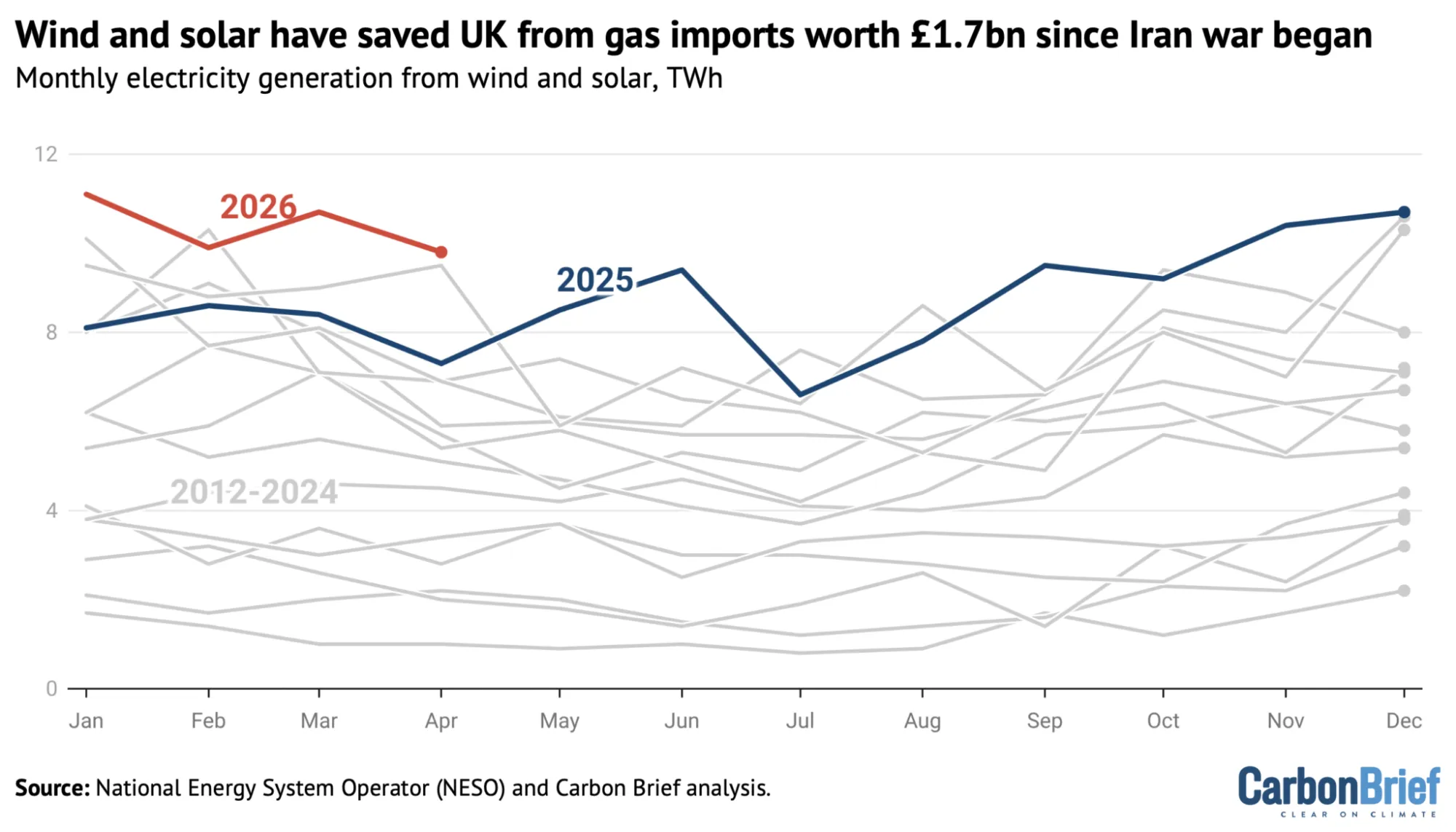
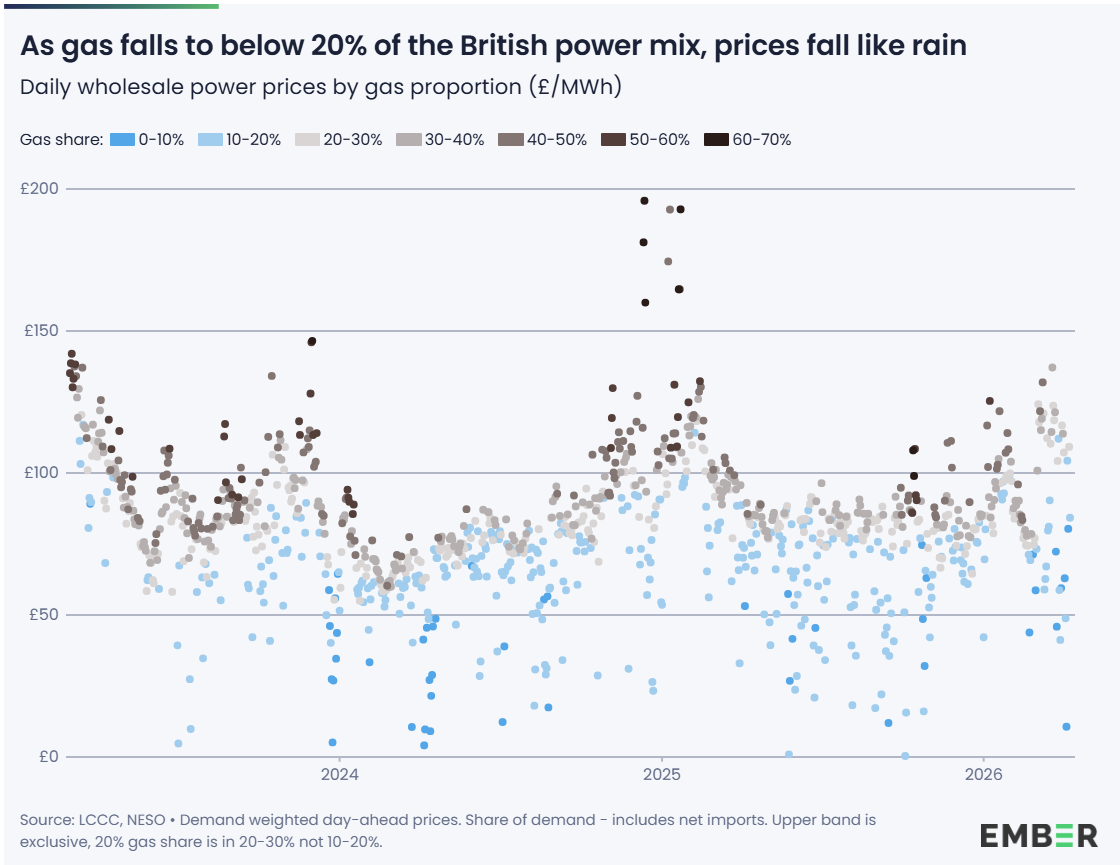
And when wind and solar power reduce the need for gas-fired generation, it pushes down wholesale power prices, finds a new study from the think tank Ember.
The analysis “shows how as more renewables comes online gas' influence as a price setter for the wholesale power market falls. It reveals how during hours last year when gas was below 20 per cent of Britain's electricity mix wholesale power prices averaged £60/MWh [$80/MWh], compared to £130/MWh during hours where gas generated more than half of power,” writes Murray.
Bonus: Dams are coming down on U.S. rivers
More good news to close us out.
“Last year, more sections of the country’s rivers were reconnected thanks to dam removals than at any other time in history, according to the nonprofit group American Rivers. In 2025, more than 100 dams were dismantled in 30 states, reconnecting around 4,900 miles of waterways,” reports the New York Times’ Cara Buckley.
“The resulting free-flowing waterways are healthier, cooler and less prone to algal blooms, and serve as vital habitat for migratory fish and other aquatic life,” she writes.
Some might worry about the loss of hydropower as dams that generate electricity shut down, but Buckley notes that hydropower dams become increasingly expensive to operate with age.
“Hydropower dams have been a source of inexpensive energy, but the cost of repairs and relicensing can outstrip the benefits, said Desiree Tullos, a professor in biological and ecological engineering at Oregon State University. And fewer than 3 percent of the country’s dams generate power.”