Clean energy advocates are winning the legal fight against the Trump administration
A string of legal setbacks has the Trump administration on the back foot. Clean energy companies and Democratic state attorneys general should continue to press their advantage.

Quitting Carbon is a 100% subscriber-funded publication. To support my work, please consider becoming a paid subscriber, making a one-time donation, or gifting a paid subscription.
The legal offensive against the Trump administration is succeeding in chipping away at the White House’s efforts to reverse Biden administration clean energy initiatives and stymie wind and solar development.
Consider the setbacks the administration has suffered in recent weeks.
On June 6, a federal judge vacated guidance issued by the Treasury Department in August 2025 that had ended renewable energy project developers’ ability to prove their eligibility for federal tax credits by demonstrating they had already spent at least 5% of the total project cost.
Last week, the Justice Department gave up on defending President Trump’s wind permitting moratorium.
“The door to federal permitting is now unlocked again and each developer will be able to make the case for permitting their individual project based on the facts and the law,” Kit Kennedy, the managing director for power, climate, and energy at the Natural Resources Defense Council, told Heatmap’s Emily Pontecorvo.
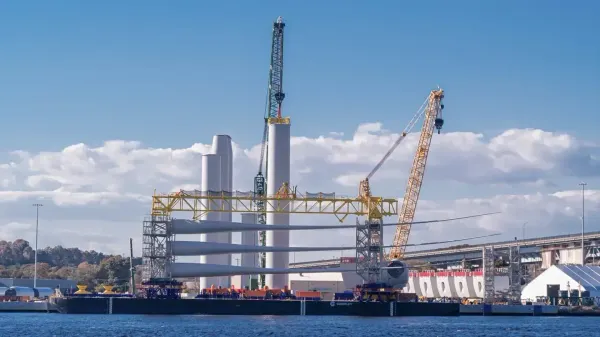
This comes after federal judges this winter struck down all five stop-work orders issued by the Interior Department in December 2025 to block construction of East Coast offshore wind farms.
For clean energy companies, and their putative allies in Democratic state attorneys general offices, the message is clear: stay on offense.
Keep fighting
Last week, a federal judge restored 11 clean energy grants that had been canceled by the Department of Energy (DOE) in October 2025.
Federal government attorneys representing Energy Secretary Chris Wright “agreed that ‘a primary reason for the termination decisions at issue is because of location in blue states,’” reported the Washington Post’s Evan Halper.
“They agreed to the stipulation,” he added, “under the condition that it would allow Wright and other Trump officials to avoid a trial and a potentially lengthy and embarrassing discovery process, in which private communications around how the projects were targeted would be made public.”
One of the restored grants in the case was awarded to a company called Sperra (formerly RCAM Technologies), a San Pedro, California-based 3D concrete printing manufacturer.
Sperra was awarded $2.5 million by DOE during the Biden administration to design “a 3D-printed concrete suction anchor for use in a variety of offshore energy applications.”
In an email, Jason Cotrell, Sperra’s founder and CEO, told me: "I hope that ruling inspires other terminated awardees and other awardees to keep fighting.”
“It wasn’t an easy decision to join this suit because I fear being blacklisted from future DOE support, but it worked out very well so far,” he added. “This is an important award for us."
Keep up the pressure
Other clean energy companies, and Democratic state attorneys general, should heed Cotrell’s call to action.
Forced onto the ropes by the string of losses in federal courts, the Trump administration is on its back foot. The administration’s opponents need to stay on the attack and go for the knockout.
They are up against a weakened opponent.
More than 10,000 lawyers have left the federal government since the beginning of 2025, the New York Times’ Eileen Sullivan and Andrea Fuller reported last month. In all, according to the Times, one in five lawyers who worked in the federal government at the end of 2024 had left by March 2026.
It’s a “striking loss of legal talent that has left some agencies pushing to find attorneys to carry out his agenda,” write Sullivan and Fuller.
And the legal challenges against the administration keep coming.
Earlier this month, a group of Northeast state attorneys general, led by New York’s Letitia James (D), sued the Trump administration to challenge the Department of Interior’s nearly $1 billion deal to pay TotalEnergies to abandon its U.S. offshore wind leases on the East Coast.
A suit is likely coming soon from California Attorney General Rob Bonta (D) to challenge a similar deal between the Trump administration and Golden State Wind LLC under which the developer abandoned a lease to develop wind power offshore the Central California coast.
Also, this month, a coalition of renewable energy groups sued the Defense Department, asking a federal court to force the Pentagon to resume reviews of onshore wind projects that have been stalled for nearly a year.
Last Friday, the groups filed a new motion asking a federal court for a preliminary injunction that would compel the Defense Department to resume wind project reviews while the case continues to be litigated.
In the wake of the lawyer exodus, stay on offense
Not only are many of the federal government’s best lawyers no longer around to help implement policy or defend the government, but a good number of the departed lawyers have switched sides and are now arguing cases against the administration.
The administration, meanwhile, is struggling to attract enough lawyers to replace those it lost.
With some of the nation’s brightest legal minds now working for Democratic state attorneys general or advocacy groups to bring suits against the administration, Trump’s courtroom losses should continue.
Which means if you're active in the clean energy economy and the administration has canceled your funding or is blocking your project, it’s an easy decision: Go to court to fight for your interests.