What I’m reading: Blue states fight back to save U.S. wind projects, Germany and China notch EV milestones, UK households can soon buy balcony solar, and more
Quitting Carbon's biweekly roundup of energy transition developments you might have missed.


Quitting Carbon is a 100% subscriber-funded publication. To support my work, please consider becoming a paid subscriber, gifting a paid subscription, or leaving a tip.
Welcome back to another recap of highlights from what I’ve been reading.
First, a quick favor: I’m always looking for ways to get this newsletter to more readers. What tends to work best? Recommendations from people we trust.
If you enjoy and value what you read here and have colleagues, friends, or family who might enjoy this newsletter, too, can you please forward this email to them with a recommendation to give it a try? Thank you!
Have a great weekend and thanks, as always, for reading.
Update on Russell Vought’s quest for complete control over federal grantmaking
In the column I published last Friday, I wrote that local and state governments, scientists, and research institutions are among the individuals and organizations alarmed by a Trump administration proposal that would give political appointees across federal agencies the power to kill grants – including funding for clean energy.
I have an important update to report.
Shortly after I published the column, a federal judge declared “that the Trump administration can’t cancel grants based on new rules or goals established after the fact – in a blow to its efforts to terminate billions of dollars already promised,” reported Politico’s Jennifer Scholtes and Kyle Cheney.
Here's more on the ruling from Scholtes and Cheney:
“U.S. District Judge Indira Talwani, an Obama appointee, denied the Trump administration’s request to dismiss a lawsuit brought by 20 states, three governors and the District of Columbia challenging the cancellation of billions of dollars in federal grant awards since President Donald Trump was inaugurated last year.”
“Federal law does not allow the ‘terminations of awards based on new program goals or agency priorities that an agency identifies after granting the award,’ the court concluded.”
“The ruling comes as lawmakers in both parties, including Senate Appropriations Chair Susan Collins (R-Maine), urge White House Budget Director Russ Vought to delay plans to overhaul the approval process for federal grants. The Trump administration is proposing a new regulation that would put political appointees in charge of approving or nixing awards for federal dollars.”
Blue states and senators go on offense to counter Trump’s offshore wind blockade
In a column last month, I argued that clean energy companies and Democratic state attorneys general should continue to press their legal advantage to thwart the Trump administration’s all-out assault on wind and solar power.
That appears to be happening.
Last week, California sent a Notice of Intent to Sue to the U.S. Department of Interior “regarding its illegal buyout of Invenergy’s offshore wind lease under the Outer Continental Shelf Lands Act.”
The notice was the second issued by California officials to the Interior Department in less than a month.
On June 23, California Attorney General Rob Bonta (D) and California Energy Commission Chair David Hochschild had sent a similar Notice of Intent to Sue to Interior to challenge its lease buyout deal with Golden State Wind.
Invenergy and Golden State Wind had both previously secured leases to develop wind projects in federal waters offshore California’s Central Coast.
On the same day that California notified the Interior Department it planned to sue to block the Invenergy lease buyout, a group of eight New England and Mid-Atlantic states – Connecticut, Delaware, Maine, Massachusetts, New Jersey, New York, Rhode Island, and Vermont – sent the Trump administration a joint Notice of Intent to Sue to challenge three Invenergy lease buyout deals on the East Coast.
Meanwhile, at the U.S. Capitol, a group of Senate Democrats just launched their own investigation into the Trump administration’s lease buyouts.
Last Friday, the 14 senators, including Minority Leader Chuck Schumer, “sent letters to four companies that have agreed to terminate their offshore wind leases in exchange for government payouts,” reports Politico’s Noah Baustin.
“The lawmakers asked the companies to provide copies of their communications with the Trump administration by Aug. 7.”
For now, the letters may serve more as a warning of investigations to come – should Democrats win a Senate majority in the November elections and reclaim control of committees as well as the power to authorize subpoenas.
As blue states join fight to lift Trump’s onshore wind blockade, German auctions yield record-breaking wind bounty
The Trump administration is trying to kill onshore wind projects, too. Here again, a coalition of (mostly) blue states has stepped in to protect the industry.
“A coalition of 18 states and Washington, D.C., has moved to join an industry lawsuit challenging the Department of Defense’s freeze on onshore wind projects in America,” Canary Media’s Dan McCarthy reported on Monday.
“It’s the latest in a nearly yearlong saga during which the Trump administration has obstructed more than 155 land-based wind projects across the country, according to data from the American Clean Power Association.”
Meanwhile, Germany is setting records for onshore wind project approvals.
“Germany approved onshore wind projects with a combined capacity of around 9 gigawatts (GW) during the first six months of the year, a new record for the period,” reports Clean Energy Wire’s Carolina Kyllmann.
“The capacity volume auctioned in tenders for state support was oversubscribed by a factor of two and a half,” she adds. “Germany had already approved a record 20.8 GW of onshore wind capacity in 2025.”
Germany and China notch EV milestones, while the lagging U.S. market looks to rebound
Germany celebrated another clean energy milestone this week.
According to new data published by the country’s motor transport authority, “electric cars outsold every other fuel type in Europe’s biggest car market for the first time” in June, Inside EVs’ Iulian Dnistran reported on Monday.
German drivers registered 84,057 new fully electric cars last month – a 78.2% year-over-year increase and good for a 28.4% market share.
In China, the province of Hainan announced it would ban the sale of new combustion cars by 2030, “becoming the first Chinese province to do so,” reports Dialogue Earth’s Xu Na.
“As part of the ‘15th Five-Year Plan for the Construction of a Beautiful Hainan’ (2026-2030), published on 13 July, the province seeks to increase the share of new energy vehicles (NEVs) in its vehicle stock from 23.75% in 2025 to 45% by 2030. This is much higher than the national target of 30% by 2030 set out in the recent Carbon Peak Action Plan for the same period,” she adds.
In the U.S., the picture is more muddled.
EV sales plunged after drivers raced last fall to take advantage of the expiring $7,500 federal tax credit (the tax credit having been killed in the Republicans’ One Big Beautiful Bill).
But the market may be stabilizing.
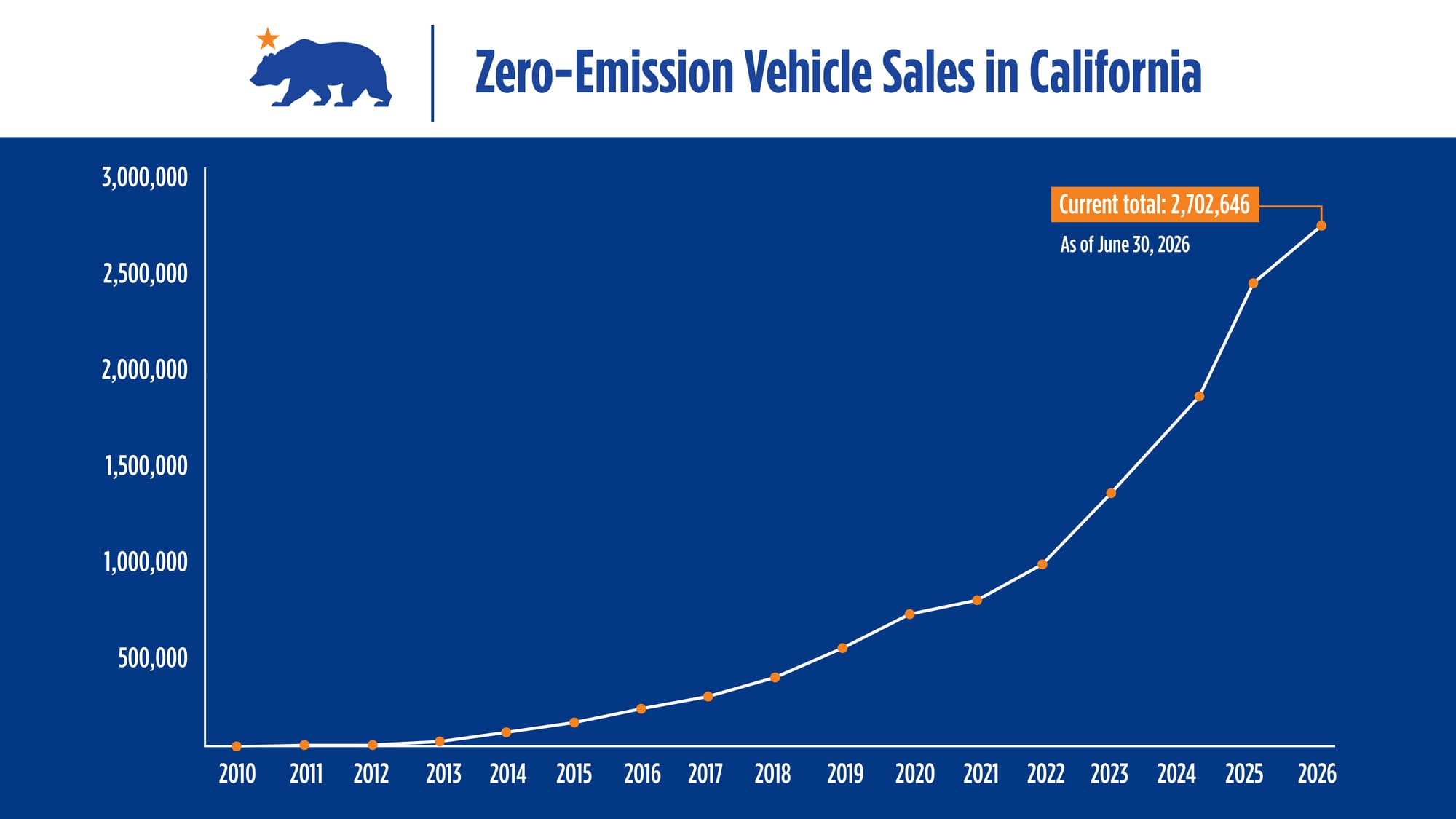
Second quarter EV sales rebounded to their highest level since the federal tax credit expired. In California, zero-emission vehicles accounted for 19.1% of new vehicle sales in Q2, up 3.3% over Q1, according to the California Energy Commission.
And so many U.S. drivers are looking for alternatives to gas-guzzlers that used EV prices are surging.
“Used electric vehicles are flying off dealer lots as pinched car buyers hunt for budget-friendly options,” reports Axios’ Joann Muller.
“The soaring demand has led to a rare phenomenon,” she adds, “used EVs rising in value, rather than depreciating, according to Recurrent, a research firm specializing in the used EV market.”
Andy Burnham takes over at 10 Downing Street
In a recent roundup, I mentioned the pending legalization of balcony solar installations as one of the clean energy achievements of the outgoing UK Prime Minister Keir Starmer.
Starmer checked that item off his to-do list just before stepping down.
“One of Keir Starmer's last acts in Govt is this: Laying legislation that will legalise 'plug-in solar' (aka balcony solar) panels in Britain It means plug-in solar panels do not (legally) have to be wired in by an electrician,” Byline Times’ Josiah Mortimer reported on Bluesky on Monday, Starmer’s last day in office.
So, when can British households buy balcony solar systems?
“An industry consultation on the plans concluded last week, paving the way for the government to officially sign a legislative amendment into law that legalises the sale of plug-in solar devices that comply with UK safety specifications,” BusinessGreen’s Michael Holder reported on Tuesday.
“The amendment is now set to come into force on 27th August, which could allow the first plug-in solar devices to potentially go on sale in shops by the end of next month.”
One of the first acts by Keir Starmer’s successor, Andy Burnham, was fulfilling a pledge to cut energy bills.
“Andy Burnham is considering radical plans that could cut household energy bills by £130 a year and make running a heat pump cheaper than a gas boiler,” the Guardian’s Heather Stewart and Jillian Ambrose reported last Saturday, just after Burnham became the new Labour leader.
The first step in implementing those “radical plans” was to remove the value-added tax (VAT) from electricity bills.
“Government is tackling rising bills with a tax cut to remove VAT from domestic electricity bills from October 1 in time to impact the next Ofgem price cap. … Cutting VAT on electricity bills is expected to take around £45 off the yearly Ofgem price cap in October. This is on top of the £150 removed from bills at the last Budget,” according to a press release from the prime minister’s office.
“The real story isn’t the £45 off bills, it’s the gas-electricity price gap,” Jan Rosenow, professor of energy and climate policy at the University of Oxford, wrote on Bluesky.
“We’ve loaded taxes onto electricity while gas gets off lighter, which discourages heat pumps. Cutting VAT narrows that gap.”
Future reforms to reduce energy bills will be taken forward by a new energy secretary.
In a Cabinet reshuffle, Burnham promoted Ed Miliband, the erstwhile head of the Department for Energy Security and Net Zero, to foreign secretary and named Miatta Fahnbulleh as Miliband’s replacement.
Fahnbulleh returns to Whitehall with climate and clean energy bona fides.
“Fahnbulleh previously served as a junior Minister at the department as it developed its plans to deliver a clean power system by 2030 and before entering Parliament in 2024 she was chief executive at the New Economics Foundation think tank, where she was a strong advocate for bolder action on climate change,” reports BusinessGreen Editor-in-Chief James Murray.
As for Miliband, the former Labour party leader was denied an even bigger promotion after an aggressive lobbying campaign by City of London bankers, the right-wing press, and some trade unions denied him a rumored appointment as chancellor.
What so spooked his opponents?
Well, the relentless, years-long, scorched-earth campaign by the UK’s right-wing tabloid press to distort his record on climate action certainly didn’t help.
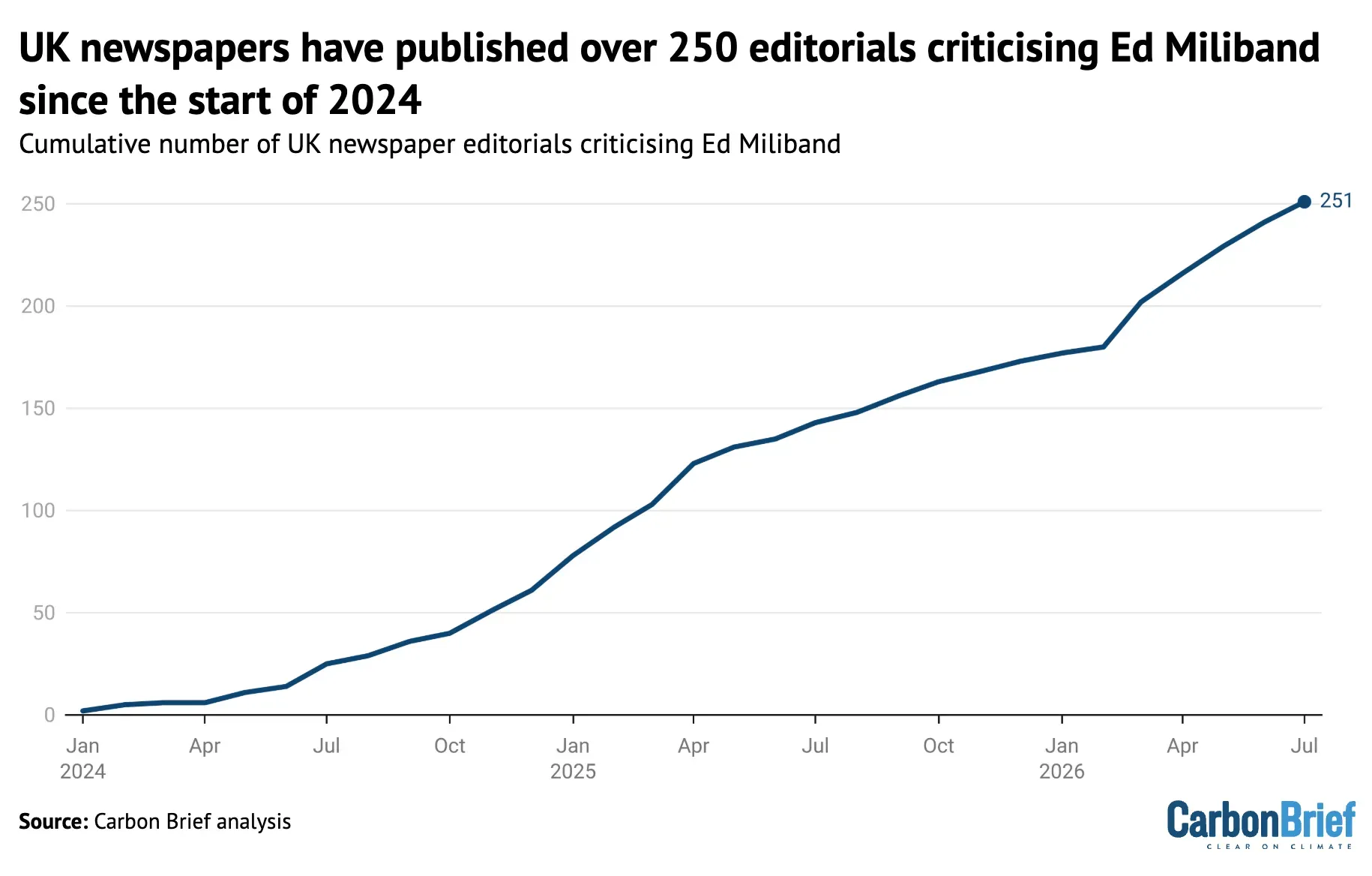
“As Ed Miliband leaves his post as energy and net-zero secretary, a final tally: There have been an incredible 251 newspaper editorials attacking him and his approach to net-zero since the start of 2024. That amounts to two editorials a week, mainly in the Sun, Daily Mail, Times and Daily Telegraph,” Carbon Brief’s Associate Editor Josh Gabbatiss wrote on Bluesky.
UK newspapers are already using the same playbook on Fahnbulleh.
On Wednesday, Carbon Brief compiled a roundup of coverage of Fahnbulleh's record on energy and climate issues in which the country's right-wing press brands her an “eco-zealot” who is “even madder than Miliband.”
One more thing: Lee Zeldin says the quiet part out loud
The Trump administration doesn’t bother pretending it’s not doing the bidding of its fossil fuel patrons.
Consider EPA Administrator Lee Zeldin’s recent remarks before the revived National Coal Council.
“Many of the items that were on your wish list are now done,’ Zeldin told members of the National Coal Council gathered at the Willard hotel in Washington. ‘Over the course of the coming few months, hopefully [we get to] the remainder of those items, although I will not prejudge the outcome of any rulemaking,’” E&E News’ Hannah Northey reported on Tuesday.
“Zeldin … ticked through a list of regulations that the administration has already rolled back. That included EPA’s move to roll back federal oversight of coal ash, coal wastewater, and moves to repeal the 2024 updates to the Mercury and Air Toxics Standards regulation, as well as carbon pollution standards,” she wrote.
“Between now and your next meeting, I’m excited to be able to share with great optimism, hope, and enthusiasm that you all, again, not prejudging the outcome of any rulemaking, we’ll have a lot to celebrate the next time you all get together again in January,” said Zeldin.