
Democrats must block Russell Vought’s proposal to politicize grantmaking and reclaim Congress' power over federal spending
A deal to block a Trump administration proposal that would give political appointees the power to kill federal grants – including funding for clean energy – expires on December 11. The Democrats must use their new majorities to reassert Congress’ constitutional authority over federal spending.

Quitting Carbon is a 100% subscriber-funded publication. To support my work, please consider becoming a paid subscriber, making a one-time donation, or gifting a paid subscription.
A critical deadline looms before Democratic majorities assume control of both houses of Congress on January 3, 2027.
The current continuing resolution to fund the federal government expires on December 11. That date also happens to be when a deal struck by soon-to-be-former U.S. Senator Susan Collins (R) and Sen. Patty Murray (D) expires.
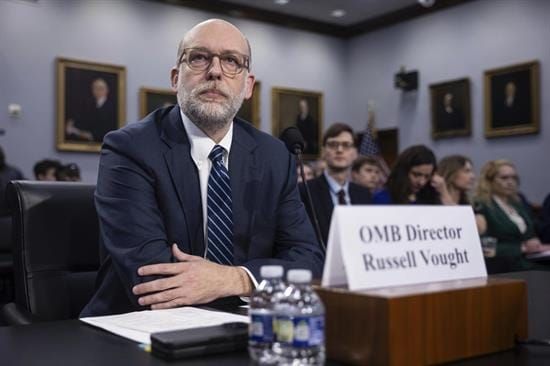
Collins and Murray, respectively the chair and ranking member of the Senate Appropriations Committee, agreed in early August to include language in the continuing resolution that blocks Russell Vought, the head of the White House Office of Management and Budget (OMB), from moving ahead with a proposal that would give Donald Trump’s political appointees the power to kill federal grants.
A looming threat
On May 29, Vought released a sweeping proposal that would overhaul the way the federal government administers grants.
If the rule is approved as written, political appointees across the federal government would be empowered to overrule peer review panels to kill grants, which could be terminated for going against the administration’s goals or priorities.
At stake is the fate of more than $1.1 trillion the federal government sends to local and state governments, tribes, universities, nonprofits, research institutions, and other beneficiaries each year.
Vought had intended to enact the new rule by October 1, the beginning of the federal government’s fiscal year. That plan was thwarted by Collins and Murray's intervention.
With both federal funding and the measure blocking Vought’s power grab set to expire on December 11, Democratic lawmakers will seek to leverage the additional bargaining power they secured in the midterm elections to extract concessions from the White House and Republicans in Congress ahead of a government shutdown.
A test for the new Democratic majorities
Federal grantees have already said they are prepared to sue the Trump administration if the final OMB grantmaking rule looks anything like the May proposal.
But Democrats shouldn’t leave this fight to the grant recipients.
From Day One of the second Trump administration, Vought and the White House have arrogated to themselves an unprecedented – and likely unconstitutional – power over federal spending.
With so little time before federal funding runs out on December 11, and with the White House and Republican lawmakers floating a budget reconciliation bill larded with funding for the Defense Department, a shutdown looks increasingly likely.
Republican hardliners will want a last chance to pass a spending bill for the next fiscal year on their terms, before Democrats take control of Congress and the budget process in January. Republican lawmakers know if they agree to a short-term spending bill funding the government through the start of the new year, most of their leverage is gone when it expires.
In a government shutdown fight, the Democrats will have no shortage of potential asks: ending funding for the Iran War, rolling back funding for ICE operations, restoring Obamacare health insurance marketplace subsidies, and blocking cuts to food stamps and Medicaid.
Notwithstanding the very worthy demands on that list, I would also urge the Democrats not to forget about Russell Vought.
Confronting Russell Vought
Grant recipients, for example, are still asking federal judges to restore nearly $8 billion in clean energy funding that was canceled by the Energy Department in October 2025.
“Nearly $8 billion in Green New Scam funding to fuel the Left's climate agenda is being cancelled,” Vought wrote on X when the cuts were announced.
In January of this year, a federal judge ruled that the cancellation of seven of those grants worth $27.5 million had been “unlawful” because it was politically motivated. The judge blocked the termination of the seven grants. Grantees are still working to restore the others.
Similarly, in September, two federal judges ruled in separate cases that the Environmental Protection Agency’s termination of $7 billion in Solar for All program grants was illegal.
Last week, the Trump administration appealed the ruling ordering it to unfreeze the funding.
It’s clear the new Democratic majorities will have to force Vought, the Energy Department, and the EPA to disburse the frozen funding to grantees.
In late October 2025, 100 House Democrats signed a letter demanding that EPA Administrator Lee Zeldin restore the Solar for All program and reinstate the grant funding. Just last week, a half-dozen House Republicans sent Zeldin a letter asking him to reinstate the program.
But the time for letters is over. Vought will ignore them anyway.
Lawmakers who are poised to hold more power come January are signaling they will take a harder line on Vought.
Rep. Brendan Boyle (D), the incoming chair of the House Budget Committee, recently said he “would not hesitate to issue” a subpoena to compel Vought to testify before the committee.
A former Republican lawmaker who chaired the House Appropriations Committee told Politico that in Senator Lisa Murkowski (R), the likely next top Republican on the Appropriations Committee, “Russ Vought’s gonna meet his match.”
We’ll see.
A power struggle
“I am apoplectic that this administration thinks that they can cancel fully executed contracts. That is not legal and we should never accept it as normal,” Martin Heinrich (D), the incoming chair of the Senate Energy Committee, told Politico when the $8 billion in clean energy grants were canceled last October.
I agree. Which means it’s time for the Democrats to be as ruthless in pursuing their legal objectives as Vought has been in pursuing his extralegal ones.
Vought must know that if he moves forward with the OMB grantmaking proposal, if he refuses to spend money authorized by Congress, or if he refuses to reinstate the $8 billion in terminated Energy Department grants or unfreeze the $7 billion for Solar for All program, there will be consequences.
What might those look like?
Vought scavenged $15 million from the carcass of the U.S. Agency for International Development (USAID) budget to pay for his security detail through the end of this year.
Was it legal for Vought to repurpose that funding? Is a $15 million security detail commensurate to the threats he faces? The Democrats should investigate to find out and strip any funding that isn’t warranted.
And yes, Vought absolutely should be subpoenaed if he refuses to testify to Congress about shuttering USAID and the Consumer Financial Protection Bureau and implementing “pocket rescissions” that violate the Impound Control Act.
And if Vought doesn't appear or refuses to hand over requested documents, he should be held in criminal contempt of Congress.
In a speech to a pro-Trump think tank before Donald Trump’s 2024 re-election, Vought said this about federal career civil servants:
“We want the bureaucrats to be traumatically affected. When they wake up in the morning, we want them to not want to go to work because they are increasingly viewed as the villains. We want their funding to be shut down so that the EPA can’t do all of the rules against our energy industry because they have no bandwidth financially to do so.
“We want to put them in trauma.”
Vought has spent the past two years making good on his vision. Over the next two years, Democrats in Congress should make Vought's remaining time at OMB equally miserable.