What I’m reading: Denmark's "greenest government," longer duty for lithium-ion grid batteries, research roundup, and more
Quitting Carbon's biweekly roundup of energy transition developments you might have missed.


Quitting Carbon is a 100% subscriber-funded publication. To support my work, please consider becoming a paid subscriber, making a one-time donation, or gifting a paid subscription.
Welcome back to another recap of highlights from what I’ve been reading. Have a great weekend and thanks, as always, for reading.
Denmark’s “greenest government yet”

Longtime readers will know that the name for this newsletter, Quitting Carbon, was inspired by the e-book of the same name I published on Denmark’s clean energy transition a decade ago.
Over the intervening years, Denmark has maintained its leadership position in the global energy transition. But now, a new government aims to shift its ambition to an even higher gear.
Last week, after weeks of negotiations, Prime Minister Mette Frederiksen presented a new center-left coalition government to King Frederik X that promises to be “the greenest government” in Danish history.
“The new government has already raised the stakes on green ambitions,” writes State of Green’s Joel Matias Jonsson. “The coalition agreement places the green transition, clean drinking water and energy security at the centre of the government's agenda.”
“Building on Denmark's existing climate ambitions,” he writes, “the new government has raised several key targets.”
The targets include:
A minimum 85% reduction in greenhouse gas emissions by 2035, up from the previous target of 82%.
Climate neutrality by 2045, five years earlier than the previous 2050 target.
Net-negative emissions equivalent to a 110% greenhouse gas reduction by 2050.
Recent offshore wind deployment milestones should make it much more likely Denmark achieves those long-term climate targets.
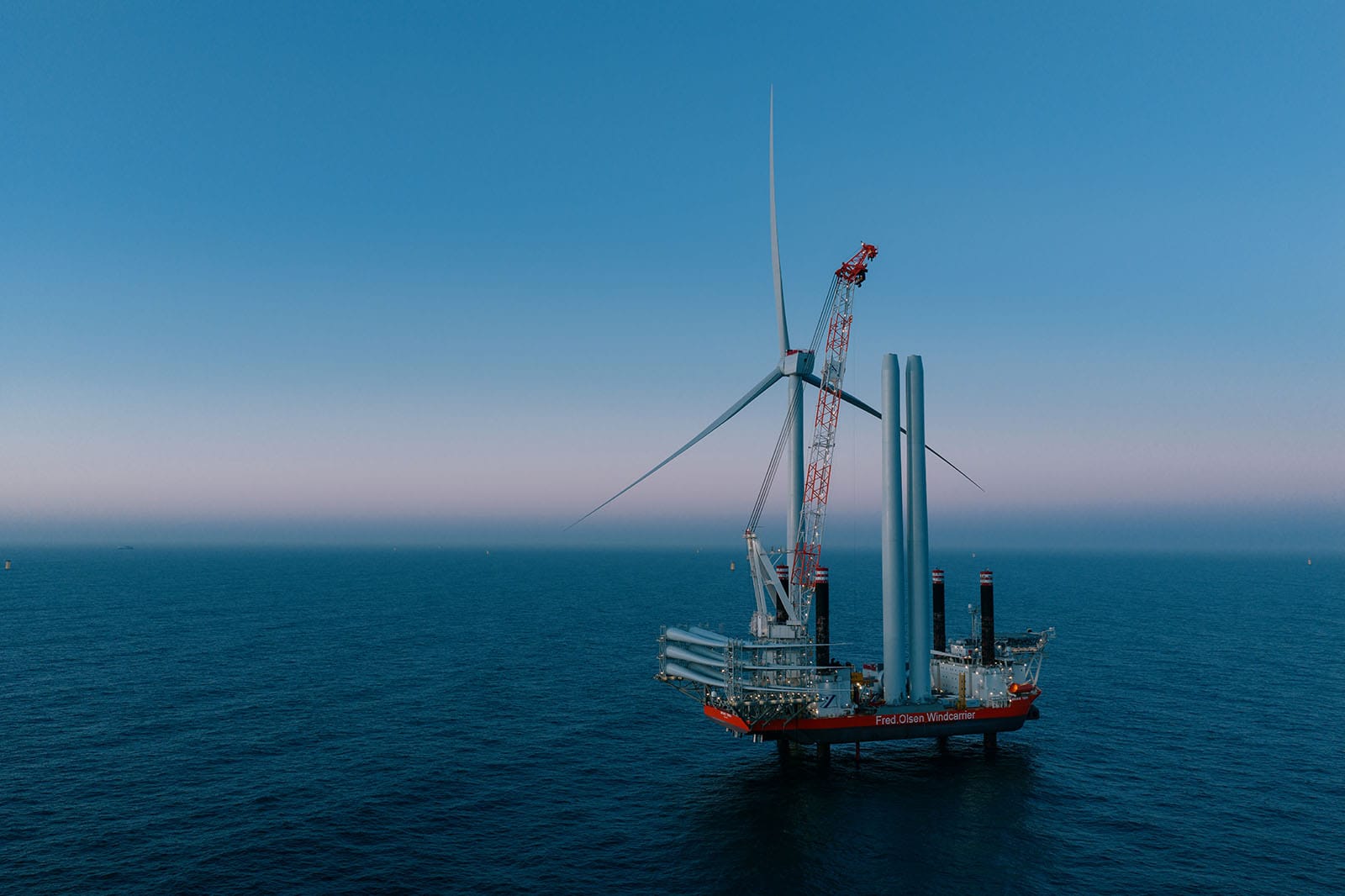
In January, the Danish Energy Agency granted approval for the country’s largest offshore wind farm, Thor, to deliver power to the grid. The first turbine was installed in March.
The 1.1-gigawatt project, which is led by the German energy giant RWE, is expected to be fully online by the end of 2027. The project, which will increase Denmark’s offshore wind capacity to 3.7 GW, will deliver electricity to one million Danish households.
Last month, the Danish Energy Agency received bids for both the North Sea Mid and Hesselo wind energy zones to develop at least 1.8 GW of new offshore wind capacity. The agency's evaluation of the bids is expected to be completed by January 2027.
Lithium-ion batteries: Not just for four hours of duty anymore
Conventional wisdom has held that lithium-ion grid batteries are best suited to discharge for up to four hours before recharging. But that practice was dictated more by economics than by technology. But as lithium-ion batteries continue to get cheaper, however, project developers are beginning to push beyond four hours.
The state of South Australia, for example, recently awarded agreements to six battery energy storage projects under its first Firm Energy Reliability Mechanism tender.
“The tender, which closed for bids in November 2025, sought long-duration dispatchable capacity across three delivery horizons to underpin grid reliability as South Australia progresses toward its target of net 100% renewable energy by 2027,” reports Energy Storage News’ George Heynes.
“Each project must be able to dispatch continuously for at least 8-hours during Forecast Lack of Reserve events, totalling 517MW and 4,136MWh,” he adds.
“It was fully expected that gas would fill some of that capacity, given it was one of the only tenders in Australia that didn’t specifically exclude the fossil fuel,” writes Renew Economy’s Giles Parkinson.
Nope.
“One of the big surprises about the latest tender for long-duration firm capacity in Australia’s most advanced renewable energy grid was the fact that none of the six battery project winners were long-duration set-ups, at least at face value,” he adds.
“As the tender manager ASL describes it, the four-hour batteries can operate for eight-hour periods simply by dialling down the rate of their output.”
In California, where utility-scale batteries are pushing fossil gas-fired power plants off the grid (more on this in the “Research roundup” below), lithium-ion batteries are likewise beginning to operate for up to eight hours.
“On June 1, the Tumbleweed project in California’s Kern County became the first major battery installation in the U.S. that can discharge power for up to eight hours at a time — twice as long as typical energy-storage facilities,” Canary Media’s Julian Spector reported last week.
Here’s another roundup of noteworthy reports and studies you might have missed:
Almost one-in-three new cars sold in 2026 will be an EV
The International Energy Agency’s (IEA) latest annual Global EV Outlook report finds that nearly one-third of the new cars sold worldwide this year will be electric.
“Global electric vehicle (EV) sales are expected to accelerate to around 23 million units, accounting for close to 30 per cent of all cars sold worldwide this year, as motorists respond to the ‘largest oil supply shock in history,’” reports BusinessGreen’s Stuart Stone.
“Electric car sales set new records in close to 100 countries last year. … Looking ahead, the falls we have seen in battery prices and the potential policy responses to the current global energy crisis are set to provide further momentum in EV markets,” said IEA Executive Director Fatih Birol in a press release.
A flurry of global wind and solar milestones
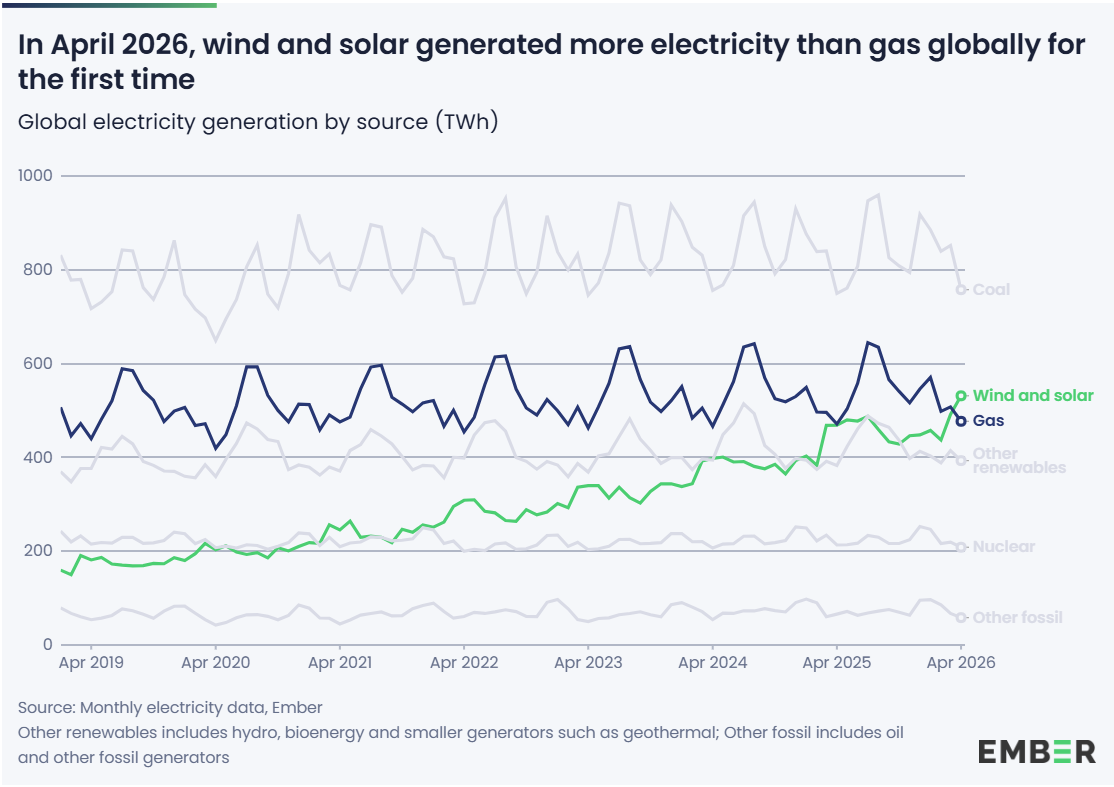
Notable firsts have been recorded for grids around the globe already this spring, according to research from the energy think tank Ember.
First, on May 21, the group published data finding that wind and solar (22%) generated more electricity than fossil gas (20%) globally for the first time in April.
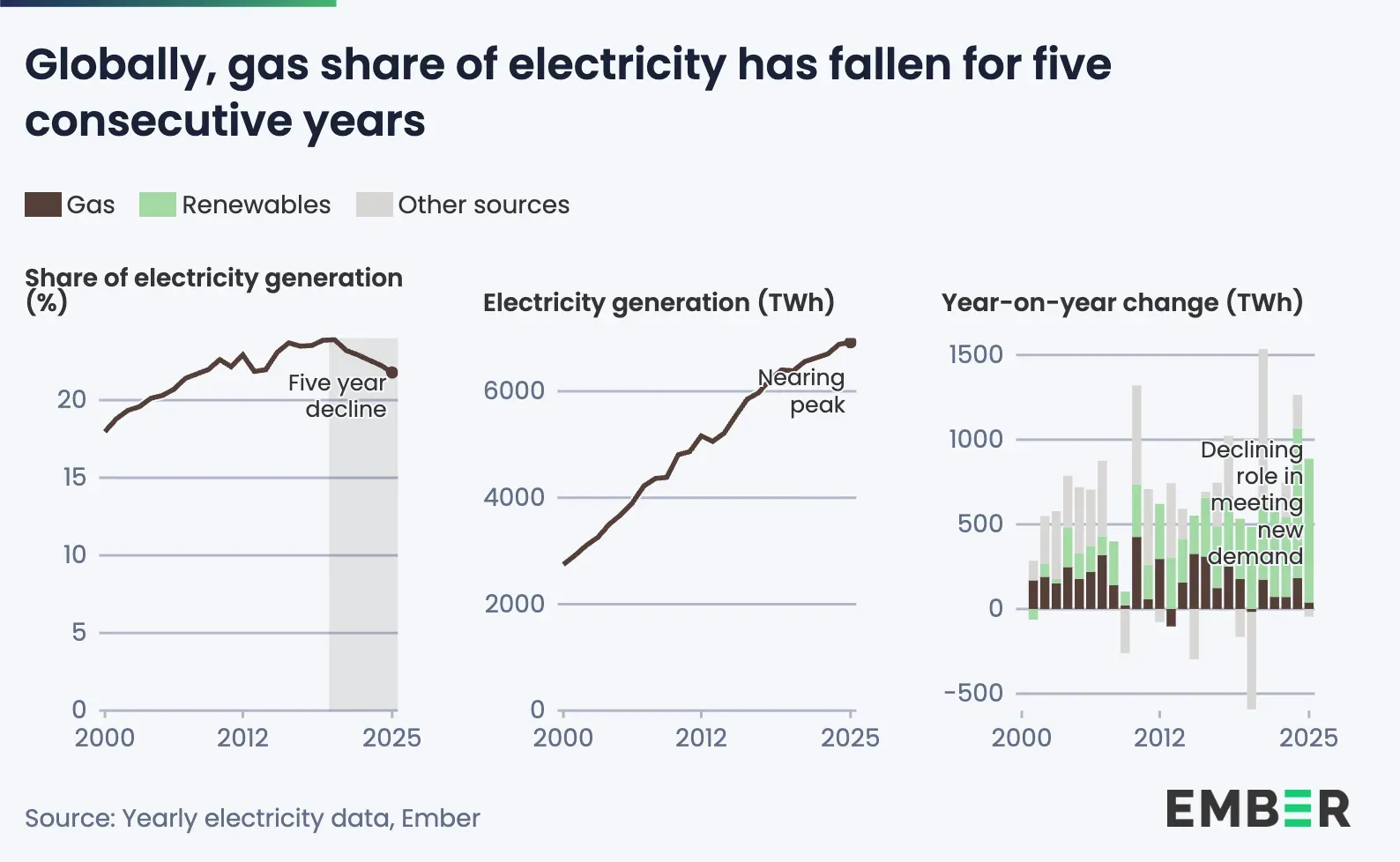
Jump to this week, and Ember announced that the share of fossil gas in the global power mix declined for the fifth consecutive year in 2025, “despite a small rise in absolute gas generation.”
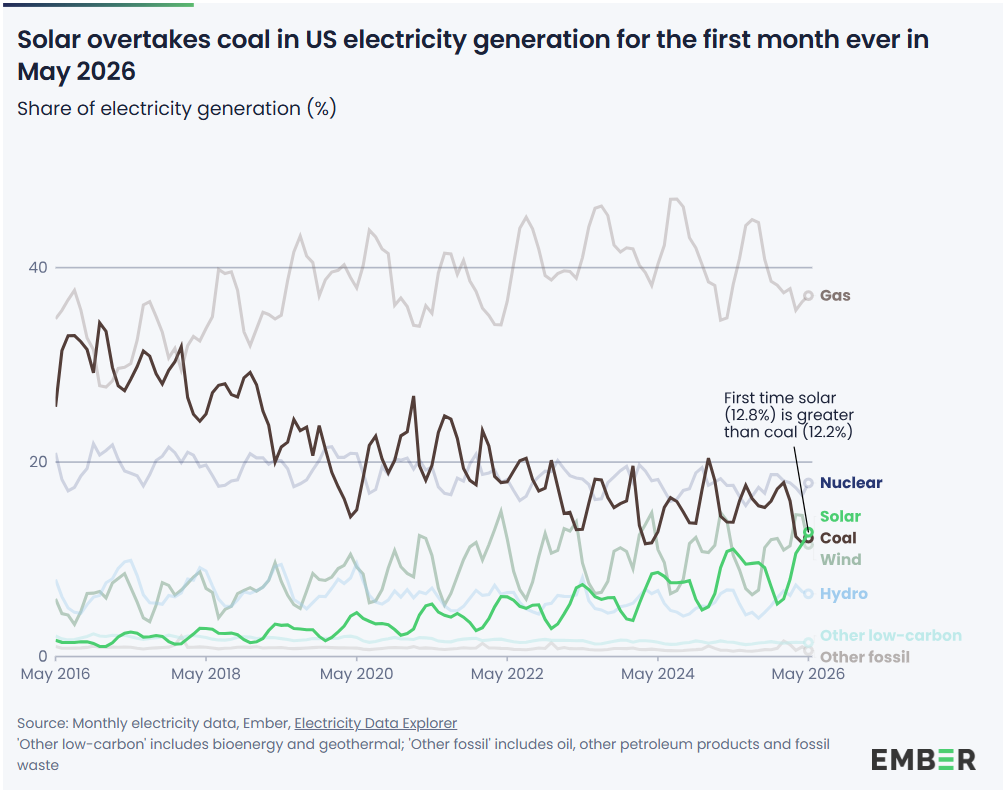
And also this week, the group published data finding that solar (12.8%) overtook coal (12.2%) in the U.S. electricity mix for the first time in May.
Renewables and batteries are pushing fossil gas power off California’s grid
Dennis Wamsted and Seth Feaster at the Institute for Energy Economics and Financial Analysis (IEEFA) shared U.S. Energy Information Administration (EIA) data last week finding that California’s fossil gas use for power hit a record low on May 16.
Wamsted and Feaster note that EIA’s latest short-term energy outlook “projects that solar generation in California will top gas generation for the first time this year, with the gap widening in 2027.”
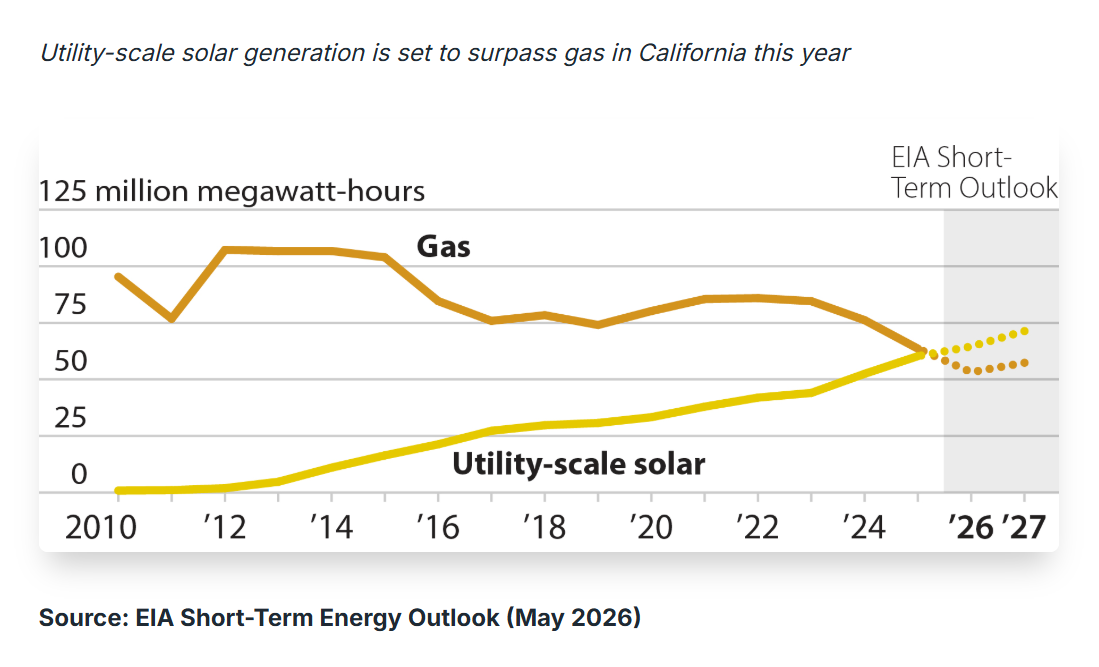
“The investments in solar, battery storage, and transmission for out-of-state wind are now cutting sharply into demand for gas, and the state’s long-term goal of exiting fossil fuels appears closer than ever,” they conclude.
Here's what California's grid transformation looks like across power generation sources.
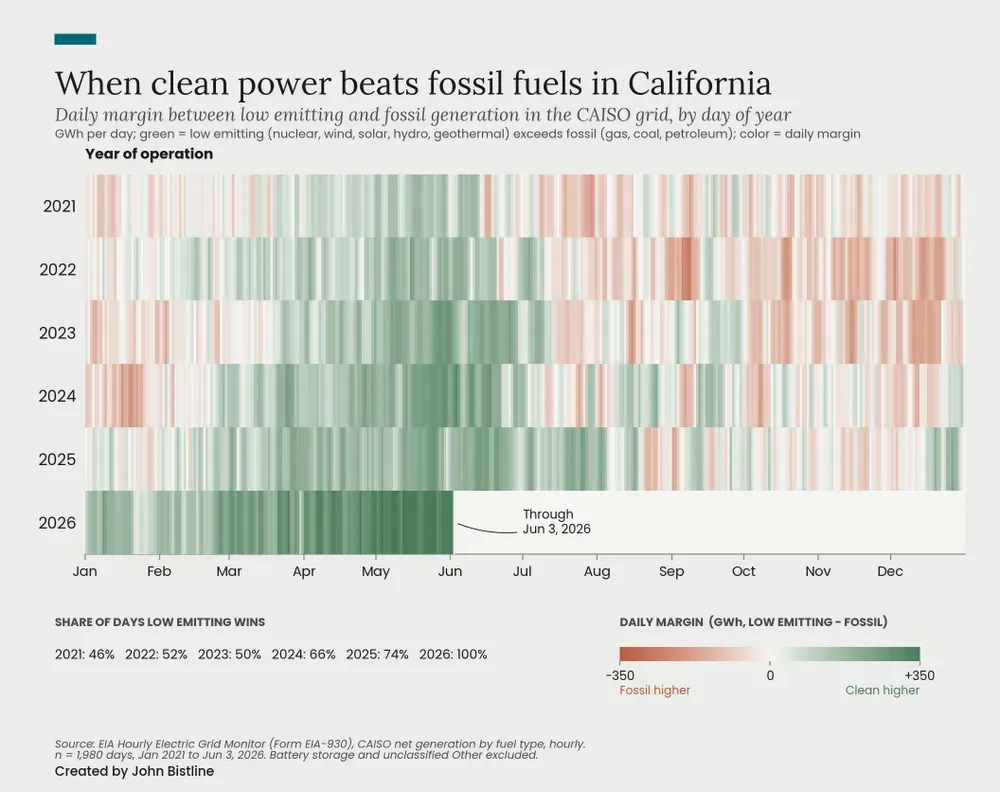
“No fanfare but, at some point in the last 4 years, California stopped being a grid that occasionally beat fossil fuels and became one that does it on a daily basis,” John Bistline, a researcher with the advisory firm Watershed, wrote Wednesday on Bluesky.
The ripple effects of the Iran war’s fossil fuel crisis
More than four months into the Israel-U.S. war against Iran, more evidence is emerging that countries are turning to clean energy in response to global fossil fuel scarcity and price volatility.
Researchers at Zero Carbon Analytics recently published a factsheet tracking this shift across the globe.
In response to the global fossil fuel crisis, Amy Kong, Nick Hedley, and Yusun Chin find that:
54 countries have introduced measures to conserve energy and shield consumers, according to the IEA.
25 countries, plus the EU, have announced a wide range of clean energy and electrification policies, investments and initiatives, according to the Global Energy Crisis Policy Monitor. These span all regions of the world, including North and South America, Europe and Asia.
And nowhere is this shift more pronounced than in Asia.
“Asia stands out globally as the region most vulnerable to constrained supply and rising energy prices caused by the war – but also as the region that has been most aggressive in rolling out clean energy measures,” write Kong, Hedley, and Chin.
“Out of all regions,” the add, “Asia has enacted the most clean energy measures since the war. 14 Asian countries have made announcements.”
Here are some notable examples they cite from across Asia:
On 30 March, the Philippine government reported the activation of 250 MW of solar capacity and 450 megawatt-hour (MWh) of battery storage.
On 11 April, the Thai government approved a THB 5 billion loan scheme to support the public’s energy transition efforts, such as rooftop solar installations and EV purchases.
On 13 April, Indonesia’s state-owned electricity company, PLN, shared plans to replace more than 2,000 diesel-powered plants (with a total capacity of 1.07 GW) with new renewable energy-based power plants, citing the need to reduce reliance on expensive imported fuels. Earlier in March, President Prabowo also announced the country would build 100 GW of solar as quickly as possible.
Bonus: Some scenes from Sacramento
I was in Sacramento on Wednesday for an all-day Electrification Summit hosted by the California Energy Commission and the Electric Power Research Institute. Watch for stories based on leads from the summit in the coming weeks.
Here are some photos from the walk to and from the event.
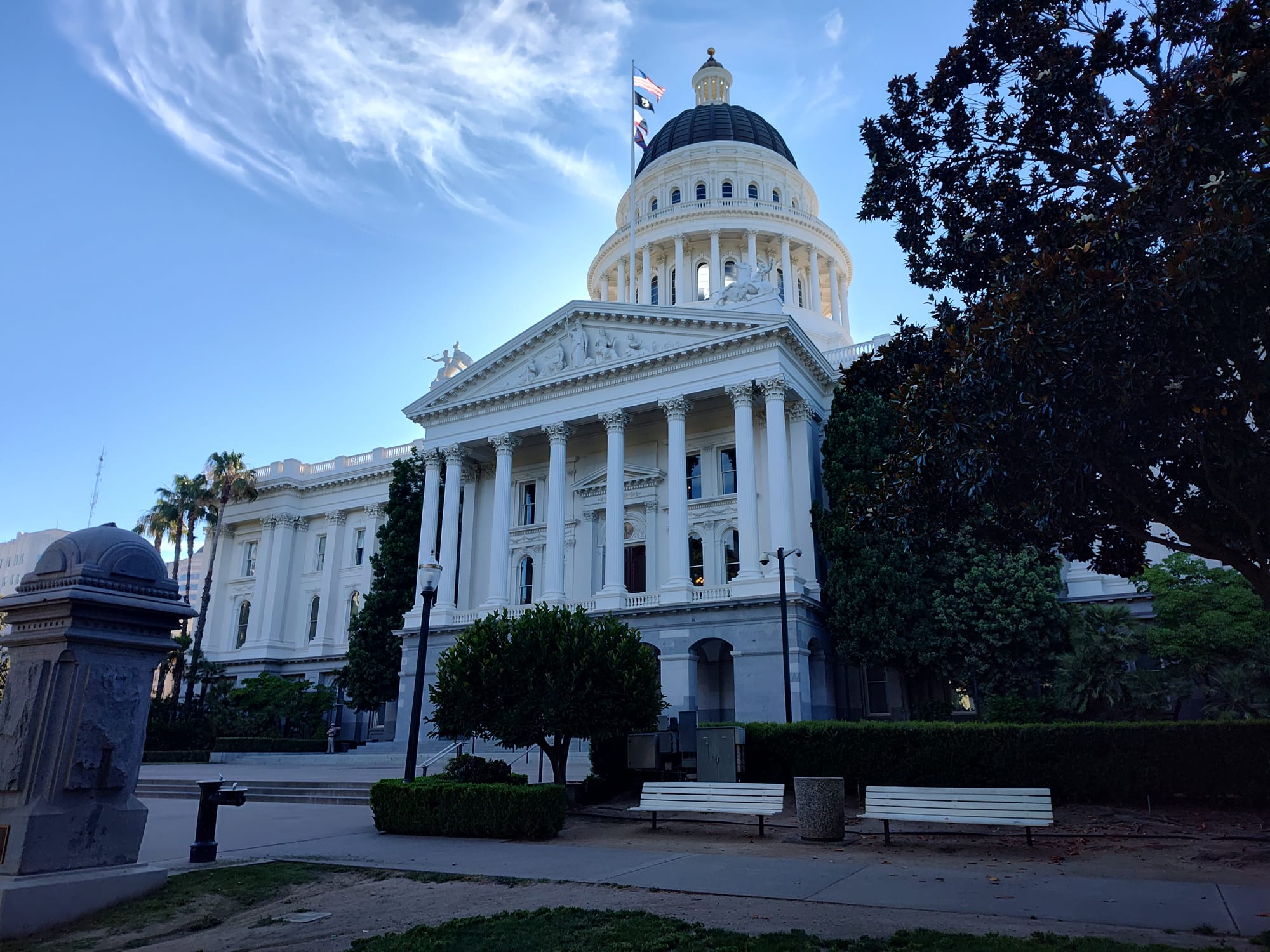


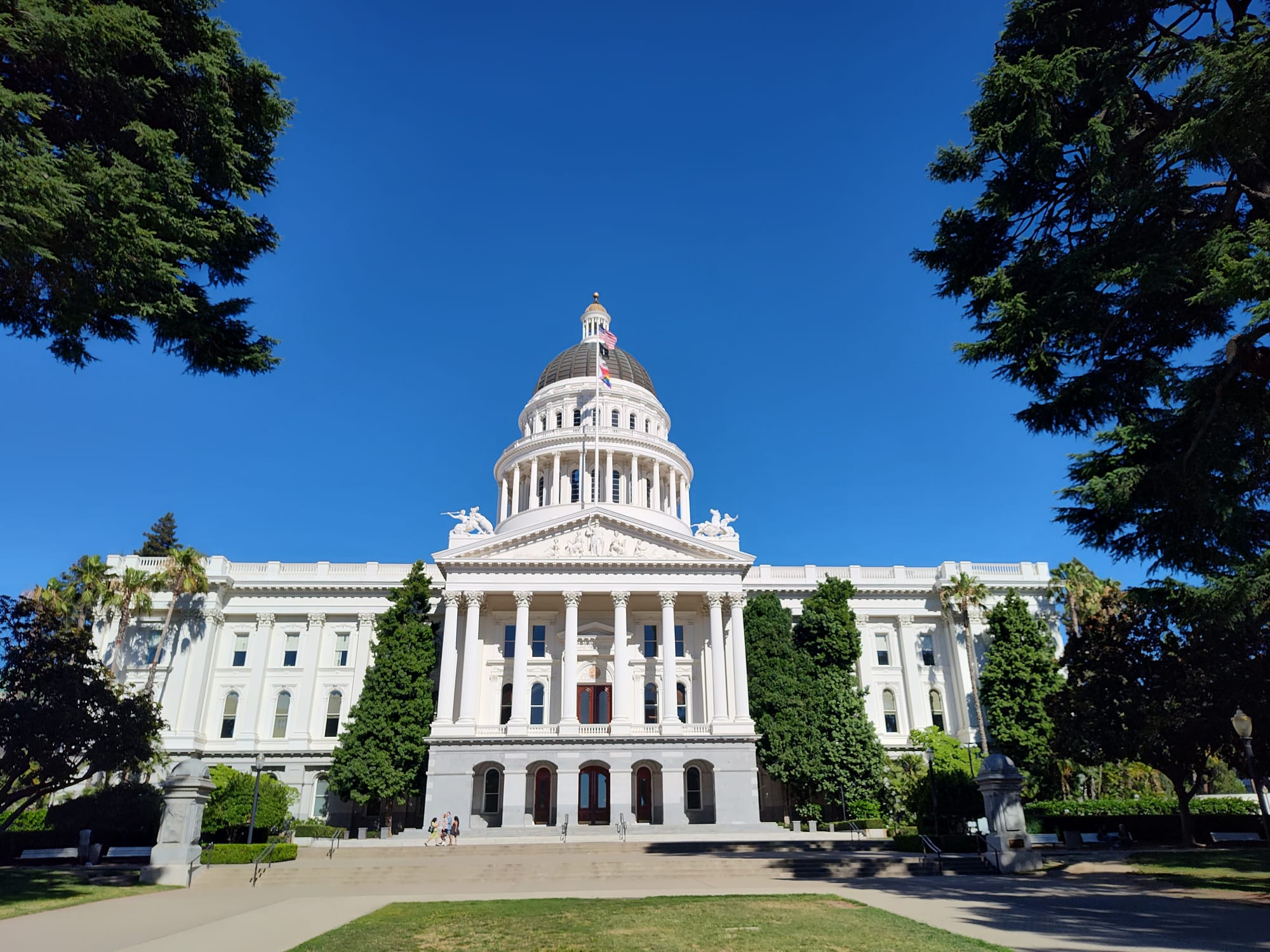
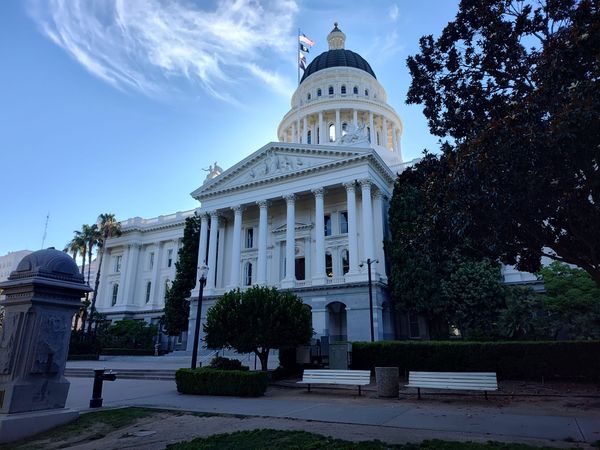
From left/top: Morning view of the California State Capitol; mural in the lobby of the California Natural Resources Agency headquarters; the historic Heilbron House, built in 1881; and afternoon view of the capitol. Credit: Justin Gerdes.